Resolving Trust Disputes Through Mediation and When It Helps

A cross-border trust dispute does not have to begin in court. In resolving trust disputes through mediation, an independent mediator helps the parties negotiate towards an agreement but cannot impose a decision. The process can provide a private setting, although success depends on the parties’ willingness to find common ground.
When beneficiaries, trustees or trust assets are connected to different countries, a disagreement can involve more than competing interpretations of the trust. Family relationships, differing expectations and questions about the applicable legal framework may all shape discussions. It is understandable to seek a resolution that protects your position and important family relationships without making sensitive issues part of public court proceedings.
This article explains how trust mediation works, when it may be a suitable alternative to litigation, and how confidentiality, family dynamics and cross-border considerations can affect the process. It also covers mediation’s limits, including situations where negotiation may not adequately address the dispute.
Table of Contents
When Is Mediation a Better Option Than Litigation In Trust Disputes?
Mediation may suit beneficiaries and trustees who can negotiate openly but need an independent structure for difficult discussions. Litigation may be necessary when evidence, disclosure or a binding judicial decision is central.
Comparing Costs and Timelines
Mediation is generally faster and more cost-effective than trust litigation, although neither route has a fixed timetable or cost. This can matter when beneficiaries are weighing legal expense against preserving trust assets and family relationships. Litigation may involve pleadings, evidence, hearings and court scheduling. Mediation focuses on negotiation, and the number of sessions depends on the issues and parties involved.
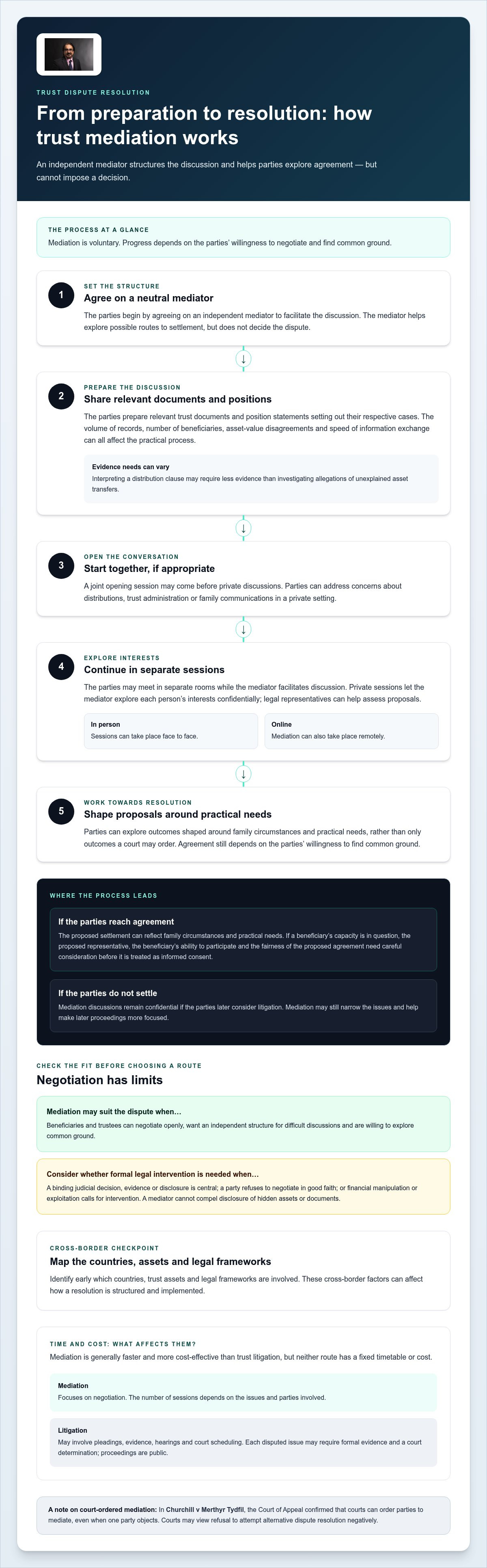
Trust dispute mediation usually begins with the parties agreeing on a neutral mediator. They prepare relevant documents and position statements outlining their respective cases. At the mediation, the parties and their legal representatives may meet in separate rooms while the mediator facilitates discussion. A joint opening session may come before private sessions. Mediation can take place online or in person.
Costs and timing depend on practical factors rather than a universal tariff: the volume of trust records, the number of beneficiaries, disagreements about asset values, and whether parties can exchange information promptly. For example, interpreting a distribution clause may require less evidence than investigating allegations of unexplained asset transfers. Mediation can narrow the issues even if the parties do not settle, helping make any later litigation more focused.
Litigation may take longer because each disputed issue can require formal evidence and a court determination. Court proceedings are public, so sensitive family matters may enter the public record. A mediator cannot compel a trustee to disclose hidden assets or documents. Mediation is therefore less suitable when meaningful negotiation depends on disclosure that a party refuses to provide.
Benefits of Mediation Over Litigation
Mediation is an out-of-court process in which an independent mediator helps parties negotiate but cannot impose a decision. It can be useful when those involved want control over discussions and wish to explore a resolution without asking a judge to decide every issue. Private sessions allow the mediator to explore each party’s interests separately, while legal representatives can help assess proposals.
A vulnerable beneficiary should receive support to understand and present their position during discussions, including appropriate legal representation and an accessible explanation of the trust issues. If mental capacity is in question, the proposed representative, the beneficiary’s ability to participate and the fairness of any proposed agreement need careful consideration before a settlement is treated as informed consent.
Mediation is voluntary, and agreement depends on the parties’ willingness to find common ground. It may be unsuitable if someone refuses to negotiate in good faith, or if financial manipulation or exploitation calls for legal intervention. If mediation fails, discussions remain confidential and the parties may consider litigation. Courts may view refusal to attempt alternative dispute resolution negatively. In Churchill v Merthyr Tydfil, the Court of Appeal confirmed that courts can order parties to mediate, even when one party objects.
Confidentiality in mediation
Trust mediation takes place privately, unlike court proceedings, where sensitive family matters may enter the public record. This distinction can affect what parties feel able to discuss about the trust and their relationships.
Privacy During Mediation
Privacy concerns who can attend and observe; confidentiality concerns how mediation discussions are treated beyond the meeting. A trust mediation may begin with a joint opening session, followed by separate discussions between the mediator and each party. This structure gives beneficiaries and trustees a setting to address difficult issues without presenting family disagreements in open court.
Parties may discuss concerns about distributions, trust administration or family communications. In private sessions, the neutral mediator can explore each person’s interests confidentially and consider possible routes to settlement. For example, a beneficiary may explain privately why a proposed distribution feels unfair, helping the mediator understand the underlying concern before discussions continue.
Wills and trust mediation is described as confidential and private: matters discussed or agreed are not communicated outside mediation or referred to in correspondence or court documentation. If the parties do not settle, discussions remain confidential if they later consider litigation. This can allow parties to make proposals without those negotiations becoming part of a later court case.
Confidentiality has practical limits: it does not compel a party to disclose hidden assets or documents. Nor does privacy resolve a disagreement about incomplete trust accounts. If a beneficiary raises concerns about missing records, the parties still need to decide how to address them. Mediation provides a forum for discussion, not the power to compel disclosure.
Confidentiality and Relationships
Confidential discussions can help relatives address grievances without making accusations part of a public court record. This matters when beneficiaries expect to remain in contact after resolving the trust issue, such as siblings who continue to take part in family decisions. A collaborative setting allows the mediator to hear each party’s concerns and guide discussion towards the practical interests behind them.
Separate sessions can make it easier to explain sensitive concerns without confronting relatives directly at the outset. For example, a beneficiary concerned about a trustee’s decisions may describe their impact privately, while the mediator considers how to raise the issue constructively. This process does not guarantee reconciliation, but it can keep negotiation focused on the dispute rather than public blame.
For families weighing privacy alongside a possible settlement, a discussion of the issues and mediation’s confidential framework can help clarify the next step. Discuss a trust dispute where private negotiations may assist.
Preserving family relationships
Trust mediation can address disputes about administration, trustee conduct, distributions or the meaning of trust terms. In England and Wales, it may help beneficiaries and trustees discuss these issues while taking family ties and the emotional weight of an inheritance into account.
Emotional Conflict in Family Disputes
Inheritance disagreements can become emotionally charged when relatives interpret the same decision differently. A beneficiary may see a distribution as unequal, while a trustee believes it follows the trust’s terms. Mediation gives each party space to explain their perspective and distinguish concerns about the assets from longer-standing family tensions.
That distinction matters when relatives will continue to interact after the dispute. For example, siblings who are both beneficiaries may need to agree how to communicate with a surviving parent who is also a trustee. A mediator can help separate immediate questions about trust administration from personal grievances, then keep discussions focused on issues the parties can resolve.
Before mediation, parties can organise the trust deed, accounts, correspondence and distribution records. Reviewing these documents helps distinguish a factual disagreement, such as whether an asset was distributed, from differing expectations. If the parties reach an agreement, clear terms can record what each will do and reduce the risk of the same issue resurfacing.
Family Trust Management Disputes
Family trust disputes may concern alleged asset mismanagement, failure to account for or distribute property, conflicts of interest, or differing interpretations of the trust terms. Mediation can bring trustees and beneficiaries together to examine the specific concern. For instance, parties may discuss whether an account explains a distribution or whether a trustee’s decision followed the deed.
Practical discussion can help distinguish an accounting problem from a disagreement about fairness. A beneficiary may want clearer information about an investment, while a trustee may be concerned about sharing confidential financial details. Mediation can help parties identify relevant information and steps to address the concern, without treating every disagreement as a breach of duty.
Some inheritance claims arise outside trust administration. According to The National Archives, the Inheritance (Provision for Family and Dependants) Act 1975 allows certain people, including adult children and financially dependent people, to claim reasonable financial provision from a deceased person's estate. Mediation may help parties discuss the family and financial issues, while the nature of the claim remains important.
Family mediation for separation disputes addresses a different situation from disagreement about trust administration. When separation and an inheritance issue overlap, parties should identify whether the dispute concerns trust assets, estate provision or arrangements arising from separation. For example, a beneficiary’s interest in a trust should not be confused with property held personally by a relative. Separating these issues helps keep negotiations precise and focused on a workable outcome.
Flexible and creative settlement outcomes
Mediation lets parties shape settlement terms around the trust, its assets and their practical needs. A mediator helps them explore options but cannot impose an outcome.
Creative Settlement Options
A creative settlement is tailored to the parties’ circumstances rather than limited to an outcome a court can order. This can matter when a dispute involves more than the division or value of trust assets.
For example, relatives disputing a sentimental family item might agree to rotate possession rather than require one beneficiary to give it up permanently. Parties could also discuss practical arrangements for family communication or trust asset administration. Any proposal must remain consistent with the trust’s terms and the parties’ authority.
The mediator helps parties assess whether a proposed arrangement addresses the underlying concern. A beneficiary seeking greater clarity about distributions may value an agreed process for providing information, while a trustee may want the agreement to define responsibilities. The parties decide whether to accept a proposal.
Recording Settlement Terms
Recording settlement terms means setting out the agreement reached during mediation in a clear document. Precise wording helps each party understand what they have accepted and what actions follow.
If the parties reach agreement, they may sign a settlement agreement drawn up on the day. Its terms can identify the trust issue, the agreed action, who is responsible and when the action will occur, if the parties have agreed a timetable. For example, a term about transferring an asset should identify it and set out the intended transfer arrangement.
Before signing, parties should read the entire document against the proposals they accepted. They can clarify ambiguous wording, identify unresolved issues and ensure the text reflects the agreement rather than an assumption made during discussion. This is particularly important when several beneficiaries or trustees are involved.
Written Settlement Agreements
A written settlement agreement records the parties’ resolution and its terms. A shared written record can reduce later disagreement about what was decided during mediation.
Parties are not obliged to reach an agreement and may leave without settling. If no settlement is reached, they can consider other options; the mediator cannot require them to accept a proposal. If they do reach agreement, the written terms should distinguish settled issues from matters left open, such as a separate concern about trust accounts.
Careful drafting is especially important when implementation involves several people or steps. For instance, an agreement about selling a trust asset should make clear what decision has been reached and how the parties will proceed. A tailored settlement can address family circumstances, but its wording must accurately capture the parties’ intentions.
Cross-border trust disputes
A cross-border trust dispute can involve beneficiaries, trustees or assets connected to different countries. When resolving trust disputes through mediation, identifying those connections early helps define who and what the discussions need to address.
Start by mapping where the trust was created, where its trustees and beneficiaries are based, and where its assets are held. For example, an English trustee, a beneficiary living in France and an investment account held elsewhere raise distinct practical questions. This map can clarify who should participate and which issues need separate consideration.
The trust deed and related documents provide a foundation for discussion. Parties can identify governing-law wording, trustee powers, distribution provisions and records relating to disputed assets, then separate agreed facts from unresolved questions. If the deed refers to one country while an asset is in another, keeping that distinction clear can help prevent confusion between the trust’s governing terms and the asset’s location.
Cross-border discussions also need clarity about implementation. A settlement might concern a distribution, an asset transfer or an agreed process for administering the trust. Parties should specify which trustee will take each action, what documents are needed and what steps remain outstanding. Agreeing that an overseas asset should be transferred is different from completing the transfer.
Language, time zones and family expectations can affect participation. A trustee in England and beneficiaries living abroad may need to agree on a suitable meeting format and ensure everyone understands the proposals. If trust records use unfamiliar terminology or another language, parties should identify the relevant documents and arrange an accurate explanation before relying on them in discussions.
Tax consequences and local requirements can affect whether a proposed outcome is workable. A settlement involving overseas property may raise questions beyond the family’s preferred division. Mediation can help isolate those questions, record what remains unresolved and distinguish a negotiated proposal from the steps needed to implement it. This is a practical consideration when resolving trust disputes through mediation across jurisdictions.
The useful starting point is a schedule of the countries, people, assets and documents connected with the dispute. This gives parties and the mediator a structured basis for negotiation, while helping identify matters requiring further analysis before terms are finalised. For assistance with a dispute involving overseas connections, discuss your cross-border trust dispute.
Sheikh Najam TEP: Notarial Services
Sheikh Najam TEP provides Notarial & Cross-Border Legal Services for trust or estate matters requiring notarial assistance with documents. This may be relevant when cross-border arrangements involve formal documentation alongside mediation, although notarial work does not determine the dispute or replace a settlement.
Where negotiations raise wider questions about the future administration of a trust, Trust and Estate Planning may help address the arrangements beyond the immediate disagreement. Inheritance Tax Planning may also be relevant when considering the tax implications of trust and estate decisions. The appropriate support depends on the issue requiring attention.
For notarial requirements connected to a trust or estate matter, contact Sheikh Najam TEP to discuss your circumstances.
Put the next step on a considered footing
The value of resolving trust disputes through mediation lies not only in reaching terms but also in ensuring they can be implemented coherently. Before proceeding, clarify who must act, which documents require attention and whether overseas assets or inheritance tax considerations affect the proposed arrangement. This preparation can help distinguish the issues requiring negotiation from the work needed after an agreement.
Sheikh Najam TEP offers Trust and Estate Planning and Inheritance Tax Planning for matters where a dispute connects with wider arrangements for a trust or estate. Its Notarial Services may also be relevant where trust or estate documents require notarial assistance. These services address distinct needs, and the appropriate next step depends on the matter requiring attention.
For a considered discussion of your trust or estate circumstances, contact Sheikh Najam TEP. A clear understanding of the issues can help you approach the next decision with greater confidence.
Frequently Asked Questions
What is Mediation?
Mediation is an out-of-court process in which an independent mediator helps parties discuss a dispute and work towards resolution. The mediator facilitates negotiation but does not decide who is right or impose terms. In a trust matter, beneficiaries and trustees might use mediation to address disagreements about administration or distributions. The parties retain control over whether to accept a proposal, and any agreement depends on their consent.
Do courts encourage mediation in inheritance disputes?
Yes. Courts may view refusal to mediate or attempt other alternative dispute resolution negatively. In Churchill v Merthyr Tydfil, the Court of Appeal confirmed that courts can order parties to mediate, even if one party objects. In an inheritance dispute, refusal to engage may affect how a court views the parties’ conduct. Mediation does not prevent a later court application if the dispute remains unresolved.
Is mediation voluntary or required in a UK trust dispute?
Mediation is ordinarily voluntary, and parties do not have to accept a settlement proposal. However, participation is not always optional: following Churchill v Merthyr Tydfil, courts can order parties to mediate, including when one party objects. Participation does not require agreement on the outcome. A trustee or beneficiary can attend, explain their position and leave without settling, while court proceedings remain a possible route for unresolved issues.
How do parties choose a mediator for a trust dispute in the UK?
The parties generally select a neutral mediator they all agree to appoint. For a trust dispute, consider whether the mediator can facilitate discussion about trust administration, beneficiary concerns and complex family dynamics. Parties should also agree on practical arrangements, including which documents to exchange, position statements and whether the meeting will be online or in person. The mediator guides negotiation but does not provide individual legal advice to the parties.
How much does trust dispute mediation cost in the UK, and how are fees shared?
There is no single fixed mediation cost for every UK trust dispute. The mediator’s fee and each party’s legal costs depend on factors such as the dispute’s complexity, the number of participants, the preparation required and session length. Parties can agree how to divide the mediator’s fee before booking; each may also incur separate legal costs. A dispute involving several beneficiaries or extensive trust records requires different preparation from a focused disagreement about one distribution.
How long does mediation usually take compared with court proceedings for a trust dispute?
Trust mediation is generally faster than litigation, but the timetable depends on the issues and the parties’ preparation. Selecting an agreed mediator, exchanging relevant trust documents and preparing position statements all affect scheduling. Court proceedings may take longer because disputed issues require formal steps and a court determination. Mediation can also narrow the questions for a later claim, even if it does not resolve the whole dispute.
Are trust mediation discussions confidential and without prejudice in England and Wales?
Trust mediation takes place privately, and discussions remain confidential if the parties do not settle and later consider litigation. Confidentiality and “without prejudice” are related but distinct concepts: confidentiality concerns keeping discussions private, while “without prejudice” concerns the use of settlement communications in legal proceedings. Parties should ensure the mediation arrangements and correspondence address how discussions will be treated. A confidential process does not require a party to disclose hidden assets or documents.
Can a trust mediation settlement be made legally binding and enforceable in the UK?
Yes. If the parties reach agreement, they can record its terms in a written settlement agreement, which they may sign on the day. The document should identify the settled issues, each party’s obligations and the steps required to implement them. For example, a distribution agreement should specify the asset and the trustee action agreed. Clear drafting matters: an informal understanding may leave room for disagreement about what the parties intended or must do.



Comments