Setting Up a Trust for Grandchildren in the UK: A Strategic Analysis of Wealth Preservation
- S Najam
- 57 minutes ago
- 12 min read

The mere act of gifting capital to a descendant is not an act of stewardship; it is a precarious exposure to the multifaceted risks of fiscal erosion and beneficiary immaturity. For the discerning patriarch or matriarch, the process of setting up a trust for grandchildren UK represents a sophisticated multidisciplinary protocol designed to insulate intergenerational wealth from the predatory nature of Inheritance Tax whilst maintaining rigorous control over asset distribution. You likely recognise that without a robust legal framework, your hard-earned legacy remains vulnerable to the 40% depletion of the current tax regime and the potential mismanagement of substantial liquidity by beneficiaries who have not yet reached financial maturity.
This strategic analysis serves as a comprehensive guide for high-net-worth individuals, offering the clarity required to navigate the complexities of trust structuring and HMRC compliance. We shall examine the strategic selection of discretionary versus bare trust vehicles, the administrative mandates of the Trust Registration Service, and the precise mechanisms required to secure your family's financial future against third-party claims or matrimonial disputes. By the conclusion of this discourse, you will possess the requisite knowledge to implement a structure that achieves both fiscal efficiency and long-term institutional stability.
Table of Contents
The Strategic Imperative of Intergenerational Wealth Preservation
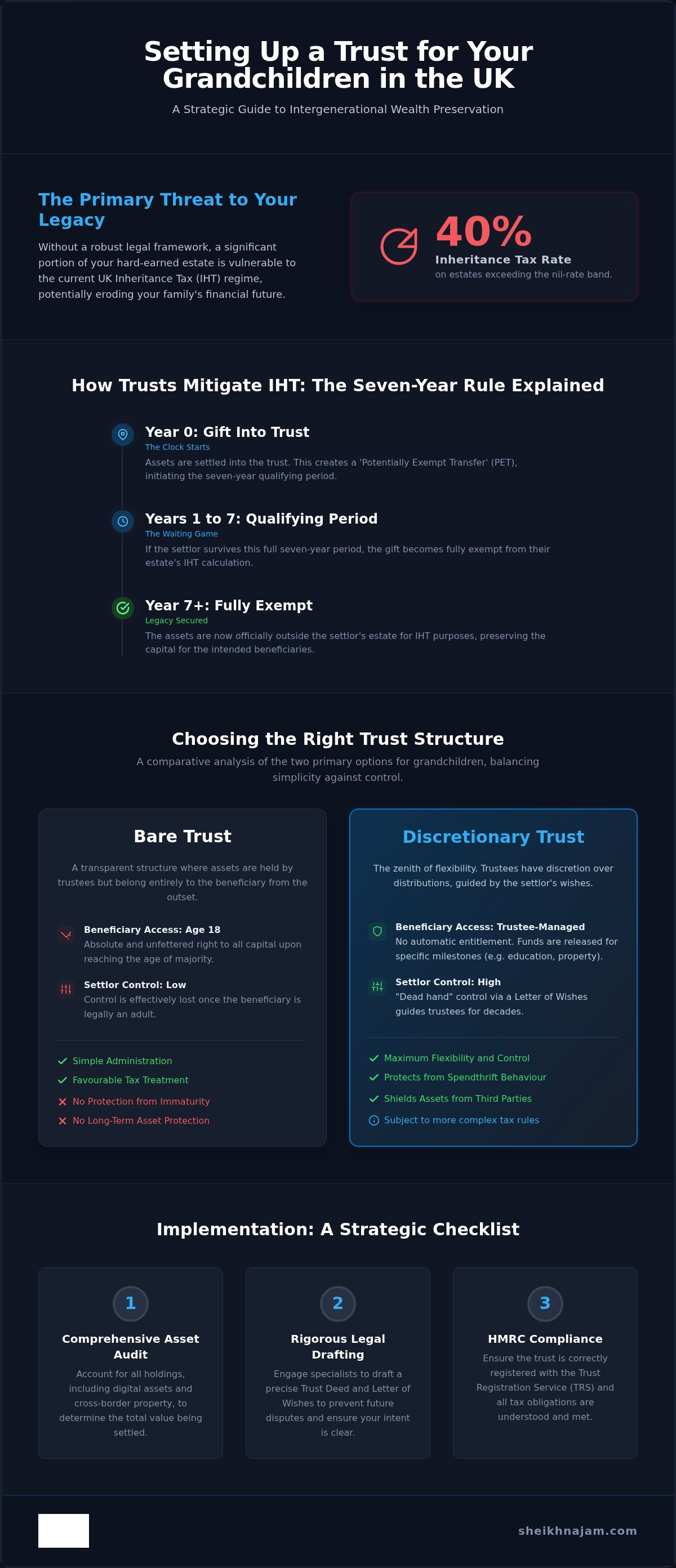
Wealth preservation in the United Kingdom is a multifaceted discipline that transcends simple asset allocation. For high-net-worth families, the primary antagonist of legacy remains fiscal attrition, specifically the 40% Inheritance Tax (IHT) levied upon estates exceeding the nil-rate band. Setting up a trust for grandchildren UK is not merely a philanthropic gesture; it's a calculated move to insulate capital from the volatility of external claims and the rigours of the tax regime. This requires a multidisciplinary perspective, blending legal jurisprudence with fiscal foresight to ensure that the transition of wealth is both seamless and protected.
Inheritance Tax (IHT) Mitigation and the Seven-Year Rule
The efficacy of a trust lies in its ability to facilitate Potentially Exempt Transfers (PETs). When assets are settled into a lifetime trust, they initiate a seven-year qualifying period. If the settlor survives this duration, the settled capital is generally removed from their taxable estate, thereby preserving liquidity for the beneficiaries. This protocol allows for the strategic use of annual gifting allowances, such as the £3,000 exemption, in conjunction with larger settlements. It effectively reduces the donor’s taxable estate whilst ensuring that the assets remain under the oversight of appointed trustees rather than being gifted outright. This method is particularly vital for managing estate liquidity in an era of rising asset valuations.
Asset Protection and Long-Term Fiduciary Control
Beyond tax mitigation, the trust serves as a critical bulwark against the risks of beneficiary immaturity or "spendthrift" behaviour. Many grandparents express valid concerns regarding the psychological impact of grandchildren receiving substantial liquidity at the age of eighteen. A trust structure enables "dead hand" control, allowing the settlor to mandate that funds are utilised for specific milestones, such as university fees or the acquisition of a first home. This protection extends to external threats; assets held within a discretionary framework are typically shielded from a beneficiary's creditors or matrimonial settlements during a divorce. Consulting a private client solicitor London is essential to ensure the Trust Deed is drafted with the technical precision required to withstand future legal challenges. This strategic oversight ensures that the family legacy remains an engine for growth rather than a source of potential dispute.
A Comparative Taxonomy of UK Trusts for Grandchildren
Identifying the correct legal architecture for intergenerational wealth transfer necessitates a rigorous analysis of the tension between fiscal transparency and fiduciary control. Setting up a trust for grandchildren UK involves a choice between structures that offer immediate transparency and those that provide long-term protection through deferred vesting. Each taxonomy carries distinct regulatory obligations under the current HMRC framework, particularly concerning the 'Relevant Property' regime and the tax treatment of the settled capital. The decision must be informed by the total value of the assets and the specific level of discretion required to manage the beneficiaries' future needs.
Bare Trusts: Simplicity versus Rigidity
Bare trusts represent the most transparent form of settlement, often favoured for their administrative simplicity and favourable tax treatment. Under this arrangement, the trustees hold the assets in name only; the beneficial interest vests immediately in the grandchild. From a fiscal perspective, HMRC generally treats the income and capital gains as belonging to the beneficiary. This can be advantageous if the grandchild’s personal allowances remain unused. However, this simplicity masks a significant legal rigidity. Upon reaching the age of majority at eighteen, the beneficiary possesses an absolute, unfettered right to demand the capital. For many high-net-worth individuals, this lack of deferred control represents a substantial risk to the long-term preservation of the family legacy.
Discretionary Trusts: The Zenith of Flexibility
Discretionary trusts offer a superior degree of fiduciary oversight, empowering trustees to determine the timing and quantum of distributions amongst a selected class of beneficiaries. This structure is particularly effective for protecting capital from external threats, such as a grandchild’s potential marital dissolution or creditor claims. Yet, this flexibility comes at the cost of a more complex tax landscape. These settlements fall within the 'Relevant Property' regime, potentially attracting a 20% entry charge on values exceeding the nil-rate band, alongside decennial anniversary charges and exit charges. Strategic planning is required to balance these costs against the benefits of asset protection and the prevention of beneficiary mismanagement.
Interest in Possession (IIP) trusts provide an alternative middle ground, granting a beneficiary the right to the income whilst the capital remains protected for future generations. The settlor's domicile and residence status also remain pivotal factors, as these dictate whether the trust’s exposure is limited to UK-situs assets or extends to a global portfolio. If you require a bespoke assessment of these structures for your estate, you may schedule a formal consultation to discuss your specific requirements.
Navigating the Fiscal and Regulatory Landscape of Trust Administration
The administrative reality of setting up a trust for grandchildren UK is defined by a rigorous adherence to HMRC’s evolving regulatory framework. Beyond the initial settlement, trustees are bound by a perpetual duty of disclosure and fiscal precision. Modern trust management is no longer a private family matter; it's a matter of public regulatory record. This necessitates a multidisciplinary approach where legal drafting meets financial crime compliance to ensure the longevity of the family estate. Every transaction must be documented with the precision expected of an institutional fiduciary to withstand future scrutiny.
Taxation of Trust Income and Gains
Fiscal efficiency is the cornerstone of successful trust administration. Discretionary trusts are subject to the trust rate of income tax, currently 45% on dividends and other income exceeding the initial £500 threshold. In contrast, Interest in Possession trusts allow income to be taxed at the beneficiary’s marginal rate, which often provides a more favourable outcome if the grandchild’s personal allowance is available. It's vital to distinguish these from parental settlements. Whilst income from a trust created by a parent for a minor child is often taxed as the parent's income, gifts from grandparents generally bypass these restrictive rules. This allows for a more effective utilisation of the grandchild's basic rate bands. Capital Gains Tax (CGT) also requires careful management; hold-over relief may be available on the initial settlement to defer immediate tax liabilities, though this requires precise professional filing.
Compliance, AML, and the Trust Registration Service
The implementation of the 5th Money Laundering Directive (5MLD) has mandated that almost all express trusts must register with the HMRC Trust Registration Service (TRS), regardless of whether they have a tax liability. Trustees must maintain an accurate record of all 'beneficial owners', including the settlor, trustees, and beneficiaries. This transparency is a legal prerequisite. When the trust corpus includes international holdings or complex digital assets, the role of professional notarial services becomes indispensable for the strategic authentication of cross-border documentation. The rising prominence of digital asset structuring requires trustees to implement robust Anti-Money Laundering (AML) protocols. These measures protect the trust from the risks of financial crime whilst ensuring that the transition of modern wealth remains compliant with UK law. Rigorous record-keeping is not merely an administrative task; it's a strategic defence against regulatory scrutiny.
The Strategic Polymath Approach to Preventing Trust Disputes
Strategic wealth preservation is as much about conflict mitigation as it is about fiscal efficiency. When setting up a trust for grandchildren UK, the settlor must anticipate the potential for intra-family friction and external challenges. High-value settlements often become focal points for litigation, where any ambiguity in drafting can lead to a perceived breach of trust or allegations of fiduciary negligence. Adopting a polymathic perspective allows the advisor to weave together legal, psychological, and regulatory safeguards, ensuring the trust remains a vehicle for harmony rather than a catalyst for discord.
Drafting with Precision: Precluding Contentious Probate
The Trust Deed is the primary instrument of defence. It must be drafted with absolute clarity, particularly regarding the 'class of beneficiaries' to include future, yet-to-be-born grandchildren, thereby preventing claims of exclusion. Incorporating robust dispute resolution clauses, such as mandatory mediation or arbitration, provides a private forum for resolution, avoiding the reputational damage of public court proceedings. This architecture should be harmonised with the settlor's international will to ensure consistency across jurisdictions. Failure to align these documents often results in contentious probate, where conflicting testamentary intentions provide fertile ground for legal challenge.
The Role of Professional Trustees and Protectors
Choosing the right fiduciaries is a strategic decision of the highest order. Whilst appointing family members might seem intuitive, it often introduces emotional bias and potential conflicts of interest. Professional trustees offer an essential layer of impartiality and technical expertise, particularly when managing complex asset classes or navigating AML compliance. To further enhance security, the settlor can appoint a 'Trust Protector'. This individual or entity holds specific powers to oversee the trustees, such as the authority to veto distributions or remove trustees, without being involved in daily administration. This dual-layered oversight ensures that the original intent, often articulated in a non-binding Letter of Wishes, is respected across generations.
The complexity of cross-border estates and the rising rigour of financial crime regulations mean that simple trust structures are often insufficient. If you wish to fortify your family’s legacy against future litigation, you should consult a specialist in high-value dispute prevention to review your current arrangements.
Implementation: Establishing Your Grandchildren's Trust Fund
The transition from theoretical structuring to operational reality marks the final, critical phase in setting up a trust for grandchildren UK. This implementation phase demands a level of meticulousness that mirrors the institutional standards of the City of London. It begins with a comprehensive audit of the assets intended for settlement. This audit must extend beyond traditional liquidity to include complex equities, real estate, and increasingly, digital asset holdings. Each asset class requires a specific valuation and legal protocol to ensure that the transfer of title is both valid and irrevocable. Failure to maintain a clear separation between the settlor's personal capital and the trust's corpus can jeopardise the entire legal framework.
The Settlement Process and Asset Transfer
The formal execution of the 'Deed of Settlement' is the legal cornerstone of the trust. This document must be executed with the necessary notarial and legal formalities, particularly when the trust corpus involves international jurisdictions where authentication is a prerequisite for asset recognition. Once the deed is perfected, the legal transfer of assets to the trustees must be finalised. This includes opening dedicated trust bank accounts and investment portfolios to maintain a legally defensible separation of funds. Trustees must then fulfill their regulatory mandate by updating the HMRC Trust Registration Service within the prescribed 90-day window to maintain absolute compliance. It's essential that these administrative protocols are handled with precision to avoid the risk of regulatory penalties or future disputes regarding the trust's validity.
Professional Oversight and Continuous Advisory
A trust isn't a static instrument; it's a dynamic entity that requires perpetual vigilance. The ongoing administration necessitates the preparation of annual accounts and the filing of trust tax returns, ensuring that all fiscal obligations are met with precision. A strategic annual review is essential to adapt the trust’s posture to shifts in tax legislation or changes in the family’s socio-economic circumstances. By leveraging expert specialist areas in estate planning, settlors can ensure that the trust remains an effective bulwark against wealth erosion. This continuous advisory loop integrates the trust into a holistic, multi-generational wealth strategy, securing the family legacy against the unpredictability of the global financial landscape. Effective implementation ensures that the trust doesn't merely exist on paper but operates as a robust mechanism for long-term prosperity.
Securing Intergenerational Prosperity through Strategic Fiduciary Oversight
The preservation of a multi-generational legacy requires more than mere financial accumulation; it demands the implementation of a rigorous legal architecture. By setting up a trust for grandchildren UK, you're not simply transferring assets but establishing a sophisticated governance framework that prioritises fiscal efficiency whilst insulating the estate from the volatility of external claims. This strategic analysis has highlighted the necessity of a multidisciplinary approach, where meticulous compliance with the Trust Registration Service and the strategic mitigation of the 40% Inheritance Tax burden are treated as institutional imperatives.
Success in this field is predicated upon the precision of the Trust Deed and the foresight to integrate international asset structuring into a cohesive family strategy. As a specialist TEP with deep expertise in complex cross-border inheritance tax planning and comprehensive notarial and regulatory advisory, I provide the authoritative oversight your estate requires. You're invited to secure your family legacy by scheduling a strategic consultation with Sheikh Najam TEP. Your commitment to strategic stewardship today ensures the enduring stability of your family's financial future for generations to come.
Frequently Asked Questions
What is the most tax-efficient way to set up a trust for grandchildren in the UK?
Tax efficiency is best achieved by utilising lifetime settlements that qualify as Potentially Exempt Transfers or Chargeable Lifetime Transfers within the nil-rate band. By setting up a trust for grandchildren UK, you facilitate the removal of assets from your taxable estate after seven years. This strategy often involves balancing the 20% entry charge of discretionary trusts against the fiscal transparency of bare trusts. Professional oversight ensures that capital gains and income tax treatments are optimised for the beneficiaries' specific tax bands.
Can I set up a trust for grandchildren whilst I am still alive?
You can certainly establish a trust during your lifetime; these are formally known as 'inter vivos' settlements. Settling assets whilst you're alive allows you to trigger the seven-year rule for Inheritance Tax mitigation immediately. It also provides an opportunity to witness the effective management of the family legacy under your guidance. Lifetime trusts are essential for proactive estate planning, offering greater control over the transition of wealth compared to trusts created through a will upon death.
How much can I put into a trust for my grandchildren without paying IHT?
You can typically settle up to £325,000 into a discretionary trust every seven years without incurring an immediate Inheritance Tax entry charge. This figure represents the current nil-rate band. Settlements exceeding this threshold attract a 20% lifetime tax charge. Bare trusts don't have this specific limit for entry charges as they're treated as Potentially Exempt Transfers. However, the assets only exit the estate fully if you survive the settlement by a duration of seven years.
What is the difference between a bare trust and a discretionary trust for grandchildren?
The primary distinction lies in the vesting of beneficial interest and the degree of trustee control. In a bare trust, the grandchild has an absolute right to the capital at age eighteen, and the assets are taxed as their own. A discretionary trust empowers trustees to decide the timing and quantum of distributions amongst a class of beneficiaries. This latter structure offers superior protection against a grandchild's potential creditors or matrimonial disputes whilst maintaining long-term capital preservation.
Do I need to register a grandchildren's trust with the HMRC Trust Registration Service?
Registration with the HMRC Trust Registration Service is a mandatory legal requirement for almost all express trusts, including non-taxable ones. Under the 5th Money Laundering Directive, trustees must disclose details of the settlor, trustees, and beneficiaries. Failure to comply with these transparency protocols can result in significant financial penalties from HMRC. When setting up a trust for grandchildren UK, ensuring your record is accurate and updated is a critical component of your ongoing fiduciary duty.
Can a trust for grandchildren be used to pay for school fees in the UK?
Trusts are frequently utilised as strategic vehicles for the structured payment of educational expenses and school fees. Trustees can distribute income or capital directly to educational institutions, ensuring the funds are used strictly for the grandchild’s academic advancement. This arrangement is particularly effective when using a discretionary structure, as it prevents the funds from being diverted for non-essential purposes. It's a prudent method of supporting a grandchild's development whilst retaining oversight of the family’s underlying capital.
What happens to a trust if a grandchild dies before reaching the age of majority?
The legal outcome depends entirely on the trust’s specific taxonomy and the precise drafting of the Trust Deed. If a grandchild dies whilst holding a vested interest in a bare trust, the assets typically form part of their own estate and pass according to the laws of intestacy. In a discretionary trust, the capital remains within the trust’s corpus for the benefit of the remaining class of beneficiaries. Rigorous drafting is required to ensure such contingencies are addressed without causing probate complications.
How do I choose the right trustees for a family wealth trust?
Selecting trustees requires a balance between familial trust and professional technical competence. You should choose individuals or institutions capable of managing complex fiscal, legal, and regulatory obligations with absolute integrity. Appointing at least one professional trustee, such as a specialist solicitor or trust company, provides an essential layer of impartiality and expertise. This ensures that the trust is administered in strict accordance with your Letter of Wishes and the prevailing legal requirements of the City of London.


Comments