2026 International Tax Structuring for Private Clients

Updated: Aug 26
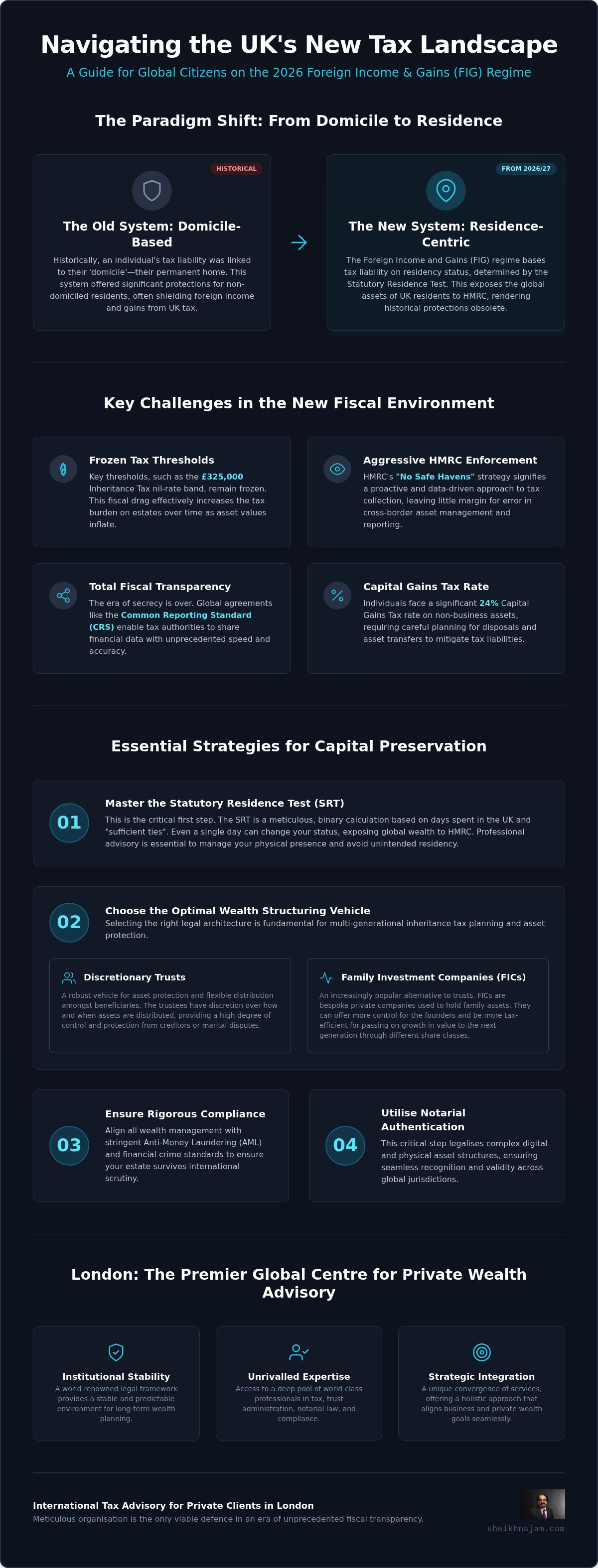
The transition from a domicile-based tax system to the residence-centric Foreign Income and Gains (FIG) regime represents the most significant structural shift in British fiscal policy for a generation, rendering historical wealth protections obsolete. For the sophisticated global citizen, the necessity for bespoke international tax advisory for private clients London has evolved from a seasonal requirement into a permanent defensive necessity. You're likely aware that the complexities of the 2026/2027 tax year, characterised by frozen thresholds and the aggressive "No Safe Havens" strategy from HMRC, leave little margin for error in cross-border asset management.
This authoritative analysis provides a meticulous examination of the strategies required to preserve capital whilst navigating the intricacies of the £325,000 inheritance tax nil-rate band and the 24% capital gains tax rate on non-business assets. We'll explore how the integration of notarial authentication and strategic trust administration creates a robust legal framework that withstands international transparency standards. By the end of this review, you'll possess a clear understanding of how to organise an estate that's both tax-efficient and resilient against multi-jurisdictional scrutiny.
Table of Contents
The Paradigm of International Tax Structuring for Private Clients in 2026
The year 2026 represents a critical junction in the history of fiscal transparency, as the global exchange of information reaches a state of total saturation. For high-net-worth individuals, the focus has shifted from simple mitigation to the creation of a resilient, multi-jurisdictional legal framework. The necessity for elite International Tax Planning has never been more acute, particularly as the UK transitions into its post-domicile regulatory phase. This environment requires a strategic objective that balances fiscal efficiency with absolute, unyielding regulatory compliance. It's no longer enough to merely react to change; one must anticipate the intersection of evolving law and private wealth.
In the City of London, a multi-disciplinary approach is no longer optional; it's the standard. We're seeing a convergence of trust administration, notarial law, and financial crime compliance that demands a high degree of academic rigor. This is where international tax advisory for private clients London distinguishes itself, offering a level of precision that safeguards assets against the aggressive "No Safe Havens" strategy employed by HMRC. Meticulous organisation is the only viable defence in an era where tax authorities share data with unprecedented speed and accuracy.
The Evolution of Wealth Preservation in a Transparent Era
The implementation of the Common Reporting Standard (CRS) has fundamentally altered client behaviour across the globe. The era of secrecy is dead, replaced by a preference for sophisticated, fully disclosed tax structuring that stands up to the most intense regulatory interrogation. This shift demands a scholarly approach when drafting international wills and trust deeds. It's not merely about the document itself, but the underlying legal theory that ensures its validity across multiple legal systems. Modern wealth preservation relies on the strength of the legal argument as much as the financial strategy.
London as the Global Centre for Private Wealth Advisory
London's legal framework remains the premier choice for multi-jurisdictional estates due to its institutional stability and the depth of its professional expertise. The strategic advantage of London-based notarial oversight cannot be overstated; it provides the "gravitas" required for international recognition. For many, this involves integrating international tax planning for business owners London with broader personal wealth goals. This holistic view ensures that commercial success and private legacy are managed with the same meticulous attention to detail, ensuring that every asset, whether digital or physical, is correctly categorised and protected.
Navigating Residence and Domicile Rules in the United Kingdom
The determination of a client's fiscal nexus to the United Kingdom is a multifaceted legal undertaking that demands the highest level of academic precision. In the current regulatory climate, the ambiguity that once allowed for flexible interpretation has been replaced by a rigid, prescriptive framework. Engaging with sophisticated international tax advisory for private clients London is essential to deciphering these complexities, particularly as the UK transitions from a domicile-based system to the new Foreign Income and Gains (FIG) regime. This shift necessitates a profound understanding of how physical presence and historical ties intersect with evolving statutory definitions.
The Statutory Residence Test: A Meticulous Calculation
The Statutory Residence Test serves as the primary mechanism for determining UK tax liability through a tiered framework of automatic tests and sufficient ties. It's a binary calculation where even a single day can shift a client's status from non-resident to resident, thereby exposing their global wealth to the HMRC. The "automatic ties" test is particularly perilous for those maintaining secondary properties in the capital, as the mere availability of a London residence for 91 days or more can trigger residency if other conditions are met. Clients often overlook how minor behavioural patterns, such as the frequency of visits or the location of family members, accumulate to form a "sufficient tie" that overrides their intended tax status.
Domicile and the Long-Term Resident
Whilst residence is determined by the calendar, domicile remains a deeper, more permanent legal concept rooted in a client’s "home" and their long-term intentions, or animus manendi. For those who have resided in the UK for 15 of the last 20 tax years, the "deemed domicile" rules apply, effectively bringing their entire worldwide estate within the scope of UK Inheritance Tax (IHT). This creates a significant exposure, as the 40% IHT rate applies to global assets exceeding the £325,000 nil-rate band. Navigating UK Tax on Foreign Income requires a proactive strategy to segregate offshore capital and income before it's inadvertently remitted or taxed.
The necessity for professional notarial services becomes apparent when executing domicile-related declarations or validating the status of foreign-sited assets for HMRC. These documents provide the requisite "gravitas" to satisfy international transparency standards and ensure that a client's historical domicile of origin is respected. For individuals seeking to restructure their affairs ahead of the 2026/2027 tax year, consulting a Strategic Polymath who understands both the technical tax law and the notarial requirements for implementation is the only way to achieve absolute certainty in an increasingly scrutinised landscape.
Comparative Analysis of Private Wealth Structuring Vehicles
Selecting the appropriate vehicle for wealth preservation requires a granular understanding of the legal mechanics governing each structure, particularly when assets are distributed across multiple jurisdictions. Discretionary trusts remain a cornerstone of British estate planning, offering unparalleled flexibility in asset distribution; however, they carry a distinct administrative burden and periodic ten-year anniversary charges that must be meticulously managed. Conversely, an Interest in Possession trust provides a fixed entitlement that may offer specific advantages for those seeking to mitigate inheritance tax through qualifying interest structures. The rise of the Family Investment Company (FIC) as a corporate alternative allows for greater control over investment strategy whilst benefiting from the UK's competitive corporation tax rates, which are often more favourable than the higher rates of income tax applied to trusts. Seeking elite international tax advisory for private clients London is the only way to ensure these vehicles don't inadvertently trigger punitive tax treatments when assets cross borders.
The friction between common law trusts and civil law jurisdictions often necessitates a hybrid approach to estate architecture. Many European nations don't recognise the separation of legal and beneficial ownership inherent in a trust, which can lead to potential double taxation or the total invalidation of the structure upon the settlor's death. In such instances, a civil law Foundation or a sophisticated corporate wrapper might serve as a more resilient instrument for international property portfolios. This level of multi-disciplinary expertise is the hallmark of international tax advisory for private clients London, providing the strategic foresight needed to protect global legacies in a transparent era.
Trust Administration and the Master Advisor
The appointment of a qualified Trust and Estate Practitioner (TEP) is paramount to ensuring fiduciary precision and the longevity of any high-value structure. Managing the administrative weight of international trusts requires a deep understanding of the OECD Global Forum on Tax Transparency standards to remain compliant with the Common Reporting Standard. Robust initial structuring is the primary defence against future litigation, as poorly drafted deeds or ambiguous beneficiary classes often lead to contentious probate London. By embedding clear dispute resolution mechanisms and notarial oversight at the outset, one can effectively litigation-proof the estate against potential will disputes and ensure the settlor's intentions are respected.
Foundations and Corporate Wrappers for Global Assets
Where a common law trust might face legal hostility, a civil law Foundation provides a recognised legal personality that simplifies asset holding in jurisdictions like Switzerland or Liechtenstein. These entities, when combined with corporate wrappers for international property, allow for efficient management and succession planning without the complexity of trust-related reporting in non-trust countries. It's essential that all structures are recognised by the relevant international tax authorities to avoid the risk of non-compliance and subsequent financial crime investigations. The integration of corporate and personal wealth goals ensures that the chosen wrapper serves both immediate fiscal efficiency and multi-generational wealth preservation.
Mitigating Risk through International Tax Compliance for Individuals
The convergence of fiscal efficiency and financial crime compliance has become the primary safeguard for the modern global estate. With HMRC's "No Safe Havens" strategy resulting in a 15% increase in investigations into offshore income during the 2024-25 tax year, the margin for administrative error has vanished. Sophisticated international tax advisory for private clients London must now address the rigorous demands of Anti-Money Laundering (AML) and Know Your Customer (KYC) protocols as a prerequisite for any structural implementation. This is not merely a matter of administrative box-ticking; it's a strategic defence of a client's global reputation and long-term mobility.
Financial Crime and Regulatory Oversight
High-net-worth individuals operate under a microscope of regulatory scrutiny that extends far beyond simple tax returns. The role of the master advisor has expanded to include the facilitation of transparent wealth transfers that satisfy both the Foreign Account Tax Compliance Act (FATCA) and the Common Reporting Standard (CRS). Ensuring that every cross-border movement of capital is meticulously documented protects the individual from being caught in the widening net of international financial crime investigations. 2026 compliance requires proactive disclosure to prevent regulatory friction and ensure the seamless transition of assets across jurisdictions. A failure to demonstrate a clear source of wealth can lead to debilitating freezes on liquidity and irreparable reputational harm amongst global financial institutions.
Structuring Digital Assets for the Next Generation
The categorisation of crypto-assets presents a unique challenge within the UK's fiscal framework, as HMRC increasingly treats these holdings as property subject to the standard 40% inheritance tax rate once the £325,000 nil-rate band is exhausted. Ensuring that digital wealth is captured within international wills London is essential for preventing the total loss of access upon the owner's demise. Practical steps must be taken to secure digital keys and seed phrases whilst maintaining a compliant audit trail that satisfies future probate requirements.
Maintain a secure, offline record of all digital asset locations and access protocols.
Review the tax residency of digital asset holding platforms to avoid inadvertent double taxation.
Integrate digital asset legacies into a broader, multi-disciplinary estate plan.
Managing the intersection of digital innovation and traditional fiscal responsibility requires a level of precision that only a strategic polymath can provide. To ensure your digital and physical assets are protected by a robust compliance framework, you should consult with a specialist in financial crime and international tax planning.
Strategic Integration: Professional Advisory and Notarial Oversight in London
The execution of complex fiscal strategies often falters at the point of implementation, where theoretical planning meets the practical reality of international law. A "Strategic Polymath" operates at this critical intersection, ensuring that every element of international tax advisory for private clients London is supported by the necessary legal infrastructure. It isn't enough to simply calculate a tax liability; one must also possess the authority to authenticate the underlying structures that mitigate it. This synergy between tax planning, trust administration, and dispute resolution creates a unified defensive posture that protects the client's interests across multiple legal systems. Meticulous execution is the only bridge between a well-conceived strategy and a legally resilient outcome.
The Notary Public as a Pillar of International Security
International tax structures frequently fail to achieve their intended outcomes because of a lack of proper notarial execution. In many civil law jurisdictions, documents that haven't been authenticated by a Notary Public carry little weight, leading to delays and potential legal challenges. The Notary provides the essential "gravitas" required for the recognition of complex corporate and personal documents, from trust deeds to share transfer forms. Securing the validity of a power of attorney for multi-jurisdictional use is particularly vital, as it allows for the seamless management of assets during periods of incapacity or absence. Without this level of meticulous oversight, even the most brilliant tax strategy remains a theoretical exercise that's vulnerable to administrative rejection.
A Multi-Disciplinary Approach to Future-Proofing
The most effective wealth preservation strategies are those that anticipate and neutralise potential conflict before it reaches the courtroom. By combining mediation and arbitration skills with technical tax expertise, a master advisor can prevent family estate disputes that often arise from ambiguous structuring. Having a single point of command over a complex legal landscape ensures that every decision is filtered through a multi-disciplinary lens, protecting the estate from the fragmentation that occurs when tax and legal advice are siloed. This holistic oversight is what provides the sophisticated client with absolute precision. Final considerations for the 2026/2027 tax year should focus on the following pillars of integration:
Aligning notarial authentication with the specific statutory requirements of foreign-sited assets.
Utilising mediation to achieve consensus amongst multi-generational beneficiaries regarding trust distributions.
Ensuring all digital and physical asset transfers are supported by a transparent, notarised audit trail.
Coordinating international wills with local probate requirements to prevent jurisdictional friction.
The result of this integrated approach is a meticulously organised estate that survives cross-border scrutiny and provides lasting security for future generations. By anchoring tax efficiency in the bedrock of notarial law and dispute resolution, the sophisticated client achieves a level of certainty that's impossible to attain through fragmented advisory. This is the hallmark of elite practice in the City of London, where academic rigor and practical implementation converge to protect the world's most complex private affairs.
Securing Your Global Legacy in a Transparent Era
The transition to a residence-based tax framework necessitates a fundamental reappraisal of existing wealth structures to ensure they remain robust against the 2026/2027 legislative shifts. Success in this transparent era depends on the meticulous integration of technical tax law with the authoritative weight of notarial authentication, particularly for assets spanning multiple jurisdictions. It's clear that a fragmented approach to advisory no longer suffices for the high-net-worth individual; instead, a multi-disciplinary strategy that encompasses trust administration, financial crime compliance, and dispute resolution is required. By prioritising academic rigour and precise legal architecture, you'll ensure your estate survives the most intense international scrutiny. Engaging with premier international tax advisory for private clients London provides the strategic foresight necessary to protect your interests whilst navigating the complexities of the new Foreign Income and Gains regime.
As a TEP qualified practitioner and a Notary Public appointed by The Court of Faculties, Sheikh Najam TEP offers the multi-disciplinary expertise required for high-value cross-border estate administration. You're invited to instruct Sheikh Najam TEP for bespoke international tax advisory and notarial services in London to secure your family's future with absolute precision. Taking these proactive steps today will provide the peace of mind that your legacy is handled with the highest degree of professional care and strategic command.
Frequently Asked Questions
What is the primary benefit of international tax structuring for private clients in London?
The primary benefit lies in the meticulous mitigation of double taxation liabilities and the preservation of global wealth through legally resilient structures. By aligning multi-jurisdictional assets with the specificities of the UK fiscal regime, private clients ensure their estates remain efficient and protected from regulatory friction. This strategic organisation provides an underlying sense of security, allowing for the seamless transition of capital whilst adhering to the highest standards of international transparency and compliance.
How do the 2026 UK residence and domicile rules affect my global tax liability?
From 6 April 2025, the abolition of the non-domiciled regime and the introduction of the Foreign Income and Gains (FIG) system fundamentally shift liability toward a residence-based model. New residents are exempt from UK tax on foreign income for their first four years, provided they were non-resident for ten consecutive years prior. However, long-term residents face the "deemed domicile" threshold at 15 years, bringing their entire worldwide estate within the scope of the 40% inheritance tax.
Can a London-based trust effectively hold assets located in multiple foreign jurisdictions?
A London-based trust remains a premier vehicle for holding multi-jurisdictional assets, provided the structure is drafted with the academic rigor necessary for cross-border recognition. Whilst the UK legal framework offers institutional weight, the efficacy of such trusts depends on their alignment with the laws of the situs where the assets reside. Specialist international tax advisory for private clients London ensures that these structures are not only valid in the UK but also respected by foreign tax authorities.
Why is it necessary to involve a Notary Public in international tax planning?
Involving a Notary Public is essential for the legalisation and authentication of documents destined for use in foreign jurisdictions, particularly civil law countries. Notarial oversight provides the requisite "gravitas" and verification of identity, authority, and capacity that international authorities demand. Without this formal authentication, complex corporate resolutions, powers of attorney, and trust deeds may be rejected, rendering even the most sophisticated international tax strategies administratively unenforceable across borders.
How can I ensure my digital assets are included in my international estate plan?
Ensuring the inclusion of digital assets requires a multi-disciplinary approach that combines technical digital asset structuring with the traditional precision of international wills. It's vital to maintain a secure, notarised record of access protocols and private keys to prevent the total loss of liquidity upon death. These assets must be explicitly categorised within the estate plan to satisfy HMRC’s property definitions, ensuring they are transferred securely and compliantly to the next generation.
What happens if my international tax structure is challenged in a will dispute?
If an international tax structure is challenged, its survival depends on the robustness of its initial legal architecture and the clarity of the settlor’s intentions. Litigation-proofing involves embedding mediation and arbitration clauses within the trust deeds to resolve conflicts before they escalate to contentious probate. A meticulously organised estate, supported by notarial evidence and expert advisory, provides the evidentiary weight required to defend the structure against claims of undue influence or lack of capacity.
Is it possible to mitigate UK Inheritance Tax if I am not domiciled in the UK?
Non-domiciled individuals can mitigate UK Inheritance Tax (IHT) by ensuring their foreign-sited assets maintain "excluded property" status under the prevailing regulations. Whilst UK-sited assets are generally subject to the 40% tax rate above the £325,000 nil-rate band, strategic structuring can protect offshore capital from the HMRC’s reach. However, the 2026 rules regarding the residence-based IHT system require a proactive review of one's residency history to maintain these critical exemptions.
What are the disclosure requirements for international assets under the 2026 regulations?
The 2026 regulations demand total transparency through the Common Reporting Standard (CRS) and FATCA, requiring the automatic exchange of financial information across global jurisdictions. High-net-worth individuals must provide detailed disclosures of their offshore income, gains, and beneficial ownership structures to prevent investigations under HMRC’s "No Safe Havens" strategy. Comprehensive international tax advisory for private clients London is indispensable for managing these reporting obligations, ensuring that all disclosures are accurate, timely, and fully compliant with international financial crime standards.


Comments