A Comprehensive Treatise on the British Notary Public: Jurisprudence, Function, and Global Utility

Updated: Aug 26
The global recognition of a sophisticated private wealth strategy often hinges not upon the brilliance of its tax architecture, but upon the meticulous seal of a british notary public. While many high-net-worth individuals perceive the notarisation process as a mere administrative formality, it remains the essential jurisprudential bridge that prevents the catastrophic rejection of documents by foreign jurisdictions. You likely recognise that in an era of heightened regulatory scrutiny, the margin for error in cross-border legalisation has vanished entirely; a single oversight can compromise years of meticulous planning.
This treatise provides an authoritative exploration of the notarial office in England and Wales, detailing its strategic role in international document authentication and private wealth resilience. We'll examine how the New Notaries (Conduct and Discipline) Rules 2026 have refined professional standards and demonstrate why the integration of notarial acts into a broader legal strategy is vital for mitigating cross-border risks. By the conclusion, you'll possess a comprehensive understanding of how this ancient office secures absolute legal validity for your most complex international affairs.
Table of Contents
The Office of the British Notary Public: An Institutional Overview
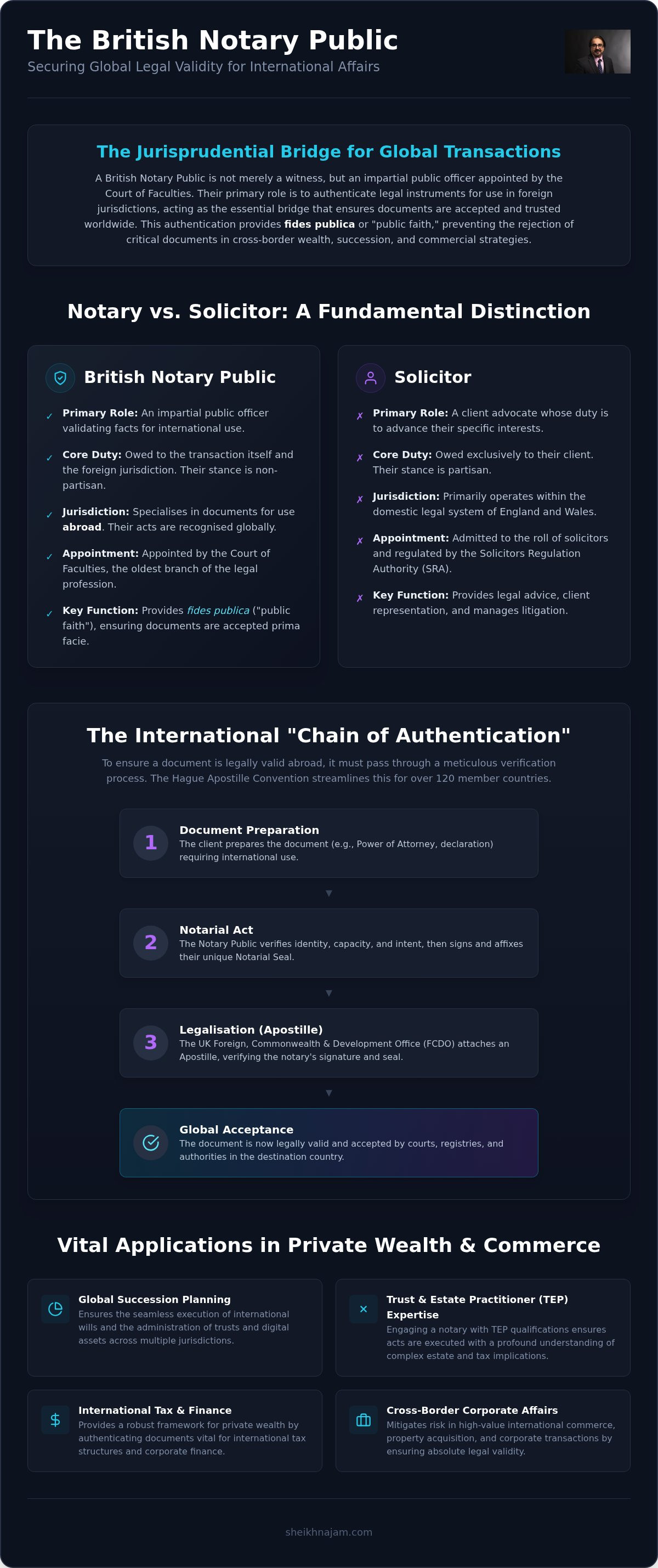
The office of the british notary public represents the oldest branch of the legal profession in the United Kingdom, serving as a vital nexus between domestic legal practice and the rigorous requirements of international jurisprudence, whilst simultaneously acting as a public officer of the law whose commission originates from the Court of Faculties of the Archbishop of Canterbury. This ecclesiastical provenance, established by the Ecclesiastical Licences Act 1533 and subsequently confirmed by the Legal Services Act 2007, imbues the office with a level of institutional weight that remains unparalleled by other legal designations. Unlike solicitors whose primary mandate involves client advocacy within the domestic sphere, the notary operates as an independent officer whose acts are designed to be recognised by courts and registries across the globe. This historical and regulatory framework ensures that notarial instruments are the most widely accepted legal documents in international commerce, providing a foundation of trust that is essential for the management of high-value, cross-border affairs.
The Appointment and Regulation of Notaries
The path to appointment is one of significant academic and professional rigour, requiring candidates to possess a qualifying law degree or professional standing as a solicitor or barrister before completing a specialised Diploma in Notarial Practice from University College London. Regulation falls under the direct authority of the Master of the Faculties, ensuring that the approximately 742 notaries currently practising in England and Wales adhere to the New Notaries (Conduct and Discipline) Rules 2026, which replaced the 2015 framework to introduce enhanced administrative powers and modernise prosecutorial functions. Central to this practice is the Notarial Seal; it's a unique, personal emblem that serves as a symbol of legal finality and global authenticity. Every act must be supported by professional indemnity insurance and contributions to a compensation fund, providing a layered sense of security for the sophisticated transactions often handled within the City of London. These stringent standards guarantee that the practitioner possesses the multi-disciplinary expertise required to navigate the intersection of English law and foreign regulatory requirements.
The Concept of Public Faith in Notarial Acts
In the context of international law, the british notary public is the purveyor of fides publica, or "public faith", a principle which dictates that a document bearing the notary’s signature and seal is accepted as authentic prima facie by foreign authorities. This Notary Public Overview clarifies how the role functions within common law systems to facilitate global commerce by providing independent evidence of facts. The notary's duty isn't merely to their client but to the transaction itself and, crucially, to the foreign jurisdiction that will rely upon the instrument. This impartiality ensures that facts regarding identity, capacity, and intent are verified with absolute precision, mitigating the risk of cross-border legal challenges. By attesting to the validity of international documents, the notary provides the "Third Eye" of the law, ensuring that private wealth strategies and commercial agreements possess the resilience required to withstand the scrutiny of foreign registries and judicial bodies.
The Jurisprudential Distinction: Notaries vs. Solicitors
The distinction between a solicitor and a british notary public resides in the divergent nature of their primary fiduciary duties. Whilst a solicitor is fundamentally an advocate whose professional mandate is to advance the interests of their specific client within the domestic legal system, the notary serves as an independent public officer whose duty extends to the transaction itself and the foreign jurisdiction receiving the instrument. This non-partisan stance is precisely why a solicitor’s signature frequently lacks the requisite legal weight for international property acquisitions or cross-border succession matters. Foreign registries and judicial bodies require the assurance that the signatory’s identity and capacity have been verified with the absolute precision that only a notarial act provides.
Primary Duties and Responsibilities
The operational focus of a notary is distinct from that of a solicitor in several critical aspects, most notably regarding the threshold of identity verification and mental capacity. According to The Notaries Society, the representative body for the profession, notaries must satisfy themselves as to the full understanding and voluntary intent of the appearer, often to a higher standard than is required for domestic transactions. Additionally, the record-keeping requirements for notaries are significantly more stringent; whilst solicitor files are typically retained for a finite period, a notary must maintain a permanent protocol of every act performed, ensuring that the validity of an instrument can be verified decades after its execution.
When to Engage a Notary over a Solicitor
Engagement of a notary becomes imperative when a transaction involves assets or legal obligations situated within civil law jurisdictions, where the notarial office holds a status of supreme evidentiary value. This is particularly relevant for transactions involving:
The acquisition or disposal of foreign real estate.
The administration of international probate and cross-border estates.
The establishment of overseas corporate structures and subsidiaries.
The execution of powers of attorney intended for use amongst foreign legal systems.
Considering that 456 of the approximately 742 notaries in England and Wales are also qualified solicitors as of 2023, the strategic advantage of engaging a practitioner who holds both legal and notarial qualifications cannot be overstated, as it ensures that domestic wealth strategies are seamlessly translated into internationally recognised instruments. The transition from domestic legal advice to international authentication occurs the moment a document is destined for a jurisdiction outside the United Kingdom's domestic courts. If you require this level of multi-disciplinary precision, you may find that integrated notarial services provide the necessary security for your global affairs.
Navigating International Document Authentication and Legalisation
The british notary public serves as the indispensable first link in the 'Chain of Authentication', a procedural sequence designed to verify the provenance of legal instruments before they're presented to foreign authorities. Whilst the notary’s seal confirms the authenticity of the signature and the capacity of the signatory, international law often requires an additional layer of sovereign verification. This secondary step, known as legalisation, ensures that the notary’s own standing is confirmed by the UK government, thereby precluding the risk of document rejection in foreign registries or judicial proceedings. For transactions originating in the City of London, where time is a critical variable, the precision of this initial notarisation determines the velocity of the entire legalisation cycle. This is especially pertinent given the increased focus on Anti-Money Laundering (AML) and the single UK Sanctions List (UKSL) implemented as of January 2026, which necessitates a more rigorous vetting process at the point of notarisation.
The Apostille Process: Interaction with the FCDO
For jurisdictions that are signatories to the Hague Convention of 1961, the legalisation process is significantly streamlined through the issuance of an Apostille. This certificate, issued by the Foreign, Commonwealth & Development Office (FCDO), confirms the validity of the notary’s signature and seal. As of July 2026, the UK Government Document Legalisation service offers a standard paper-based Apostille for £45, whilst the e-Apostille service is available for £35. The british notary public plays a strategic role in this interaction, ensuring that every document meets the FCDO’s rigorous criteria to avoid the delays associated with administrative rejection. In urgent commercial matters, the use of registered consular agents can facilitate return delivery for approximately £76.60, providing the expedited turnaround required for high-stakes international commerce where a single day's delay can have profound financial implications.
Consular and Embassy Legalisation
Transactions involving states that aren't party to the Hague Convention require a more complex, multi-layered approach known as Consular Legalisation. This process involves the document being sent first to the FCDO and subsequently to the relevant foreign embassy or consulate in London for final attestation. Each embassy maintains its own idiosyncratic requirements, fees, and processing timelines, creating a logistical labyrinth for the uninitiated. A scrupulous notarial practice manages these variables by maintaining direct lines of communication with diplomatic missions, ensuring that documents destined for emerging markets or non-Apostille states are processed with absolute meticulousness. This high-level command over the 'Chain of Authentication' is what distinguishes an elite City of London practitioner; it provides clients with the certainty that their cross-border legal instruments will be accepted without reservation. The efficacy of this process relies on the notary’s ability to anticipate the specific jurisprudential nuances of the destination country, transforming a potential bureaucratic hurdle into a seamless component of a broader wealth strategy.
Strategic Applications in Private Wealth and Global Succession
The efficacy of a multi-jurisdictional wealth strategy is frequently contingent upon the precision of its evidentiary foundation, where the british notary public acts as a critical architect in the resilience of cross-border estates. For high-net-worth individuals, the intersection of notarial acts and inheritance tax planning is not merely administrative; it's a strategic necessity. Authenticating declarations of trust or international wills ensures that domestic tax mitigation strategies are recognised by foreign fiscal authorities, thereby preventing the double taxation or asset freezing that often accompanies unverified instruments. This meticulousness extends to the burgeoning field of digital asset structuring. Here, the notary provides a vital service in verifying the ownership of crypto-assets and the secure transition of private keys, ensuring that these complex holdings are seamlessly integrated into a broader succession plan. A british notary public is indispensable for the legalisation of a multi-jurisdictional international will as they provide the definitive attestation of testamentary capacity and execution protocol required to satisfy the diverse formal requirements of foreign probate registries and civil law judicial bodies.
International Probate and Estate Administration
In the aftermath of a death involving cross-border assets, the notary’s role transitions to the verification of the identity of executors and beneficiaries for presentation to overseas registries. By providing certified copies of grants of probate and authenticating the necessary affidavits, the practitioner mitigates the risk of contentious probate, which often arises from procedural discrepancies in foreign courts. This level of independent verification is essential for the smooth transmission of wealth, particularly when dealing with jurisdictions that don't recognise the English concept of "personal representative" without rigorous notarial intervention. The objective is to provide a clear, indisputable path for the administration of the estate, protecting the interests of the beneficiaries against multi-jurisdictional legal challenges.
Structuring Global Private Wealth
The administration of family offices and private investment vehicles requires a constant stream of authenticated corporate documentation to satisfy the compliance requirements of offshore trust structures and international banks. Notarial acts serve as the "Public Faith" foundation for these entities, certifying the authority of directors and the validity of constitutional documents. This is particularly vital for Lasting Powers of Attorney (LPA) and their international counterparts; ensuring these documents are valid across borders is paramount for maintaining continuity in wealth management should a principal lose capacity. To ensure your global succession plans are supported by this level of institutional weight, you should consult an elite notarial practice that specialises in international tax planning and estate administration.
Engaging a Scrupulous Notarial Practice in the City of London
Selecting a british notary public within the competitive landscape of the City of London requires a discerning eye for more than simple proximity; it demands an appreciation for the practitioner’s multi-disciplinary background and their ability to operate at the intersection of several complex fields simultaneously. For high-net-worth individuals, the choice of notary is a decision that impacts the long-term resilience of their global affairs. The Sheikh Najam TEP approach distinguishes itself through the seamless integration of notarial acts with TEP-qualified expertise in international tax and estate planning. This ensures that every authenticated instrument is not merely a standalone document but a meticulously crafted component of a broader, multi-jurisdictional wealth strategy designed to withstand the most rigorous regulatory scrutiny.
The Meticulousness of Notarial Verification
A notarial appointment is a process of significant jurisprudential weight, characterised by a level of due diligence that far exceeds the standard requirements of domestic legal witnessing. The notary’s primary mandate is to prevent international fraud and financial crime by verifying, with absolute precision, the identity and capacity of the appearer. This involves a thorough examination of original identification documents and a scrupulous assessment of the individual’s understanding and voluntary intent. By ensuring that all parties are acting under their own free will and fully comprehend the legal implications of the transaction, the notary provides a layer of security that is essential for maintaining the integrity of the international legal order. This rigorous standard of verification is what provides the "Public Faith" necessary for foreign courts to accept the document without further enquiry.
Preparing for Your Consultation
To facilitate a seamless consultation and ensure the absolute validity of the resulting instruments, clients should prepare a comprehensive dossier of documentation before their appointment. The following items are typically required for high-net-worth individuals and corporate entities:
Current, valid original passports or high-quality photographic identification to satisfy stringent Know Your Client (KYC) protocols.
Recent proof of residential address, such as a utility bill or bank statement issued within the last three months, to comply with Anti-Money Laundering (AML) regulations.
The original instrument to be notarised, along with any specific instructions or templates provided by the foreign legal counsel or registry.
For corporate matters, the company’s constitutional documents and evidence of the signatory’s authority, such as a board resolution or power of attorney.
Bespoke Notarial Solutions for the City of London
Within the sophisticated environment of the City, the value of a master advisor who understands the regulatory burden as well as the strategic goal cannot be overstated. Sheikh Najam TEP offers a bespoke service that transcends the traditional boundaries of the notarial office, providing high-level command over intricate legal landscapes. This multi-disciplinary approach ensures that your international documents are not only valid but are also optimised for your specific tax and succession objectives. To ensure your most complex affairs are handled with absolute precision, you may enquire regarding professional notarial services and international wealth planning to secure the institutional weight your global strategy requires.
Securing Global Interests through Jurisprudential Precision
The role of the british notary public remains the final arbiter of legal validity in the complex arena of international commerce and private wealth management. We've examined how this ancient office provides the "Public Faith" necessary to bridge the gap between domestic legal strategies and foreign regulatory requirements. By ensuring the meticulous authentication of instruments, from international wills to digital asset structures, the practitioner secures the resilience of cross-border estates against the risks of document rejection or contentious probate. This level of verification is the cornerstone of global wealth resilience.
Sheikh Najam, as a public officer appointed by the Court of Faculties and holding the prestigious TEP designation, offers a multi-disciplinary approach that synthesises notarial precision with high-level international succession planning and digital asset structuring. This unique combination of qualifications provides the command and control required to manage your most intricate legal landscapes with absolute certainty. It's a standard of care that reflects the elite nature of City of London advisory.
Request a consultation with Sheikh Najam TEP for bespoke notarial and estate planning services to ensure your global affairs are supported by the institutional weight they deserve. Your legacy remains protected when handled with such exacting expertise.
Frequently Asked Questions
What is the difference between a notary public and a solicitor in British law?
A solicitor acts as a client advocate within the domestic legal system, whilst a british notary public serves as an independent public officer whose primary mandate is the authentication of instruments for international recognition. The notary's duty is to the transaction and the foreign jurisdiction, ensuring that the document possesses the "Public Faith" required beyond UK borders. This non-partisan stance is essential for instruments destined for registries and judicial bodies outside the United Kingdom.
Why do I require an apostille for my notarised document?
An apostille is a certificate issued by the Foreign, Commonwealth & Development Office that verifies the authenticity of the notary's signature and seal. It is a requirement under the Hague Convention of 1961, providing a streamlined method for foreign courts and registries to accept the document without further diplomatic or consular verification. Without this sovereign attestation, many foreign jurisdictions will refuse to recognise the legal validity of the notarised instrument.
Can a British notary public authenticate documents for use in any country?
A british notary public can authenticate documents for any jurisdiction, although the subsequent legalisation requirements differ depending on whether the destination is a signatory to the Hague Convention. For non-signatory states, the document must undergo the more complex process of consular legalisation, involving attestation by the relevant foreign embassy in London. A scrupulous practitioner manages these varying requirements to ensure global acceptance of your legal instruments.
How long does the process of notarisation and legalisation typically take?
The act of notarisation itself is typically completed during a single appointment, whilst the legalisation phase varies according to the service level selected at the Foreign, Commonwealth & Development Office. Standard paper-based apostilles usually take several working days; however, expedited or same-day services are often utilised for urgent commercial transactions in the City of London. Consular legalisation for non-Apostille states can extend this timeline significantly depending on the specific embassy's procedures.
What documents must I provide to a notary for identity verification?
You must provide original, valid photographic identification, such as a passport, alongside contemporary proof of residential address like a utility bill or bank statement issued within the last three months. These requirements satisfy stringent Anti-Money Laundering protocols and ensure the notary can definitively attest to the identity and capacity of the signatory. For corporate matters, additional evidence of authority, such as board resolutions or constitutional documents, is also required.
Is it possible for a notary to witness the signing of an international will?
Witnessing the execution of an international will is a core function of the notarial office, particularly when assets are held in civil law jurisdictions. The notary provides the necessary attestation of testamentary capacity and ensures that the execution adheres to the specific formal requirements of the foreign jurisdiction where the will is to be proved. This level of independent verification is vital for preventing future challenges to the estate's validity in foreign courts.
What are the common reasons for a foreign jurisdiction to reject a notarised document?
Foreign jurisdictions frequently reject documents due to a failure to complete the full "Chain of Authentication," such as omitting the mandatory apostille or consular seal. Rejections also occur if the notary hasn't explicitly verified the capacity of the signatory or if the identification documents utilised during the process have expired. Procedural errors in the attestation clause or a failure to adhere to the destination country's specific linguistic requirements can also compromise the instrument's legal finality.
How does the role of a notary public interact with inheritance tax planning?
The notary facilitates inheritance tax planning by authenticating the declarations of trust and asset valuations required by foreign fiscal authorities to recognise domestic tax mitigation strategies. This independent verification ensures that cross-border estates are administered efficiently, reducing the likelihood of asset freezing or double taxation in multi-jurisdictional successions. It provides the evidentiary foundation necessary for foreign tax offices to accept the legitimacy of complex wealth structures and succession arrangements.


Comments