A Treatise on Residence and Domicile Rules in the UK: A Strategic 2026 Analysis

Updated: Aug 26
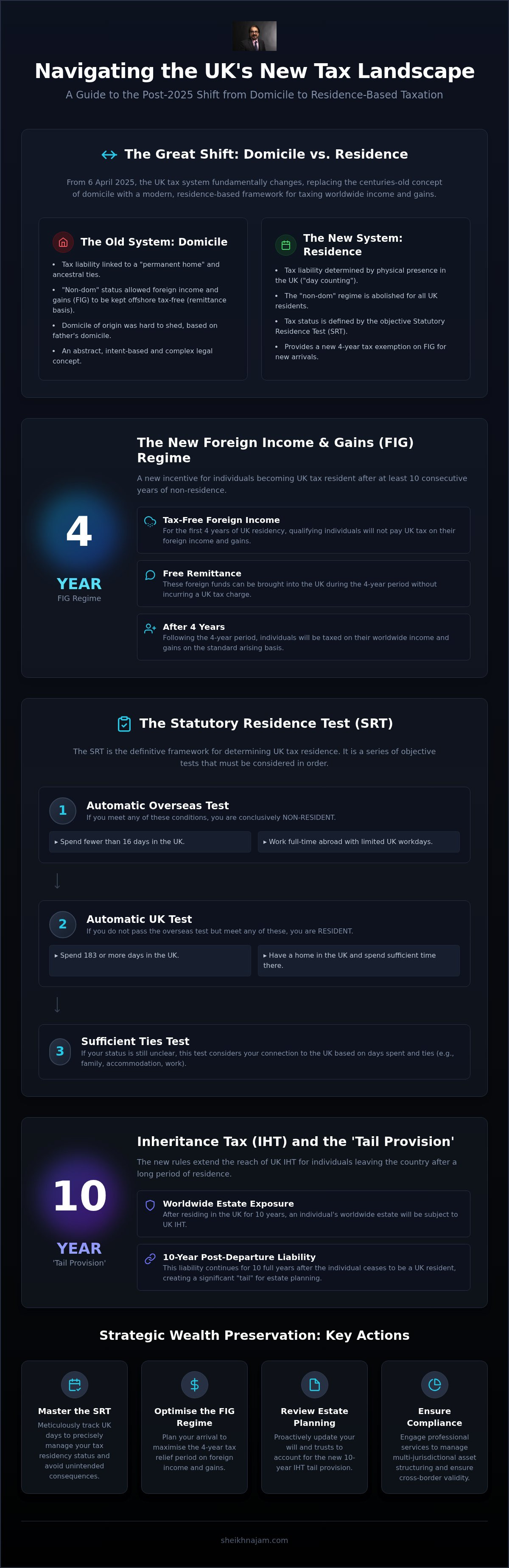
The total abolition of the remittance basis on 6 April 2025 marked the end of a centuries-old fiscal tradition, replacing it with a landscape where physical presence, rather than ancestral ties, dictates the extent of one's liability to the Exchequer. You perhaps find yourself grappling with the sudden exposure of your global estate to the UK’s arising basis of taxation; it is a shift that necessitates a total recalibration of long-standing wealth preservation strategies. This comprehensive analysis serves as a master framework for understanding the updated residence and domicile rules in the uk, offering the strategic foresight required to protect multi-jurisdictional interests in this new era of transparency.
We shall dissect the mechanics of the four-year Foreign Income and Gains (FIG) regime and the stringent ten-year "tail provision" that now tethers former long-term residents to the UK inheritance tax net. By examining the Statutory Residence Test through the lens of current 2026/27 regulatory requirements, this treatise ensures that your transition to a residence-based regime is managed with absolute precision. You will gain a sophisticated understanding of the mitigation protocols necessary to insulate your worldwide assets from unnecessary fiscal erosion while maintaining full compliance with the evolving standards of the City of London.
Table of Contents
The Conceptual Evolution of UK Fiscal Presence: Distinguishing Residence from Domicile
The Statutory Residence Test: A Meticulous Framework for Determining UK Tax Status
The Foreign Income and Gains (FIG) Regime: Navigating the Post-2025 Landscape
Inheritance Tax and the Long-Term Resident: Deemed Domicile in a Residence-Based Era
Strategic Wealth Preservation: Multi-Jurisdictional Compliance and Estate Planning
The Conceptual Evolution of UK Fiscal Presence: Distinguishing Residence from Domicile
The shift in the UK’s fiscal framework represents a fundamental departure from centuries of legal precedent. Historically, the concept of domicile in common law served as the primary nexus for taxation, tethering an individual’s worldwide estate to the UK based on a perceived permanent home. However, the current iteration of the residence and domicile rules in the uk has decisively pivoted toward a residence-based regime. Tax residence is now defined by the empirical metric of physical presence within a specific tax year, whereas domicile remains a more abstract construct of belonging. This distinction is critical; while domicile still informs certain civil law matters, its role as the arbiter of tax liability has been systematically dismantled in favour of objective, statutory residency tests. High-net-worth individuals must recognise that their fiscal footprint is now measured by the calendar rather than the lineage.
The Historical Significance of Domicile of Origin
A domicile of origin is a birthright concept, traditionally acquired from one's father and notoriously difficult to divest. To shed this status, one must establish a domicile of choice through the twin pillars of physical relocation and a demonstrable, permanent intent to abandon the UK indefinitely. Under the 2026 framework, the weight once afforded to these common law nuances has diminished within the tax sphere. The abolition of the non-dom regime means that the historical "non-dom" status no longer provides a shield against the taxation of foreign income and gains for long-term residents. It's no longer enough to claim a foreign "heart"; the Exchequer now looks strictly at where you lay your head. This evolution reflects a broader global trend toward transparency and objective fiscal connectivity.
Residence as the Modern Determinant of Liability
The 2025 reforms transformed UK tax liability from an intent-based enquiry into a fact-based calculation. For the sophisticated investor with multi-jurisdictional interests, 2026 marks a settled era where residency is the primary trigger for worldwide tax exposure. This shift necessitates a meticulous approach to international estate planning, particularly regarding how notarial services are utilised to authenticate residency declarations across borders. Precision in day-counting is no longer a mere administrative task; it's a strategic necessity to prevent unintended fiscal consequences. Understanding the updated residence and domicile rules in the uk is the first step in constructing a robust, cross-border wealth preservation strategy that withstands the scrutiny of both HMRC and foreign tax authorities. Failure to distinguish between these concepts can lead to a dual-residency trap, where assets are vulnerable to overlapping claims of jurisdiction.
The Statutory Residence Test: A Meticulous Framework for Determining UK Tax Status
The methodology of the Statutory Residence Test (SRT) acts as the definitive arbiter of status, providing a rigorous, standardised framework that replaces the opaque determinations of the past. Within the current residence and domicile rules in the uk, the SRT serves as a mechanical gatekeeper, demanding an empirical verification of one's physical presence. This process begins with the Automatic Overseas Test; if an individual meets any of its criteria, such as working full-time abroad or spending fewer than 16 days in the UK, they're conclusively non-resident. Failure to satisfy these overseas criteria necessitates an evaluation against the Automatic UK Test, where specific thresholds of presence trigger residency regardless of intent. High-net-worth individuals must consult the official Statutory Residence Test (SRT) guidance to ensure their multi-jurisdictional movements don't inadvertently create a UK tax nexus.
The Mechanical Application of the SRT
Calculating presence for the 2026 tax year requires a disciplined adherence to day-counting protocols. The "midnight test" remains the foundational metric of this system, where an individual is deemed present for a day if they are in the UK at the end of it, subject to narrow exceptions for transit or exceptional circumstances. Accuracy in this area is paramount, as even a single day can shift a person's entire global tax liability. The 183-day rule serves as the primary threshold for automatic residency, where presence for more than half the tax year triggers an incontrovertible UK tax status. For those who maintain complex international lifestyles, these quantitative measures provide the legal certainty required to manage a global estate with absolute precision.
Evaluating Sufficient Ties and Tying Factors
When an individual's status isn't resolved by the automatic tests, the Sufficient Ties Test provides a final, qualitative layer of scrutiny. This analysis identifies five specific connections: family ties, accessible accommodation, substantive work in the UK, the 90-day tie from previous years, and the country tie for departing residents. There is an inverse relationship between these connections and the time one may spend in the country; as the number of ties increases, the permitted number of days in the UK decreases significantly. Meticulous record-keeping is therefore essential for private clients who wish to retain significant British interests whilst maintaining non-resident status. Strategic international tax planning ensures that these ties are managed with foresight, allowing you to maintain control over your fiscal footprint before these connections crystallise into a worldwide tax liability.
The Foreign Income and Gains (FIG) Regime: Navigating the Post-2025 Landscape
The introduction of the Foreign Income and Gains (FIG) regime on 6 April 2025 represents a paradigm shift in how the United Kingdom treats the wealth of its international residents. This new framework, which replaces the archaic remittance basis, allows qualifying new residents to enjoy a total exemption on foreign income and gains for their first four years of UK residence. This transition is a cornerstone of the modernised residence and domicile rules in the uk, designed to provide clarity whilst aligning the British tax system with international norms. For those engaged in international tax planning for business owners London, the FIG regime offers a window of opportunity to restructure global holdings before the broader arising basis of taxation takes effect.
Eligibility for the 4-Year Exemption
To qualify for this exemption, an individual must have been a non-UK tax resident for at least ten consecutive tax years prior to their arrival. This is a strict, binary test. It removes the ambiguity that often plagued the previous domicile-based system. Accessing the FIG regime isn't automatic; it requires a formal election to be made on the individual’s annual tax return for each relevant year. It's a strategic choice. Opting into this regime results in the loss of the tax-free personal allowance and the capital gains tax annual exempt amount. For high-net-worth individuals, this loss is usually negligible compared to the benefits of exempting substantial offshore income.
The Arising Basis and Long-Term Compliance
Once the four-year qualifying period expires, the resident is mandatorily transitioned to the arising basis of taxation. This means that their worldwide income and gains become subject to UK tax as they accrue, regardless of whether the funds are brought into the country. Managing this transition requires a sophisticated 2026 international tax structuring for private clients strategy to mitigate the impact of worldwide exposure. It's no longer sufficient to merely wall off foreign assets. One must consider the interplay between UK domestic law and international double tax treaties. This ensures that global wealth is preserved through meticulous planning and multi-disciplinary oversight, preventing the erosion of capital as residency matures into a long-term fiscal commitment.
Inheritance Tax and the Long-Term Resident: Deemed Domicile in a Residence-Based Era
The transition toward a residence-based fiscal nexus reaches its most profound impact within the realm of capital taxes, where the concept of "deemed domicile" has been fundamentally recalibrated. Under the current residence and domicile rules in the uk, the previous 15-year threshold has been discarded in favour of a more aggressive 10-year residency test. This means that once an individual has been a UK tax resident for at least 10 out of the last 20 tax years, their worldwide estate falls within the scope of the 40% Inheritance Tax (IHT) charge. This exposure isn't limited to UK-situs assets; it encompasses international real estate, offshore investment portfolios, and foreign bank accounts that were previously shielded by non-domiciled status. You'll find that the standard nil-rate band of £325,000 offers negligible protection for high-value estates, making proactive mitigation an absolute necessity.
The 10-Year Rule for IHT Liability
The 10-year residency test serves as the new benchmark for IHT deemed domicile. This mechanism ensures that a "tail provision" maintains a fiscal shadow over the individual even after they've ceased to be physically present in the United Kingdom. For those who have been resident for 20 years or more, this tail can persist for a full decade post-departure, meaning your global assets remain within the grasp of the UK tax net long after you've established a new life abroad. It's also vital to consider the spouse exemption; for mixed-residency couples, the exemption is capped at £325,000 unless the non-resident spouse elects to be treated as UK-domiciled for IHT purposes. This election is a double-edged sword that requires precise legal weighing to avoid unintended worldwide exposure.
Trusts and Excluded Property
The status of Excluded Property Trusts (EPTs) has undergone a fundamental transformation, moving away from a focus on the settlor’s domicile at the time of creation to a residence-based assessment. Assets settled into a trust by a long-term resident are now subject to the same residence tests as the individual, potentially bringing previously "excluded" property back into the charge for IHT. Protecting international wealth requires a meticulous review of trust deeds and a strategic cross-reference with an international tax compliance for individuals framework to ensure that existing structures remain effective. Secure your legacy by engaging in proactive Inheritance Tax Planning to mitigate the impact of these stringent residency thresholds before they crystallise into a 40% liability for your heirs.
Strategic Wealth Preservation: Multi-Jurisdictional Compliance and Estate Planning
Integrating the updated residence and domicile rules in the uk into a comprehensive wealth strategy requires a multi-disciplinary approach that transcends mere fiscal calculation. It's a matter of legal architecture. For the sophisticated client, the validity of a residency declaration often hinges on the precise execution of notarial services, which provide the necessary authentication for foreign jurisdictions. This is particularly vital when managing digital assets and crypto-wealth, where the absence of a physical situs creates a unique challenge for tax residence purposes. Professional mediation becomes an essential tool when these multi-jurisdictional interests collide. It ensures that estate disputes are resolved with the discretion and precision that high-net-worth affairs demand, avoiding the public nature of traditional litigation.
International Wills and Cross-Border Succession
Residency status dictates the validity and taxation of international wills London, necessitating a careful coordination with foreign succession laws. The EU Succession Regulation, commonly known as Brussels IV, allows individuals to choose the law of their nationality to govern the succession of their estate, yet this choice must be meticulously aligned with their UK residency status to prevent conflicting tax claims. Proactive structuring is the only way to mitigate the risk of contentious probate London, where ambiguity in residency can lead to prolonged disputes over the distribution of global assets. You must ensure that your testamentary documents are robust enough to withstand scrutiny in every jurisdiction where you hold interests.
Digital Assets and Modern Compliance
The unique challenges of situating digital assets for tax residence purposes require a Strategic Polymath approach to elite private wealth management. Unlike traditional real estate, digital assets don't possess a physical location, leading the Exchequer to look at the residency of the beneficial owner as the primary connecting factor. Ensuring regulatory compliance in financial crime and Anti-Money Laundering (AML) protocols is mandatory for international transfers, especially as the residence and domicile rules in the uk become more fact-based. We provide the meticulous oversight needed to structure these assets within residence-based boundaries, ensuring that your digital portfolio remains a secure and compliant component of your broader estate. This level of precision is the hallmark of a master advisor who operates at the intersection of law, technology, and global finance.
Securing Your Global Estate in a Residence-Based Era
The transition to a residence-based tax regime demands a total reappraisal of how global wealth is structured, particularly as the definitive shift from ancestral domicile to the empirical metrics of the Statutory Residence Test takes full effect. It's clear that the current residence and domicile rules in the uk place a premium on meticulous day-counting and proactive estate planning, especially when considering the strategic nuances of the 4-year FIG regime. The 10-year inheritance tax tail remains a formidable challenge for long-term residents, necessitating a multi-disciplinary approach to ensure that your worldwide assets don't fall victim to unintended fiscal exposure.
Navigating these intricate legal landscapes requires the steady hand of a master advisor who operates at the intersection of tax, law, and international compliance. As a Trust and Estate Practitioner (TEP) and a specialised Notary Public for international affairs, I provide the precise command and control necessary to safeguard your interests through expertise in multi-jurisdictional estate litigation. Consult Sheikh Najam TEP for a Strategic Analysis of Your Residence and Domicile Status to fortify your global position with the precision your affairs deserve. Your strategic foresight today ensures the security of your estate for generations to come.
Frequently Asked Questions
How is UK tax residence determined in 2026?
UK tax residence is determined by the Statutory Residence Test, which serves as the definitive arbiter of one's fiscal nexus to the United Kingdom. This mechanical framework evaluates specific criteria across three distinct stages: the Automatic Overseas Tests, the Automatic UK Tests, and the Sufficient Ties Test. Precision in day-counting is mandatory, as even a single day's presence at midnight can shift your status from non-resident to resident.
What is the 4-year Foreign Income and Gains (FIG) regime?
The four-year Foreign Income and Gains (FIG) regime is a relief mechanism for qualifying new residents who've been non-UK tax resident for ten consecutive years. Under this framework, individuals can elect to receive a total exemption on their foreign income and gains during their initial four years of residency. This represents a significant pillar of the updated residence and domicile rules in the uk, providing a clear window for international wealth restructuring.
Is the non-dom tax status still available in the UK?
The traditional non-domiciled status and the associated remittance basis of taxation were formally abolished on 6 April 2025. The UK has moved to a residence-based system where all residents are generally taxed on their worldwide income and gains as they arise. This shift necessitates a total recalibration of estate plans that previously relied on the common law concept of domicile to shield offshore assets from the Exchequer.
How many days can I spend in the UK without becoming a tax resident?
The number of days you can spend in the UK without triggering residency depends entirely on your specific connections under the Sufficient Ties Test. Whilst 183 days is the absolute threshold for automatic residency, those with multiple ties, like family or accommodation, might become resident after spending as few as 16, 46, or 91 days. It's a sliding scale that requires meticulous diary management to ensure you don't inadvertently establish a UK tax nexus.
Does UK residence affect my inheritance tax on overseas property?
Yes, UK residence exerts a profound impact on your inheritance tax liability regarding overseas property once the 10-year residency threshold is surpassed. Under the 2026 framework, long-term residents are subject to a 40% charge on their worldwide estate, including foreign real estate and offshore accounts. This exposure is no longer mitigated by non-dom status, making proactive trust and estate planning essential to protect your international legacy from fiscal erosion.
What happens to my deemed domicile status if I leave the UK in 2026?
If you depart the UK in 2026 after a period of long-term residence, your deemed domicile status for inheritance tax purposes persists through a tail provision. Depending on whether you were resident for at least 10 of the last 20 tax years, your worldwide assets can remain within the UK tax net for up to a decade post-departure. This mechanism prevents individuals from avoiding IHT by simply relocating shortly before a chargeable event occurs.
Can a notary public help with international residence documentation?
A Notary Public is essential for the authentication of residency declarations and other strategic documents required for multi-jurisdictional compliance. By providing an official seal recognised by the Court of Faculties, a notary ensures that your declarations of status are legally robust across international borders. This is a vital component of managing the residence and domicile rules in the uk, especially when dealing with foreign tax authorities or cross-border succession.
How do the new rules affect trusts established before April 2025?
Trusts established before April 2025 are no longer shielded by the historical excluded property rules if the settlor meets the new residence-based criteria. The 2026 framework has moved away from domicile-based protections, potentially bringing previously exempt offshore trust assets into the scope of UK inheritance tax. You'll need a comprehensive review of existing trust deeds to determine how these residence-based shifts affect your long-term wealth preservation and compliance strategies.


Comments