Apostille Services in London: A Strategic Guide to Document Legalisation (2026)

Updated: Aug 26
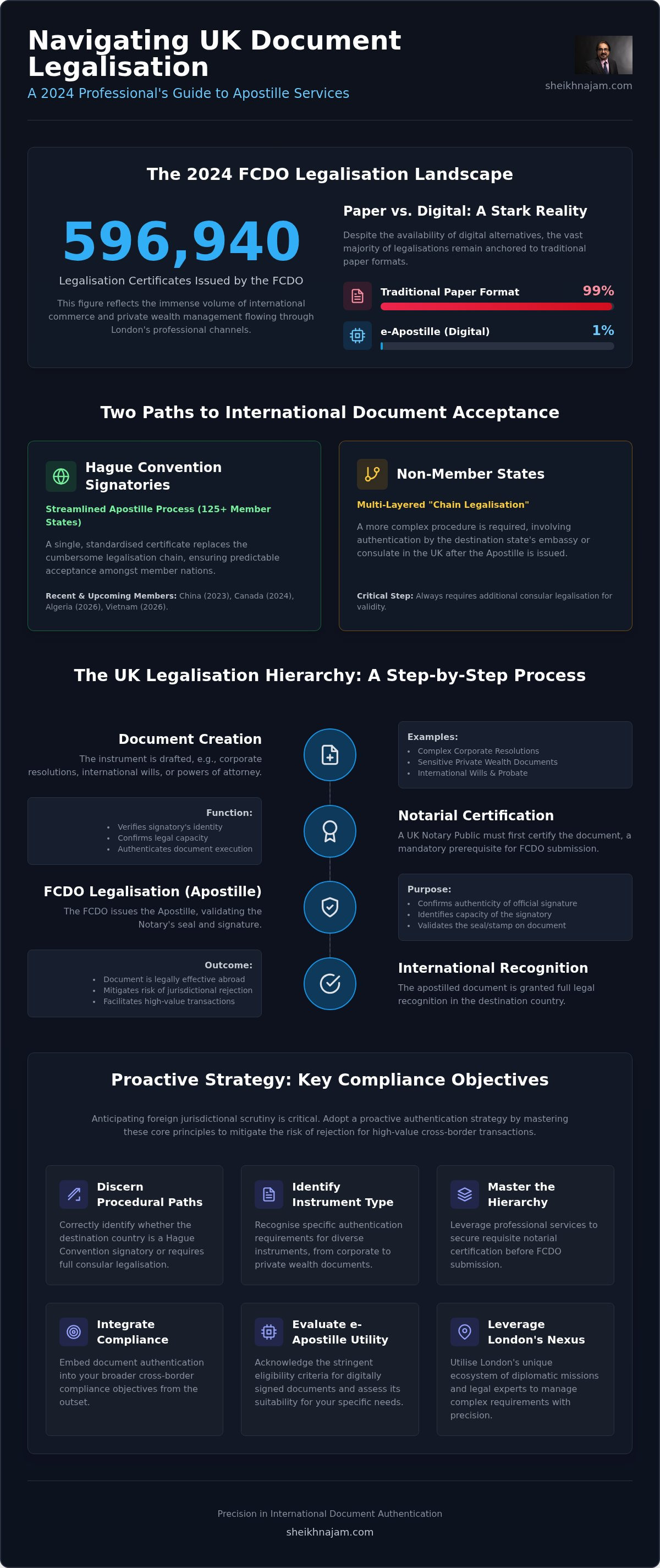
Whilst the Foreign, Commonwealth & Development Office issued nearly 600,000 legalisation certificates in 2024, a staggering 99% of these instruments remained anchored to traditional paper formats despite the availability of digital alternatives. This persistent reliance on physical documentation underscores the profound complexity inherent in securing reliable apostille services London for high-stakes international affairs. For the sophisticated practitioner, authentication is not a mere formality. It is a critical safeguard against the jurisdictional rejection of vital instruments.
You likely recognise that the intersection of UK notarial practice and foreign regulatory requirements creates a landscape fraught with potential for procedural error. This article provides an authoritative analysis of the current legalisation framework, offering the clarity required to navigate the 2024 FCDO Premium service modifications and the expanding reach of the Hague Convention. We shall examine the hierarchical necessity of notarial certification, the specific eligibility criteria for emerging e-Apostille protocols, and the strategic integration of these processes into your broader cross-border compliance objectives.
Table of Contents
Understanding the Necessity of Apostille Services in London’s International Legal Landscape
The Hague Convention of 1961: Strategic Implications for Cross-Border Document Validity
Categorising Documents for Legalisation: From Corporate Resolutions to Private Wealth Instruments
Navigating the Legalisation Process: FCDO Requirements and the Role of the Notary Public
Strategic Compliance: Integrating Apostille Services into Multi-Jurisdictional Affairs
Understanding the Necessity of Apostille Services in London’s International Legal Landscape
The apostille serves as a definitive certificate of authenticity, an instrument born from The Hague Convention of 1961, designed to facilitate the seamless movement of public documents across international borders. Within the United Kingdom, the Foreign, Commonwealth & Development Office (FCDO) functions as the exclusive competent authority vested with the power to issue these certificates. For the sophisticated client, engaging apostille services London is not merely a logistical requirement. It is a strategic imperative that ensures a document issued in one jurisdiction is afforded full legal recognition in another. This process necessitates a precise distinction between the underlying physical document, the professional notarial act that verifies its execution, and the final apostille certificate that validates the authority of the public official involved.
The Functional Purpose of Document Legalisation
Document legalisation exists to mitigate the risks of fraud and jurisdictional rejection by providing a verifiable audit trail of authority. Historically, this required "chain legalisation," a cumbersome and multi-layered procedure involving both the origin state’s foreign ministry and the destination state’s embassy. The transition to the streamlined apostille process has significantly reduced these administrative burdens. The certificate confirms the capacity in which the signatory has acted and the identity of the seal or stamp affixed to the instrument. It ensures that the document is fit for its intended purpose, whether that involves the transfer of high-value assets, the establishment of a corporate subsidiary, or the administration of a complex international estate.
London as a Centre for Global Document Authentication
London’s pre-eminence as a global financial and legal nexus makes it the natural epicentre for document authentication. The City’s dense concentration of diplomatic missions, international corporations, and elite legal practitioners creates a unique ecosystem where complex legalisation requirements are managed with absolute precision. Whilst the FCDO Legalisation Office is physically situated in Milton Keynes, the strategic management of these applications occurs within the London legal market. This proximity to the Court of Faculties and the various foreign consulates allows for a sophisticated interplay between the Notary Public and the government’s legalisation protocols. Managing apostille services London within this prestigious environment provides an additional layer of security and institutional weight, ensuring that every instrument meets the rigorous standards demanded by foreign courts and regulatory bodies. The FCDO issued 596,940 apostilles in 2024, a figure that reflects the sheer volume of international commerce and private wealth management flowing through the capital's professional channels.
The Hague Convention of 1961: Strategic Implications for Cross-Border Document Validity
The Hague Convention of 5 October 1961, formally entitled the Convention Abolishing the Requirement of Legalisation for Foreign Public Documents, represents a seminal achievement in the harmonisation of private international law. By replacing the cumbersome, multi-layered "legalisation chain" with a single, standardised certificate, the treaty has fundamentally transformed how public instruments circulate amongst its 125 member states. The recent accession of major economic powers, including China in November 2023 and Canada in January 2024, alongside the anticipated entry into force for Algeria in July 2026 and Vietnam in September 2026, underscores the convention's enduring relevance. For those engaging apostille services London, this framework provides a predictable legal environment where a London-issued apostille carries significant evidentiary weight within European and North American judicial systems, facilitating the movement of instruments without the need for repetitive verification by diplomatic agents.
Jurisdictional Nuances and Consular Requirements
Whilst the convention simplifies procedures for member states, significant jurisdictional nuances remain for "Non-Hague" territories. In these instances, documents must undergo a more rigorous consular legalisation process, which often involves the London Chamber of Commerce for commercial instruments before submission to the relevant embassy or high commission. Navigating the specific requirements of certain Middle Eastern or Asian jurisdictions requires a meticulous understanding of local administrative preferences that often exceed the standard FCDO protocols. When Navigating the Legalisation Process for these complex regions, the practitioner must account for additional layers of verification, such as pre-certification by the Arab-British Chamber of Commerce, to ensure the instrument's ultimate acceptance by foreign ministries and regulatory bodies.
The Evidentiary Weight of an Apostilled Instrument
Foreign authorities and judicial bodies afford an apostilled document a profound "presumption of regularity," accepting the signature and seal of the public official as authentic without further proof. This is particularly vital in the context of litigation or the administration of high-value estates, where the validity of an instrument can be the pivot upon which a case turns. The strategic importance of this authentication cannot be overstated for international wills London, as it ensures that testamentary intentions are recognised across borders with minimal friction. By establishing a robust audit trail through the notary’s seal and the subsequent apostille, the instrument gains a level of global portability that is essential for modern private wealth management. To secure the long-term efficacy of your global assets, seeking bespoke notarial advisory ensures that every document is prepared to withstand the most rigorous international scrutiny.
Categorising Documents for Legalisation: From Corporate Resolutions to Private Wealth Instruments
The classification of documents for legalisation is a nuanced exercise that requires a profound understanding of both domestic issuance and foreign receptivity. Within the elite legal landscape of the City, apostille services London are frequently utilised to authenticate a diverse array of instruments, ranging from foundational corporate charters to intricate testamentary dispositions. It's a process where each category of document carries its own specific requirements for prior certification. For instance, whilst birth or marriage certificates issued by the General Register Office may be submitted directly to the FCDO, private instruments such as notarising company resolutions London must first undergo rigorous verification by a Notary Public to establish their validity before the state will affix its seal.
Authenticating Corporate Governance for International Use
Corporate entities operating across multiple jurisdictions must often provide evidence of their standing and authority to foreign banks, regulators, and joint venture partners. This typically involves the legalisation of Certificates of Incorporation, Articles of Association, and specific Board Resolutions that empower officers to act on the company’s behalf. The notary public for company documents acts as a vital intermediary in this process, certifying that the signatories possess the requisite capacity and that the resolutions have been passed in accordance with the company’s constitution. This level of professional oversight is essential for compliance with anti-money laundering (AML) protocols, as foreign authorities don't accept unverified corporate claims. Once the apostille is affixed, receiving parties can verify an apostille through the official government portal, providing an additional layer of digital security for high-value transactions.
Estate Planning and Private Client Instruments
For the high-net-worth individual, the legalisation of private wealth instruments is a cornerstone of effective cross-border succession planning. This includes the authentication of Grants of Probate, Trust Deeds, and Lasting Powers of Attorney (LPAs) to ensure that fiduciaries can manage assets held in foreign jurisdictions without administrative delay. It's a strategic necessity that provides the "presumption of regularity" foreign courts require to recognise the authority of a UK-based executor or trustee. Similarly, for individuals relocating for professional purposes, the legalisation of academic and professional qualifications is mandatory to satisfy the entry requirements of overseas regulatory bodies. Managing these sensitive affairs through apostille services London ensures that every instrument, from a complex trust structure to a simple educational certificate, is processed with the meticulousness required to withstand international scrutiny.
Navigating the Legalisation Process: FCDO Requirements and the Role of the Notary Public
The path to successful document legalisation is a rigorous, multi-stage procedure that demands absolute adherence to the Foreign, Commonwealth & Development Office (FCDO) protocols. For the discerning client, the efficiency of apostille services London depends upon a methodical approach to these five critical steps:
Step 1: Certification Assessment: One must first determine if the instrument requires prior authentication. Whilst documents issued by UK government departments often qualify for direct submission, private legal instruments must be certified by a registered Notary Public or solicitor.
Step 2: Service Tier Selection: The applicant must choose between the standard postal service, which currently carries a 15 to 20 working day turnaround, or the expedited 1 to 2 day turnaround available through registered service providers.
Step 3: Protocol-Compliant Submission: Instruments are submitted to the Legalisation Office in Milton Keynes alongside the requisite supporting evidence and a comprehensive application summary.
Step 4: Official Verification: FCDO officials verify the signature, seal, or stamp on the document against their internal database of authorised signatories.
Step 5: Secure Dispatch: Upon successful authentication, the apostille certificate is permanently affixed to the instrument, which is then returned via secure courier for international use.
The Critical Distinction Between Solicitor and Notarial Certification
A frequent point of confusion amongst practitioners is the distinction between solicitor and notarial certification. Whilst both are legally valid within the UK, a Notary Public is a public officer whose seal is recognised globally, particularly in civil law jurisdictions and across the European Union. Solicitors, by contrast, are primarily recognised within the Commonwealth. For documents intended for high-stakes international commerce or foreign judicial proceedings, notarial certification is the preferred standard. It provides a level of institutional weight that a standard solicitor’s signature cannot match. It's imperative to ensure that the certifying official is already registered with the FCDO database, as any discrepancy in the official records will lead to an immediate rejection of the application. You may secure these high-level Notarial Services to ensure your documents are prepared with the precision required for global acceptance.
Modern Legalisation: The Rise of the e-Apostille
The digital evolution of apostille services London has seen the introduction of the e-Apostille, a streamlined alternative to traditional paper-based methods. This service, which typically offers a 2 to 3 working day turnaround, is exclusively available for documents that have been digitally signed by a UK notary or solicitor. It's important to recognise that paper documents, such as birth or marriage certificates issued by the General Register Office, remain ineligible for this digital format. Whilst the e-Apostille offers enhanced security features and faster processing, the traditional "wet ink" apostille remains the superior strategic choice for jurisdictions that have not yet fully integrated electronic verification into their local administrative frameworks.
Strategic Compliance: Integrating Apostille Services into Multi-Jurisdictional Affairs
The transition from reactive administrative compliance to a proactive document authentication strategy is a hallmark of sophisticated multi-jurisdictional management. For the high-net-worth individual or corporate entity, apostille services London shouldn't be viewed as a final, hurried step before a deadline. Instead, they represent a foundational component of a broader international strategy. By engaging a notary for international business documents London at the inception of a transaction, you ensure that every instrument is drafted, witnessed, and authenticated to meet the most exacting standards of foreign registries and financial institutions. This foresight mitigates the risk of jurisdictional rejection, which can have catastrophic consequences for time-sensitive acquisitions or complex estate distributions.
Risk Management in International Transactions
The acquisition of foreign real estate or the execution of cross-border corporate mergers requires a level of procedural precision that leaves no room for ambiguity. Rejection of a Power of Attorney or a Board Resolution by an overseas land registry can lead to missed completion dates and substantial financial penalties. It's essential that all instruments are correctly witnessed and authenticated at the point of execution, acknowledging that the apostille is only as valid as the underlying notarial act. Meticulousness in the preparation of these documents ensures that they're not just legally valid in the UK, but also culturally and administratively acceptable in the destination jurisdiction, thereby preserving the momentum of international commerce. Such precision is particularly vital when apostille services London are integrated into the management of high-value asset portfolios where the presumption of regularity is non-negotiable.
The Advisor’s Role in Global Document Strategy
For practitioners coordinating legal matters or property transactions within the United States, you can check out Sacramento Notary Co for professional mobile notary and loan signing services that provide the same level of reliability and precision required for international compliance.
The role of the Trust and Estate Practitioner (TEP) is pivotal in harmonising the requirements of London notaries, the FCDO, and various foreign consulates. Managing these disparate entities requires an architect who understands the interplay between UK law and the regulatory frameworks of Hague and non-Hague states. Within the context of inheritance tax and estate planning, the apostille ensures that digital asset structures and international wills are recognised by foreign fiduciaries without the need for protracted litigation. By positioning Sheikh Najam as the primary architect of your international document compliance, you gain access to a multi-disciplinary expertise that prioritises security, stability, and strategic foresight. This ensures that your global affairs aren't merely compliant, but are structured to withstand the evolving complexities of the international legal landscape, providing the assurance that your most intricate matters are handled with absolute precision.
Securing Your International Standing through Professional Authentication
The efficacy of your cross-border instruments hinges upon the meticulous alignment of notarial acts with the stringent requirements of the Foreign, Commonwealth & Development Office. As the global landscape expands with the recent accession of nations like China and Canada to the Hague Convention, the demand for authoritative legalisation has never been more pronounced. Transitioning from reactive administration to a proactive document strategy ensures that your corporate resolutions and private wealth instruments maintain their legal weight across diverse jurisdictions. Precision is paramount. As a practitioner appointed by The Court of Faculties and a specialist in international tax and estate planning, Sheikh Najam provides the multi-disciplinary oversight required to navigate these intricate legal landscapes. You are invited to consult Sheikh Najam for expert notarial and apostille services in London to ensure your global affairs are handled with absolute precision. Aligning your international interests with a Member of the Society of Trust and Estate Practitioners (TEP) provides the institutional security your most complex matters deserve.
Frequently Asked Questions
What is the difference between notarisation and an apostille in London?
Notarisation is a private legal act performed by a Notary Public to verify the authenticity of a signature and the capacity of the signatory. Conversely, an apostille is a public administrative act where the Foreign, Commonwealth & Development Office (FCDO) verifies the credentials of the official who performed the notarisation. For complex instruments, notarisation is the prerequisite that establishes the document’s validity, whilst the apostille serves as the final layer of international recognition.
How long does it take to get an apostille in London in 2026?
Current FCDO processing intervals for apostille services London in 2026 depend on the selected service tier. Standard postal applications typically require 15 to 20 working days for completion. Registered service providers can often secure authentication within 1 to 2 working days through specialised channels. The e-Apostille service offers a digital alternative with a turnaround time of 2 to 3 working days, though it's restricted to documents digitally signed by a UK notary.
Can I get an apostille for a document not issued in the UK?
No, the FCDO cannot affix an apostille to a document issued outside the United Kingdom. Public instruments must be legalised by the competent authority in the country where they were originally issued. If you possess a foreign document requiring authentication for use in a third country, you must contact the relevant embassy or the issuing state’s foreign ministry. London-based practitioners can, however, notarise copies of foreign documents, though this doesn't legalise the original.
Is an e-Apostille accepted by all countries in the Hague Convention?
Acceptance of the e-Apostille is not yet universal amongst all Hague Convention signatories. Whilst the e-APP initiative promotes digital adoption, certain jurisdictions and local registries still mandate traditional paper-based "wet ink" apostilles for specific transactions, such as property transfers or complex probate matters. It's imperative to verify the receptivity of the receiving authority before opting for a digital certificate, as an unrecognised format will lead to immediate procedural delays in your international affairs.
Why was the Premium Legalisation Office in Central London closed?
The FCDO centralised operations at their high-security facility in Milton Keynes to enhance the integrity of the authentication process and manage the increasing volume of applications more efficiently. This strategic shift replaced the previous walk-in service with a system that prioritises registered service providers and postal applications. This ensures that all instruments undergo a rigorous and standardised verification protocol, maintaining the prestigious reputation of UK-issued documents in the global market.
Do I need to visit the Foreign Office in person to get an apostille?
Personal attendance at the Legalisation Office is not permitted as the facility is not accessible to the general public. All applications for apostille services London must be submitted either through the official postal system or via a registered service provider with access to the FCDO’s business channels. This procedural restriction ensures that the authentication of high-value instruments remains a controlled administrative exercise, free from the logistical disruptions of a public-facing counter service.
What happens if my document is rejected by the Legalisation Office?
If an instrument is rejected, the Legalisation Office typically provides a formal notification detailing the specific grounds for refusal. Common reasons include the absence of a registered signature or the failure to secure requisite notarial certification for a private document. In such instances, the document must be rectified by the certifying official and resubmitted. It's vital to note that FCDO fees are generally non-refundable, making meticulous preparation essential to avoid unnecessary administrative costs.
How much does it cost to legalise a business document for international use?
The statutory FCDO fee for a standard paper-based apostille is £45, whilst the e-Apostille is priced at £35. However, the total cost for legalising a business document often includes additional disbursements for notarial certification and the professional fees of the service provider. These costs reflect the complexity of the verification required and the urgency of the application. For high-stakes corporate governance, the investment in professional oversight is a necessary safeguard against jurisdictional rejection.


Comments