Breach of Trust in London: Guide for HNWIs (2026)

Updated: Aug 26
Can a multi-generational legacy, meticulously structured across disparate global jurisdictions, be dismantled by the quiet negligence or overt malfeasance of a single fiduciary? For the sophisticated settlor or beneficiary, the discovery of a trustee’s failure isn't merely a financial setback; it represents a profound violation of the institutional stability upon which high-value wealth preservation is predicated. You likely recognise that the inherent complexity of modern trust structures often masks the early indicators of mismanagement until asset depletion becomes a critical risk, necessitating a decisive approach to breach of trust litigation London.
This comprehensive analysis serves as a strategic roadmap for protecting your interests within the Chancery Division of the High Court. We'll explore the sophisticated procedural nuances of 2026, including the recovery of trust assets via equitable compensation and the absolute removal of dishonest or incompetent trustees. By synthesising academic depth with practical litigation strategy, this guide ensures your most complex private affairs are restored to a state of absolute precision and regulatory compliance.
Table of Contents
The Legal Framework of Fiduciary Duty within the London Chancery Division
Anatomising the Breach: Categories of Fiduciary Failure and Trustee Liability
Strategic Litigation Procedures: Navigating the High Court and Beddoe Applications
Modern Complexities: Digital Assets and Multi-Jurisdictional Trust Disputes
Resolution and Recovery: Strategic Command in Contentious Trust Matters
The Legal Framework of Fiduciary Duty within the London Chancery Division
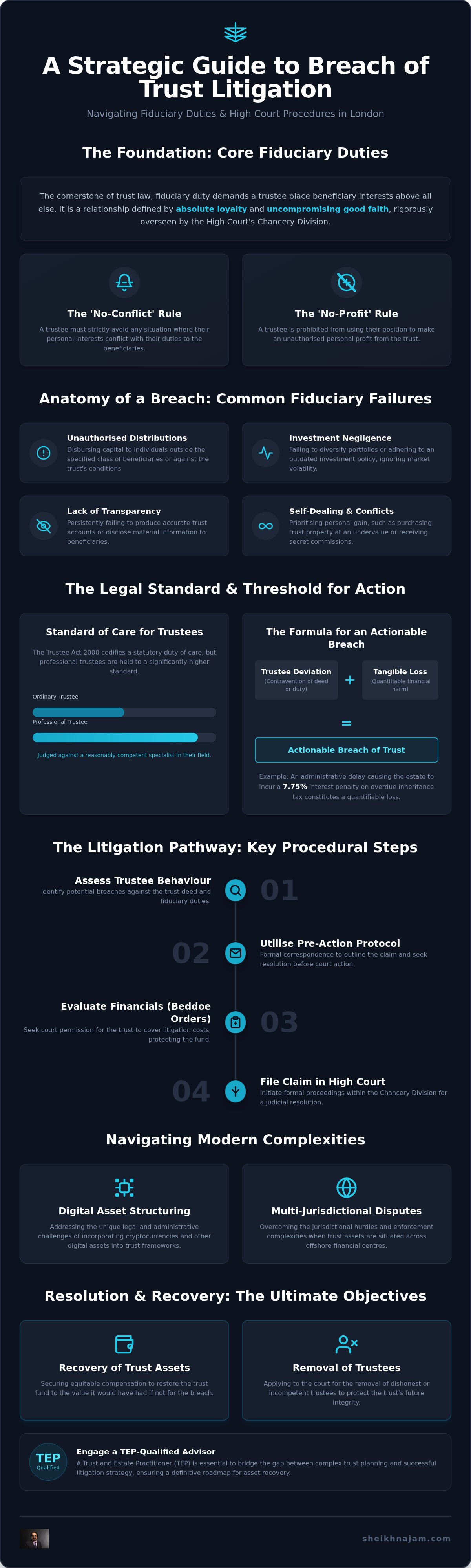
The architecture of trust law in England and Wales is anchored by the profound obligations of the fiduciary duty, a role that demands absolute loyalty and the prioritisation of beneficiary interests above all else. Within the sophisticated environment of the London High Court, this relationship is defined by an uncompromising requirement for good faith and the strict avoidance of any conflict between a trustee's personal interests and their fiduciary mandates. The Chancery Division maintains an ancient yet modernised jurisdiction over these arrangements, ensuring that the 'conscience' of the trust is preserved through rigorous judicial oversight and the application of equitable principles. In precise legal terms, a breach of trust is defined as a contravention of either the specific provisions of the trust deed or the statutory duties prescribed under the Trustee Act 2000.
The Court distinguishes between 'friendly' Part 8 applications, where fiduciaries seek judicial guidance on administrative complexities, and 'hostile' claims. It's in the latter category where breach of trust litigation London becomes necessary to address allegations of misconduct or severe negligence that threaten the integrity of the trust assets.
Statutory vs. Common Law Duties of Trustees
The Trustee Act 2000 codified a statutory duty of care, requiring trustees to exercise such care and skill as is reasonable in the circumstances, taking into account any special knowledge or experience they possess. However, common law fiduciary obligations remain profoundly relevant in contemporary litigation, particularly regarding the 'no-profit' and 'no-conflict' rules. The High Court applies a heightened standard of care to professional trustees whose specialised expertise and remuneration justify a more rigorous level of scrutiny. A professional's failure isn't judged against the standard of an ordinary person but against that of a reasonably competent specialist in their field.
The Threshold for Actionable Breach of Trust
Administrative errors don't always transition into actionable breaches. The requirement for loss is central to the Court's assessment. Whilst a trustee may technically deviate from administrative instructions, the Chancery Division is often reluctant to grant substantial remedies unless that deviation has resulted in a tangible diminution of the trust fund's value. For example, administrative delays that cause the estate to incur the 7.75% interest rate on overdue inheritance tax represent a quantifiable loss that moves beyond a mere technicality. Beneficiaries must strategically assess these factors when evaluating trustee behaviour, as the costs of breach of trust litigation London must be balanced against the potential for meaningful recovery.
Anatomising the Breach: Categories of Fiduciary Failure and Trustee Liability
The manifestation of fiduciary failure often begins with subtle deviations from the trust instrument, yet these irregularities frequently escalate into systemic asset depletion. Unauthorised distributions, where capital is disbursed to individuals outside the specified class of beneficiaries or in contravention of vesting conditions, represent a direct violation of the trustee’s primary mandate. Similarly, investment negligence remains a frequent catalyst for breach of trust litigation London, particularly when fiduciaries fail to diversify portfolios or continue to adhere to an outdated Investment Policy Statement that ignores current market volatility or inflationary pressures. Fiduciaries also possess a non-negotiable obligation to provide transparency; the persistent failure to produce accurate trust accounts or disclose material information constitutes a breach that often necessitates judicial intervention to restore beneficiary oversight.
Self-dealing and conflicts of interest represent the most egregious categories of failure, occurring when a trustee prioritises personal gain or the interests of a third party over the welfare of the beneficiaries. Whether through the purchase of trust property at an undervalue or the receipt of unauthorised commissions, these actions undermine the very foundation of the trust relationship. The High Court views such breaches with extreme gravity, often requiring the fiduciary to disgorge any profits obtained through their position, regardless of whether the trust suffered a direct financial loss.
The Doctrine of Joint and Several Liability
Under English law, the principle of joint and several liability dictates that each trustee may be held fully accountable for the collective failures of the board, regardless of their individual level of involvement in the specific breach. While the Trustee Act 1925 provides a mechanism for relief under Section 61, where the Court may excuse a trustee who has acted honestly and reasonably, this threshold is notoriously high for professional advisors. Many trust deeds incorporate Exoneration Clauses to shield fiduciaries from liability for non-fraudulent acts, yet the High Court increasingly scrutinises these provisions to ensure they don't undermine the irreducible core of the trust.
Equitable Compensation and Restitutionary Remedies
Recovery in the Chancery Division focuses on restoring the trust fund to the position it would've occupied 'but for' the trustee’s misconduct. This may involve the 'falsification' of accounts, where unauthorised disbursements are struck out as if they never occurred, or a 'surcharge' to account for assets that should've been received but for the trustee’s negligence. In cases of misappropriation, the Court employs the sophisticated mechanism of tracing to follow trust property into the hands of third parties or into substituted assets. Resolving these intricate financial discrepancies requires the oversight of a specialist in Trust Disputes to ensure that every pound is accounted for through meticulous forensic analysis.
Strategic Litigation Procedures: Navigating the High Court and Beddoe Applications
The commencement of breach of trust litigation London requires a meticulous adherence to the Pre-Action Protocol, a procedural phase designed to facilitate the exchange of information and explore settlement before the matter ascends to the High Court. This preliminary stage demands a precise articulation of the alleged Breach of trustee duties, ensuring that all parties fully comprehend the legal and financial stakes involved. It's during this window that the master advisor evaluates the viability of the claim against the potential for protracted conflict, seeking to resolve the dispute before the significant court fees, which increased by up to 34% for certain applications in July 2026, begin to accrue.
Central to the trustee’s defensive strategy is the Beddoe Application, which functions as a pre-emptive request for the Court’s indemnification regarding legal costs. A Beddoe Application is a procedural safeguard for trustees seeking court blessing for litigation expenses. If granted, the trustee is permitted to draw upon the trust assets to fund their defence, a prospect that can significantly impact the net recovery for beneficiaries. Consequently, beneficiaries must rigorously contest such applications if they believe the trustee’s defence is unmeritorious or represents a further misapplication of trust capital that could lead to significant asset depletion.
The High Court Litigation Timeline
Once the Claim Form is issued within the Chancery Division, the litigation enters a structured sequence of pleadings and evidence. Disclosure represents a particularly heavy burden in trust disputes; fiduciaries are often compelled to produce exhaustive trust records, historical ledgers, and internal communications that may reveal the provenance of the breach. The trial itself frequently pivots on the testimony of expert witnesses who provide authoritative analysis on complex valuation matters or the appropriateness of specific investment vehicles relative to the trust’s stated objectives. This methodical accumulation of detail ensures that the Court possesses a comprehensive understanding of the trustee's behaviour before rendering a judgment.
Alternative Dispute Resolution (ADR) in Trust Conflicts
While the High Court offers a definitive judicial resolution, many HNWIs favour the discretion and flexibility of Mediation and Arbitration to resolve sensitive family wealth disputes. These mechanisms allow for a more nuanced negotiation that can preserve familial relationships whilst securing equitable compensation for assets lost through mismanagement. For those managing intricate multi-disciplinary affairs, integrating these methods with broader commercial dispute resolution London strategies provides a layered approach to asset protection and conflict resolution, avoiding the public filing requirements mandated by Practice Direction 51ZH since January 2026.
Modern Complexities: Digital Assets and Multi-Jurisdictional Trust Disputes
The formal recognition of digital assets as a third category of personal property under the Property (Digital Assets etc) Act 2025 has fundamentally altered the landscape of fiduciary responsibility. Trustees now face unprecedented challenges in Digital Asset Structuring, where the failure to secure private keys or the mismanagement of cold storage protocols can lead to catastrophic losses that are often irreversible. These modern failures frequently trigger breach of trust litigation London, especially when fiduciaries fail to reconcile the extreme volatility of crypto-assets with the statutory "prudent investor" rule. The High Court's scrutiny now extends to the technical competence of the trustee, demanding a level of digital literacy that matches their traditional financial acumen.
Beyond the digital realm, the "Sham Trust" doctrine remains a critical tool for beneficiaries seeking to pierce opaque asset protection structures. If a settlor maintains such a high degree of control that the trust doesn't actually exist as a separate legal entity, the Chancery Division may set the entire arrangement aside. This is particularly relevant in multi-jurisdictional disputes where assets are held in offshore centres like Jersey or the BVI, requiring a sophisticated synthesis of English trust principles and local statutory frameworks to achieve a successful recovery.
Litigating Breach of Trust in Digital Assets
Fiduciaries are increasingly scrutinised for their technical governance. The duty to diversify now extends to the digital realm, where an over-concentration in a single volatile protocol or the failure to utilise multi-signature wallets may be deemed actionable negligence. Recovery strategies for misappropriated digital wealth involve the sophisticated use of proprietary injunctions and disclosure orders against exchanges. These efforts are bolstered by the HMRC Crypto-Asset Reporting Framework (CARF) data that became fully operational in 2026, allowing practitioners to track the movement of trust capital with greater forensic precision than ever before.
Cross-Border Evidence and International Notarial Acts
High-value disputes rarely remain confined to a single territory. When trust assets are situated in offshore jurisdictions, the evidentiary burden in the London High Court becomes significantly more complex. A London notary for company documents plays a vital role in this process, authenticating foreign trust instruments and legalising cross-border evidence to ensure its admissibility. This notarial oversight is often the linchpin in challenging fraudulent structures, where the authentication of signatures and corporate resolutions is paramount. Furthermore, the intersection of international tax planning and litigation risk management requires a practitioner who can navigate the TRS registration requirements for non-UK trusts holding UK land, a mandate that became more stringent in June 2026. To ensure your global interests are protected with absolute precision, consider engaging a specialist in Trust Disputes who possesses the multi-disciplinary expertise to command these intricate legal landscapes.
Resolution and Recovery: Strategic Command in Contentious Trust Matters
The final resolution of a trust dispute represents the culmination of strategic foresight and forensic rigour. For the high-net-worth individual, the objective extends beyond the mere recovery of assets; it involves the restoration of institutional order and the preservation of a multi-generational legacy. Navigating high-value contentious probate in London or a complex trust conflict necessitates a bespoke litigation strategy that harmonises legal aggression with the nuances of family diplomacy. This synthesis ensures that while assets are protected, the underlying familial structures aren't irreparably fractured by the process.
Beneficiaries should act with immediacy upon discovering irregularities. Securing trust accounts, documenting communications, and obtaining a professional audit are essential preliminary steps. The advantage of the "Strategic Polymath" approach lies in the ability to anticipate the trustee’s defensive manoeuvres, such as the Beddoe applications discussed previously, while simultaneously preparing for the technical demands of breach of trust litigation London. By integrating international tax foresight with Chancery expertise, the master advisor provides a level of command that surface-level legal practices cannot replicate.
Removal and Replacement of Trustees
When a fiduciary relationship has fundamentally broken down, the removal of the trustee becomes a mandatory prerequisite for asset recovery. Applications are typically brought under Section 36 of the Trustee Act 1925 or via the Court’s inherent jurisdiction to ensure the proper administration of trusts. The High Court prioritises the welfare of the beneficiaries and the safety of the trust estate above the personal interests of the incumbent trustee, ensuring that administrative errors don't escalate into systemic failure. Appointing an Independent Administrator or a Professional Trustee is often the most effective mechanism to restore administrative integrity and ensure a seamless transition that protects the trust’s long-term viability. This procedural intervention halts further asset depletion and provides a stable foundation for the subsequent pursuit of equitable compensation.
Securing Your Legacy with Sheikh Najam TEP
The resolution of high-value wealth conflicts demands a practitioner who operates at the intersection of several complex fields simultaneously. Sheikh Najam TEP provides this elite level of multi-disciplinary expertise, combining legal rigour with notarial and international tax planning capabilities. This comprehensive perspective ensures that every strategic decision is made with an understanding of its tax implications and regulatory consequences. Meticulousness is the hallmark of the practice; academic depth is the engine of its success. To protect your interests and restore the precision of your private affairs, Consult with Sheikh Najam TEP for a strategic review of your trust dispute and a definitive roadmap to recovery.
Restoring Precision to Your Private Wealth Arrangements
The preservation of substantial assets within the London High Court demands a synthesis of legal precision and strategic foresight that transcends traditional advisory roles. We've analysed the rigorous fiduciary standards of the Chancery Division and the procedural complexities of Beddoe applications; ensuring you're equipped to identify when administrative errors evolve into actionable failures. Addressing modern challenges, particularly regarding digital asset structuring and multi-jurisdictional recovery, requires a master advisor who possesses both academic depth and practical command over the 2026 regulatory landscape. Successfully navigating breach of trust litigation London isn't merely about asset recovery; it's about the definitive restoration of your legacy's integrity.
As a TEP-qualified practitioner and specialist in the London High Court Chancery Division, Sheikh Najam provides the meticulous oversight necessary for international wealth and digital asset structuring. Your complex affairs deserve the security provided by an elite, multi-disciplinary expert who operates at the intersection of several complex fields. To ensure your interests are protected with absolute precision, Instruct Sheikh Najam TEP for Expert Breach of Trust Litigation today. It's possible to resolve even the most intricate disputes while maintaining the stability of your global estate.
Frequently Asked Questions
What constitutes a breach of trust under English law?
A breach of trust represents a categorical failure to adhere to the fiduciary mandates established by the trust instrument or the statutory frameworks of the Trustee Act 2000. Such failures encompass unauthorised asset distributions, investment negligence, and the prioritisation of personal interests over beneficiary welfare. Within the context of breach of trust litigation London, the Court examines whether the trustee’s conduct deviated from the standard of care expected of a reasonably prudent fiduciary.
Can a trustee be personally liable for losses to the trust fund?
Trustees are personally accountable for restoring the trust fund to the financial position it would've occupied had the breach not occurred. This principle of equitable compensation ensures that fiduciaries cannot hide behind the trust structure when their negligence or dishonesty causes quantifiable loss. Because liability is typically joint and several, a single trustee might be compelled to satisfy the entire judgment, regardless of the relative culpability of their co-trustees.
How long does a beneficiary have to bring a breach of trust claim in London?
The Limitation Act 1980 generally prescribes a six-year period for initiating breach of trust claims, commencing from the date the breach occurred. Crucially, no such statutory limitation applies to claims predicated on trustee fraud or the recovery of trust property wrongfully retained by the fiduciary. Despite these legal thresholds, beneficiaries should avoid unnecessary delays to prevent the opposing party from invoking the equitable doctrine of laches, which can bar recovery.
What is a Beddoe Order and why does it matter in trust litigation?
A Beddoe Order functions as a judicial indemnity that permits a trustee to deploy trust capital to fund legal expenses in contentious matters. This procedural mechanism is vital for fiduciaries seeking protection from personal cost exposure; however, it represents a significant risk to the beneficiaries’ eventual recovery. Contesting such applications is a critical component of breach of trust litigation London, ensuring that trust assets aren't misappropriated to defend egregious fiduciary failures.
Can a trustee be removed for a simple mistake or does it require serious misconduct?
The High Court’s inherent jurisdiction to remove a trustee is typically reserved for instances where the trust’s safety or the beneficiaries' welfare is compromised. While a singular, minor administrative error mightn't suffice, a persistent pattern of negligence or a total breakdown in the fiduciary relationship often justifies judicial intervention. The Court prioritises the integrity of the trust administration over the trustee’s tenure, removing fiduciaries whose continued presence hinders the trust's objectives.
How does the London High Court handle trusts involving offshore assets?
The Chancery Division exercises robust oversight over trusts involving offshore assets by utilising in personam jurisdiction over trustees resident or present within the United Kingdom. While the assets may be situated in jurisdictions like the BVI or Jersey, the Court can compel fiduciaries to account for their global management. This process often requires the authentication of foreign instruments through notarial acts and rigorous adherence to the updated 2026 Trust Registration Service mandates.
What are the possible defences a trustee might use against a breach of trust claim?
Trustees often invoke exoneration clauses contained within the trust deed to shield themselves from liability for non-fraudulent acts. Additionally, Section 61 of the Trustee Act 1925 allows the Court to excuse fiduciaries who've acted honestly and reasonably. Other defences include beneficiary consent or the argument that the alleged loss didn't result from the trustee’s specific conduct. Professional trustees face a significantly higher threshold when attempting to satisfy these statutory requirements.
Is mediation compulsory for trust disputes in the UK?
While mediation isn't a mandatory statutory requirement, the Civil Procedure Rules impose significant pressure on parties to engage in Alternative Dispute Resolution. Unreasonable refusal to participate in mediation can result in severe cost sanctions, where the Court may penalise a winning party for their lack of cooperation. For most high-value disputes, mediation remains the strategically superior option, offering a level of confidentiality and diplomatic flexibility that formal High Court proceedings cannot provide.


Comments