Double Taxation Treaties in London: A Strategic Analysis of International Fiscal Protocols

Updated: Aug 28
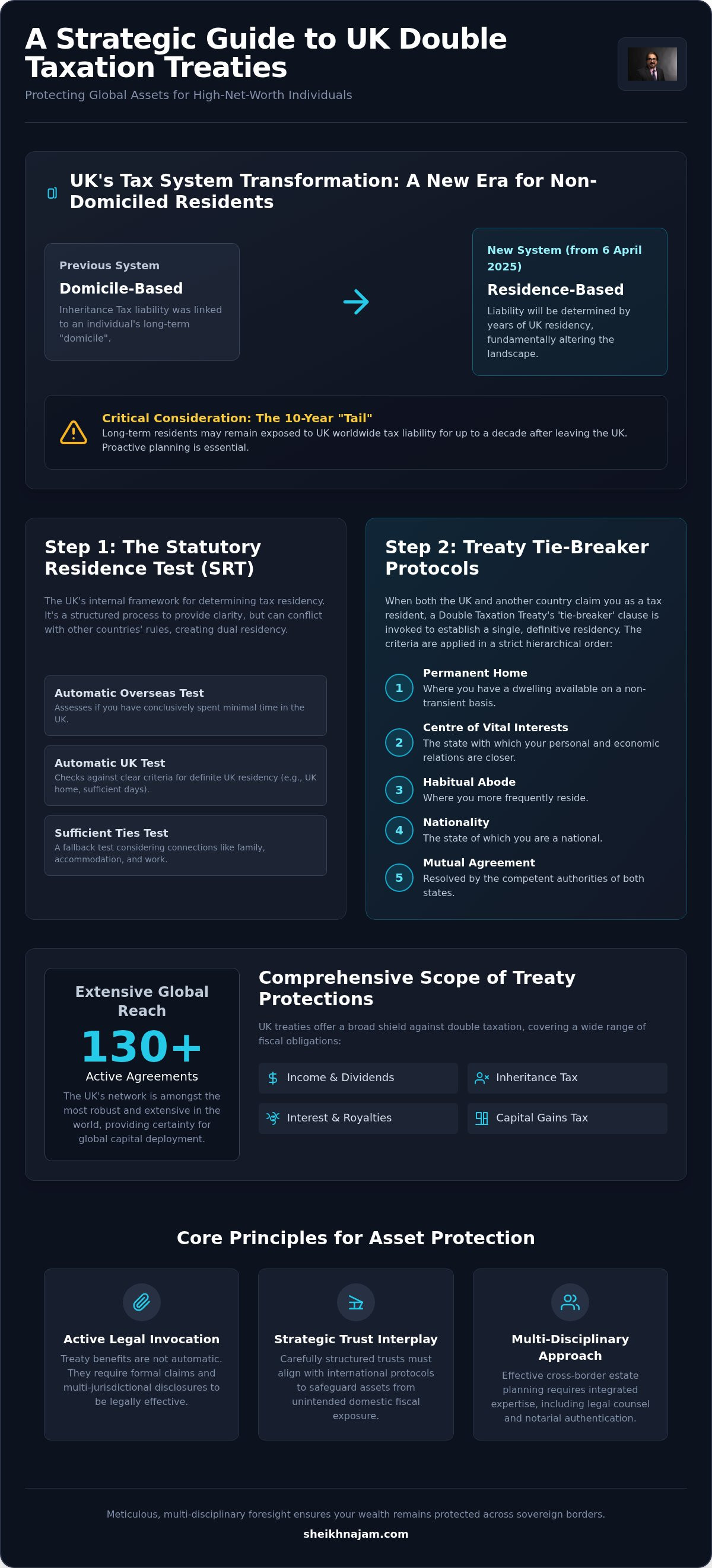
The global mobility of capital, whilst a hallmark of the modern high-net-worth individual, frequently exposes the uninitiated to the punitive reality of unintended dual taxation across disparate sovereign borders. In this environment, the sophisticated application of double taxation treaties London serves as an indispensable instrument of fiscal architecture, especially as the United Kingdom pivots towards a residence-based inheritance tax system that fundamentally alters the landscape for non-domiciled residents. You're likely aware that the transition to a residency-based framework, effective since 6 April 2025, necessitates a rigorous reassessment of your international exposure to ensure capital preservation.
This strategic analysis promises a comprehensive examination of how these international fiscal protocols safeguard your global assets and provide clarity amidst the intricacies of the Statutory Residence Test. We'll evaluate the interaction between treaty relief and complex trust structures; we will also delineate the methods to mitigate the "tail" of worldwide tax liability that now follows long-term residents for up to a decade after departure. By aligning your global interests with the precise requirements of UK law, you can ensure that your wealth remains protected through meticulous, multi-disciplinary foresight and academic precision.
Table of Contents
The Architecture of International Fiscal Cooperation: Double Taxation Treaties in London
Determining Fiscal Domicile: The Statutory Residence Test and Treaty Tie-Breaker Protocols
Navigating Complexities: Common Misconceptions and the Risk of Dual Exposure
Wealth Preservation for the Global Citizen: Treaties, Trusts, and the Non-Domiciled Individual
Strategic Implementation: Integrating Treaty Protections into Cross-Border Estate Planning
The Architecture of International Fiscal Cooperation: Double Taxation Treaties in London
London remains the preeminent global nexus for the structured management of international wealth, a status underpinned by the world's most extensive network of international tax agreements. A Double Taxation Treaty is a formal agreement between two sovereign states to prevent the same income or gains from being taxed twice. These instruments are not merely administrative protocols; they represent a sophisticated architecture of fiscal cooperation designed to mitigate the friction of dual taxation. By providing a clear hierarchy of taxing rights, double taxation treaties London offer the certainty required by high-net-worth individuals to deploy capital across borders. Whilst many jurisdictions rely on the standard OECD Model Tax Convention, the UK's bilateral approach often incorporates bespoke nuances that reflect its historical standing as a global financial centre.
The Scope of Treaty Protections in the United Kingdom
Treaty protections in the UK extend far beyond simple income mitigation. They encompass a broad spectrum of fiscal obligations including dividends, interest, and royalties, alongside Capital Gains Tax and, increasingly, the complexities of Inheritance Tax. With the UK's transition to a residence-based Inheritance Tax system on 6 April 2025, the role of treaties in determining the "tail" of liability for departing residents has become paramount. For corporate entities and family offices, the concept of 'Permanent Establishment' remains a critical threshold. It dictates whether a business presence in London triggers a domestic tax liability or remains protected under treaty logic. This distinction is vital for those managing global assets through UK-based vehicles.
Historical Context and the Evolution of the UK Treaty Network
The evolution of the UK's treaty network is deeply rooted in its colonial and post-colonial history, resulting in a landscape of approximately 130 active agreements. This network has been recently modernised by the Multilateral Instrument (MLI), which allows for the rapid implementation of base erosion and profit shifting measures without the need for individual bilateral renegotiation. This layered approach ensures that London provides a secure environment for treaty-protected investment, where the traditional weight of established law meets the sharp focus of modern regulatory compliance. High-net-worth individuals frequently choose London because its treaty network is amongst the most robust in the world. It's a system built on centuries of legal tradition, yet it remains agile enough to address contemporary challenges in international tax planning.
Determining Fiscal Domicile: The Statutory Residence Test and Treaty Tie-Breaker Protocols
The Statutory Residence Test (SRT) serves as the definitive legislative framework for determining an individual's tax residency status within the United Kingdom. It's a structured mechanism that categorises taxpayers through Automatic Overseas, Automatic UK, and Sufficient Ties tests. Whilst the SRT provides internal clarity, it often conflicts with the domestic laws of other sovereign states, leading to the precarious state of dual residency. In such complex instances, the double taxation treaties London provides for a 'tie-breaker' clause to resolve these jurisdictional overlaps. Tie-breaker rules prioritise 'permanent home' and 'centre of vital interests' over simple day-counting.
The Hierarchy of Tie-Breaker Criteria
The hierarchy of these criteria is meticulously ordered to ensure legal certainty. Firstly, the 'Permanent Home' test scrutinises where an individual maintains a dwelling available for their use on a non-transient basis. If a home is available in both states, the analysis shifts to the 'Centre of Vital Interests', an evaluative process that weighs personal and economic relations, such as the location of family, social ties, and primary business activities. Secondary and tertiary determinants, such as 'Habitual Abode' and 'Nationality', are only invoked when the primary tests prove inconclusive. This rigorous sequence is detailed within the UK's double taxation treaties to ensure that fiscal liability is assigned with absolute precision.
Practical Implications for Dual Residents in London
For dual residents, the risk of being deemed resident in two jurisdictions simultaneously can lead to catastrophic fiscal exposure. Mitigation requires more than just administrative filing; it demands the strategic authentication of residency evidence. Notarial Services play a vital role here, as a Scrivener Notary can formally certify documents that substantiate a foreign 'permanent home' or economic nexus. This level of meticulousness is a cornerstone of the International Tax Planning for London Business Owners framework. The interaction between the SRT and double taxation treaties London demands a sophisticated understanding of both domestic law and international protocols. If you require assistance in navigating these intricate protocols, consider seeking expert International Tax Planning to align your global assets with UK requirements.
Navigating Complexities: Common Misconceptions and the Risk of Dual Exposure
A prevalent fallacy amongst international taxpayers is the assumption of automaticity regarding treaty benefits. In reality, the protections afforded by double taxation treaties London mandate proactive invocation through formal claims and rigorous disclosure protocols. Filing a tax return in a foreign jurisdiction doesn't discharge one's obligations to HMRC; instead, it merely establishes the evidentiary basis for relief. One must distinguish between the 'exemption method', where specific income is entirely excluded from the domestic tax base, and the 'credit method', which allows foreign tax paid to be offset against UK liability. A treaty only reduces the rate of tax or provides a credit; it does not necessarily eliminate the filing requirement. For a comprehensive introduction to double tax treaties, one must appreciate that these instruments are defensive shields that require active, precise deployment rather than passive reliance.
The Pitfalls of Informal Tax Planning
The danger of relying on outdated treaty versions or superseded protocols cannot be overstated, particularly as the UK transitions away from the remittance basis towards the new four-year Foreign Income and Gains (FIG) regime effective from April 2025. Failure to meticulously document the provenance of funds can lead to intrusive HMRC investigations and punitive back-tax assessments. Engaging a sophisticated private client solicitor London ensures that your compliance strategy remains aligned with the most current legislative iterations. Meticulous record-keeping is the only safeguard against the presumption of non-compliance in an era of increased transparency.
Financial Crime and AML Implications of Cross-Border Transfers
For the global citizen resident in the capital, the confluence of non-domiciled status and complex trust governance necessitates a sophisticated reliance on double taxation treaties London. Whilst the long-standing remittance basis was superseded on 6 April 2025 by the four-year Foreign Income and Gains (FIG) regime, the strategic relevance of international protocols remains undiminished for the preservation of multi-jurisdictional capital. These treaties provide a critical buffer against UK 'look-through' provisions, which otherwise seek to attribute offshore trust income directly to a London-resident settlor. As individuals approach the ten-year threshold of the new residence-based inheritance tax system, the interaction between domestic 'long-term resident' logic and treaty-based 'situs' rules becomes the primary theatre for wealth preservation. Integrating these protections into international wills in London is imperative to ensure that succession occurs without the friction of dual-jurisdictional tax claims.
Trust Structuring and Treaty Benefits
Establishing the fiscal 'residence' of a trust for treaty purposes is a task of extreme technicality, typically determined by the residency of the trustees and the location of effective management. Strategic planning must account for 'settlor-interested' trust regulations, where HMRC may disregard the trust's legal personality unless treaty protections are explicitly and formally invoked. By utilising these protocols, it's possible to mitigate Inheritance Tax (IHT) on non-UK situated assets, even for those who have fallen within the scope of the UK's worldwide tax net due to the ten-year residency rule. This meticulous approach ensures that the trust remains a robust vehicle for intergenerational wealth transfer, shielded from the volatility of shifting domestic tax regimes.
Succession Planning and Contentious Probate Risks
The intersection of tax treaty status and testamentary validity frequently defines the landscape of cross-border estate disputes. A failure to align treaty-based residency claims with the declarations made in a will can provide fertile ground for litigation, particularly where forced heirship rules or competing jurisdictional claims arise. Expertise in high-value contentious probate in London is essential for defending estates where treaty protections are challenged by disgruntled beneficiaries or inquisitive revenue authorities. International estate administration must move beyond mere probate; it must encompass a multi-disciplinary defence of the decedent's fiscal legacy across all relevant borders. If you require a meticulous review of your trust structures or international succession strategy, please contact me for International Tax Planning and Estate Advisory services.
Strategic Implementation: Integrating Treaty Protections into Cross-Border Estate Planning
The successful implementation of an international fiscal strategy requires a profound synthesis of disparate professional disciplines. Relying solely on tax advice without the supporting legal and notarial architecture leaves an estate vulnerable to jurisdictional challenge. In the context of double taxation treaties London, the practitioner must act as a master architect, ensuring every pillar of the global structure is aligned with both domestic statutes and international protocols. Meticulous documentation is the cornerstone of successful treaty-based tax mitigation. Without it, the most sophisticated treaty claims can fail under the weight of an HMRC enquiry or a foreign audit, especially as global transparency standards reach unprecedented levels of scrutiny and multi-lateral cooperation.
The Role of Notarial Services in International Tax Compliance
Authentication serves as the essential bridge between sovereign legal systems. When invoking treaty benefits, foreign tax authorities often demand certified evidence of UK residency or the legal standing of trust vehicles. This is where professional notarial services in London become indispensable. A Scrivener Notary provides the high-level authentication required for these documents to be recognised abroad, navigating the complexities of the apostille and legalisation process with absolute precision. It's not merely about a signature; it's about providing the evidentiary weight that compels foreign jurisdictions to respect the treaty-protected status of your assets. This meticulousness ensures that claims for relief on dividends, interest, or royalties aren't rejected on purely formalistic grounds by overseas revenue departments.
Securing Your Legacy Through Meticulous Advisory
Commanding the intricate nexus of international fiscal protocols requires more than mere administrative compliance; it demands the strategic deployment of double taxation treaties London to ensure the absolute preservation of global capital. Treaty relief isn't automatic. We've established that the transition to a residence-based inheritance tax regime necessitates a rigorous application of tie-breaker clauses and the meticulous authentication of residency status through notarial practice. By integrating treaty protections into your international wills and trust structures, you mitigate the risk of punitive dual exposure whilst securing a seamless intergenerational legacy. This multi-disciplinary approach provides the necessary command over complex cross-border legal landscapes.
As a specialist sole practitioner and public officer appointed by The Court of Faculties, I operate from the City of London to provide elite multi-disciplinary expertise in high-value cross-border estate administration. You can secure your global interests with expert international tax and notarial advisory from Sheikh Najam TEP. Entrusting your affairs to a master advisor ensures that every nuance of international law is leveraged for your strategic advantage. It's time to align your global assets with UK law with absolute precision.
Frequently Asked Questions
Is double taxation relief applied automatically by HMRC for London residents?
Relief is not granted automatically; rather, it necessitates a proactive claim via a self-assessment tax return or specific treaty relief forms. Taxpayers must explicitly invoke the relevant articles of the double taxation treaties London to mitigate dual exposure. Failure to formally request relief may result in the full domestic rate being applied by HMRC, regardless of the treaty's existence. This administrative burden underscores the necessity of meticulous record-keeping and professional oversight to ensure total compliance.
Can I choose which country's tax treaty is more favourable for my income?
You cannot arbitrarily select a treaty; eligibility is strictly governed by the specific bilateral agreement between the UK and the jurisdiction where the income arises or where you're resident. The protocols within double taxation treaties London are designed to resolve conflicts of law through established tie-breaker rules. Whilst strategic structuring can influence which treaties apply, the choice is ultimately a matter of legal fact determined by your fiscal domicile and the location of your global assets.
How does the Statutory Residence Test affect my ability to claim treaty relief?
The Statutory Residence Test (SRT) serves as the primary mechanism for establishing whether you're a UK resident for tax purposes. Since most treaty benefits are only available to residents of one or both contracting states, your SRT status is the fundamental prerequisite for any claim. If the SRT deems you a UK resident, you can then utilise treaty tie-breaker clauses to resolve dual residency disputes and secure relief on international income streams through formal disclosure to HMRC.
What happens if there is no double taxation treaty between the UK and my home country?
In the absence of a formal treaty, you may still be eligible for unilateral relief under UK domestic law. This allows you to credit foreign tax paid against your UK tax liability on the same income, preventing total dual taxation. However, unilateral relief is often less comprehensive than treaty-based protections and doesn't offer the certainty of tie-breaker protocols. This situation significantly increases the complexity of managing global assets and necessitates the engagement of rigorous, multi-disciplinary advisory.
Do double taxation treaties cover UK Inheritance Tax for non-doms?
Whilst the majority of treaties focus on income and capital gains, the UK maintains a separate network of specific estate and inheritance tax treaties. These agreements are vital for non-domiciled individuals, particularly as the UK transitions to a residence-based inheritance tax system. These protocols determine the 'situs' of assets and assign taxing rights to a single jurisdiction, providing a critical safeguard against the 40% domestic rate on worldwide estates for those with international interests.
Can a trust benefit from double taxation treaty protections?
A trust can indeed benefit from treaty protections, provided it's classified as a person or a resident for the purposes of the specific agreement. This determination often hinges on the residency of the trustees and the location of the trust's effective management. Navigating these requirements is essential to prevent look-through provisions from attributing offshore income to UK-resident settlors, ensuring that the trust remains a robust and compliant vehicle for high-value international wealth preservation.
How do I prove my tax residency to a foreign jurisdiction whilst living in London?
Proving residency requires obtaining a formal Certificate of Residence (CoR) from HMRC, which confirms your status under the relevant treaty. For high-value international affairs, this document often requires notarial authentication and legalisation to be accepted by foreign revenue authorities. This process ensures that your claim for reduced withholding rates or tax exemptions is recognised abroad, facilitating the seamless transfer of capital across sovereign borders without the risk of unintended fiscal friction or regulatory delay.
What is the difference between the 'Credit Method' and the 'Exemption Method' in tax treaties?
The Credit Method allows you to offset tax paid in a foreign jurisdiction against your UK liability, ensuring you pay the higher of the two rates. Conversely, the Exemption Method completely removes the relevant income from the tax base of one jurisdiction. Most UK treaties utilise the credit method, though specific exemptions may apply to certain income types. Understanding this distinction is vital for accurately calculating your global tax exposure and ensuring strategic alignment with UK law.


Comments