Expert Guide to International Trusts for London Clients

Updated: Aug 26
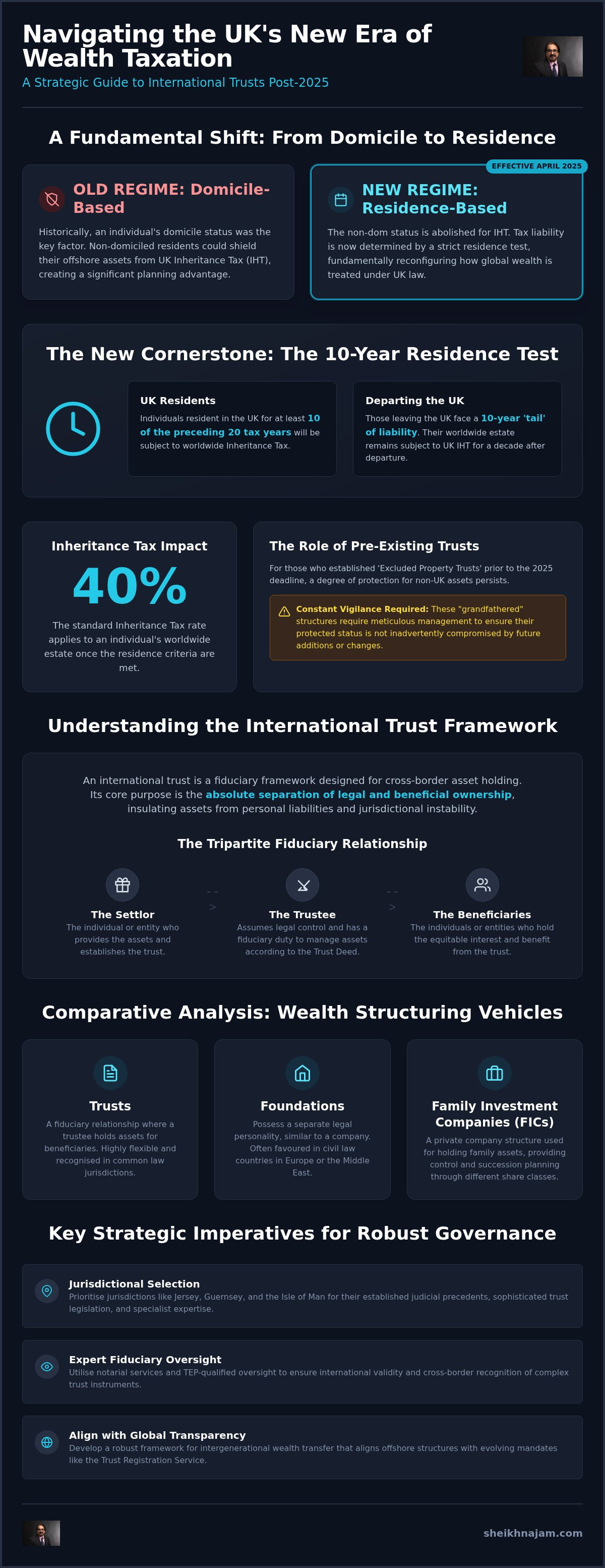
The abolition of the non-domiciled status is not merely a fiscal adjustment; it is a fundamental reconfiguration of how global wealth must be anchored within the British legal framework. For the sophisticated London client, the historical reliance on domicile as a shield against the 40% inheritance tax rate has been replaced by a rigorous ten-year residence test, necessitating a profound reappraisal of international trusts. It's understandable that you feel a sense of profound uncertainty as the 6 April 2026 thresholds for Agricultural and Business Property Reliefs approach, alongside the expanding reach of the Trust Registration Service.
This guide provides a definitive examination of how to navigate this volatile legal landscape, ensuring your fiduciary arrangements remain both compliant and strategically robust. We shall analyse the transition to residence-based liability, the integration of international wills, and the meticulous governance required to preserve intergenerational prosperity amidst global transparency mandates.
Table of Contents
The Evolving Paradigm of International Trusts in 2026
In the rigorous sphere of high-net-worth advisory, the definition of international trusts must be precisely distinguished from the charitable conservation of historic estates. These are, in essence, bespoke fiduciary frameworks designed to manage the complexities of cross-border asset holding and the preservation of multi-generational capital. The core objective of such a structure is the absolute separation of legal and beneficial ownership. This creates a robust layer of protection that insulates assets from personal liabilities and jurisdictional instability. Despite the prevailing shift towards global transparency and the increased reporting mandates of the Trust Registration Service, the trust remains the pre-eminent vehicle for those seeking to maintain a coherent governance structure across disparate legal systems.
The international recognition of these private arrangements is largely predicated upon the Hague Convention on the Law Applicable to Trusts, a treaty that ensures the legal validity of a trust is respected even in jurisdictions where the concept may not be natively embedded in local law. It's this treaty that allows a trust established in a common law jurisdiction to be recognised for probate or tax purposes in a civil law country, provided the structure meets specific criteria of validity and intent.
The Fiduciary Relationship: Settlor, Trustee, and Beneficiary
A trust’s integrity rests upon the tripartite relationship between the settlor, who provides the assets; the trustee, who assumes legal control; and the beneficiaries, who hold the equitable interest. Trustees are subject to a high standard of care, often codified as a duty to act with the prudence of a 'reasonable person' whilst adhering strictly to the terms of the Trust Deed. In the context of discretionary trusts, where the trustee has the power to determine the timing and amount of distributions, the rights of beneficiaries are primarily focused on the right to information and the ability to challenge a breach of fiduciary duty through the courts. The settlor's intent must be clearly documented to avoid the structure being set aside as a 'sham' or an 'alter ego' of the individual.
Jurisdictional Selection: Beyond 'Offshore' Labels
The choice of jurisdiction has evolved beyond a simple search for low-tax environments. Elite practitioners now prioritise jurisdictions like Jersey, Guernsey, and the Isle of Man for their established judicial precedents, sophisticated trust legislation, and the presence of a specialist bar. The UK's 2025 reforms, which moved the tax system towards a residence-based model, have forced a re-evaluation of how offshore status interacts with UK tax liability. For many London clients, the stability of a common law trust must be weighed against the benefits of civil law foundations. These foundations offer a separate legal personality that can be advantageous in certain European or Middle Eastern contexts where the trust concept isn't traditionally recognised.
The Residence-Based Regime: A New Era for UK-Connected Trusts
The legislative shift effective from April 2025 has fundamentally dismantled the historical advantages of the non-domicile regime, replacing it with a stringent residence-based framework that leaves little room for ambiguity. Under these revised protocols, any individual who has been a UK resident for at least 10 of the preceding 20 tax years falls within the scope of worldwide inheritance tax, regardless of their long-term intentions or ancestral ties. This 10-year rule represents a seismic change for high-net-worth families who previously relied on domicile status to shield offshore capital. For those who established 'Excluded Property Trusts' prior to the 2025 deadline, a degree of protection persists, yet these structures now require constant vigilance to maintain their grandfathered status. Individuals departing the UK in 2026 must also contend with a 10-year 'tail' of liability, where their worldwide estate remains subject to the 40% IHT rate despite their physical absence from the country.
Inheritance Tax Mitigation in a Residence-Based World
Within this rigorous environment, international trusts remain a cornerstone for the strategic segregation of non-UK assets. Success depends on adhering strictly to UK government guidance on non-resident trusts to ensure that 'Excluded Property' status isn't inadvertently compromised. Trustees are now burdened with enhanced 2026 reporting requirements, necessitated by the move towards a residence-based model for all settlors who meet the 10-year residency test. The 20% entry charge and periodic 6% charges continue to apply to UK-situs assets, making the jurisdictional location of trust property more critical than ever. For those seeking to audit their existing structures against these residence-based thresholds, engaging in specialised international tax planning is a prudent step.
The Interaction with International Wills
Fiduciary governance is incomplete if divorced from testamentary intent. It's vital that the provisions of a trust deed are meticulously synchronised with international wills London. Conflicting instructions between a trust's letter of wishes and a formal will can precipitate protracted litigation in the Chancery Division. As a Notary Public, I've observed that the authentication of cross-border estate documents is the final, essential safeguard against jurisdictional rejection. The Notary ensures that the execution of these documents meets the formal requirements of both the UK and the trust's home jurisdiction, preventing the administrative paralysis that often follows a death in a multi-jurisdictional family.
Comparative Analysis: Trusts vs Foundations and FICs
The structural choice for wealth preservation is frequently a choice between the historic flexibility of international trusts and the rigid, distinct juridical persona of a foundation. Unlike a trust, which is a fiduciary relationship lacking independent legal standing, a foundation exists as a separate legal entity, a distinction that fundamentally alters the landscape of liability and asset ownership. The Law Commission's review of trust law highlights the ongoing dialogue surrounding the modernisation of these traditional frameworks, ensuring they remain robust against the shifting tides of global regulation. For the sophisticated client, the decision often hinges on the 'control versus protection' trade-off. Trusts generally require a more complete divestment of control to ensure the integrity of the asset protection, whereas other vehicles might permit a more direct hand in management, albeit with different tax implications.
Asset suitability also dictates the structural choice. While trusts remain the gold standard for traditional portfolios and real estate, digital asset structuring often benefits from the corporate governance models found in companies or foundations. These entities can more easily interface with digital exchanges and custodians, providing a clear chain of title that can be more complex to establish within a purely fiduciary arrangement. It's a strategic calculation where the nature of the underlying capital must dictate the architecture of the holding vehicle.
Foundations: The Civil Law Alternative
Foundations are particularly favoured by families from civil law backgrounds, such as those with ties to the UAE or Liechtenstein, where the concept of 'split title' isn't natively recognised. In 2026, the UK tax treatment of these foreign entities remains complex, as HMRC may look through the structure to treat it as a settlement or a company depending on the specific drafting of the charter and regulations. It's a nuanced area where the lack of a trustee can simplify administration but complicates the application of double tax treaties. The foundation's ability to hold assets in its own name provides a level of comfort to those who find the common law trust's reliance on a third-party trustee to be an unacceptable relinquishment of oversight.
Family Investment Companies (FICs) in the UK Landscape
A Family Investment Company (FIC) operates as a bespoke private limited company, typically structured with multiple share classes, often referred to as 'Alphabet shares', to separate voting control from the right to receive dividends or capital growth. This allows parents to retain management control whilst shifting the future value of the estate to the next generation, effectively mitigating inheritance tax over the long term. From a fiscal perspective, the 25% corporation tax rate on profits often proves more palatable than the 45% income tax rate applied to discretionary trusts, provided the capital remains within the company for reinvestment. FICs are particularly effective for UK-resident families who require a transparent, corporate governance structure that's easily understood by domestic financial institutions.
Contentious Trusts: Navigating Fiduciary Disputes and Litigation
The genesis of litigation regarding international trusts often lies in a perceived erosion of the fiduciary bond, particularly where an absence of transparency fosters suspicion amongst the beneficial class. Within the Chancery Division of the High Court, the removal of a trustee represents an exercise of the court’s inherent supervisory jurisdiction. It's a remedy typically reserved for instances where the safety of the trust capital or the welfare of the beneficiaries is demonstrably imperilled. Such proceedings are intellectually and procedurally rigorous. The court must distinguish between mere friction and a fundamental breakdown in administration. Where these structures are linked to the estate of a deceased person, the nuances of contentious probate London come to the fore, requiring a multi-disciplinary approach to resolve conflicting claims over testamentary validity and trust funding.
To mitigate the reputational and financial costs of public litigation, high-value trust conflicts are increasingly channelled through mediation or arbitration. These private avenues allow for a sophisticated resolution that respects the confidentiality of the family’s private affairs, which is often the primary objective when establishing international trusts. Unlike the binary outcomes of a trial, these mechanisms provide the flexibility to restructure a trust in a manner that addresses the underlying causes of the dispute.
Breach of Fiduciary Duty and Trustee Liability
Professional trustees are subject to an exacting standard of care that reflects their specialised status in the 2026 legal market. Beneficiaries possess powerful equitable remedies, including the ability to trace assets misapplied by a trustee or to seek personal restitution for losses occasioned by a breach of duty. Contemporary judicial trends suggest a narrowing of the protection afforded by exculpation clauses. Courts are increasingly reluctant to permit such provisions to shield trustees from the consequences of gross negligence or wilful default. If you require a forensic examination of fiduciary conduct, it's essential to instruct Sheikh Najam TEP for the professional resolution of trust disputes.
Information Requests and Beneficiary Rights
The entitlement of a beneficiary to inspect trust accounts is not a proprietary right but a function of the court’s power to ensure the trust is properly administered. This principle, articulated in the 'Schmidt v Rosewood' decision, grants the court discretion to order disclosure even when the trust deed seeks to limit such transparency. Trustees often find themselves in a precarious position when navigating the 'Schmidt v Rosewood' framework. They must manage the competing interests of diverse beneficiary groups who may have conflicting views on investment strategy or capital distribution. Handling these requests requires a meticulous balance between the duty of accountability and the settlor's desire for confidentiality.
The Strategic Necessity of Expert Fiduciary Oversight
The role of the Trust and Estate Practitioner (TEP) has evolved into that of a guardian over the structural integrity of wealth, particularly as the transition to residence-based taxation complicates the administration of international trusts. In the current regulatory climate, the TEP provides the requisite multi-disciplinary oversight to ensure that fiduciary arrangements remain compliant with both UK mandates and the reporting requirements of foreign jurisdictions. Regular 'trust health checks' are no longer optional; they're a vital mechanism for adapting to legislative shifts, such as the 2026 thresholds for inheritance tax reliefs and the expanding scope of the Trust Registration Service. This continuous stewardship ensures that the separation of legal and beneficial ownership remains robust, protecting the capital from the risks of jurisdictional drift or administrative obsolescence.
Notarial Authentication for International Trust Validity
The legal efficacy of a trust instrument frequently terminates at the border if it hasn't been subjected to formal authentication. Foreign jurisdictions, particularly those within civil law systems, often require trust deeds and letters of wishes to be notarised and apostilled before they'll recognise the authority of a trustee or the capacity of a settlor. Through professional notarial services, I provide the strategic verification necessary to ensure these documents are accepted by international registries and financial institutions. The Notary’s role is to verify the identity and authority of the parties, mitigating the risk that a cross-border transaction is stalled or invalidated due to a lack of formal proof. Relying on unauthenticated documents in a multi-jurisdictional context is a precarious strategy that can lead to the total failure of an estate plan during a critical period of transition.
Modernising the Trust: Digital Assets and Compliance
Modern fiduciary stewardship must now encompass the unique challenges posed by digital asset structuring, including the settlement of crypto-assets and NFTs into established frameworks. These assets require a nuanced approach to custody and valuation, whilst necessitating a high degree of technical competence to ensure they're correctly characterised for tax purposes. Fiduciaries are also burdened with the necessity of maintaining robust Anti-Money Laundering (AML) and Know Your Customer (KYC) procedures that satisfy the increasingly stringent demands of global transparency registers. It's a complex intersection of private law and financial regulation where the advice of a 'Strategic Polymath' becomes indispensable. To ensure your fiduciary structures are prepared for the digital age, you're invited to secure your legacy with a bespoke consultation on international trust structuring.
Securing Fiduciary Integrity in an Era of Global Fiscal Transition
The transition from domicile-based protections to the rigorous ten-year residence regime demands a fundamental reappraisal of how wealth is anchored. As established, the efficacy of international trusts in 2026 is no longer a matter of simple offshore placement; it's a sophisticated exercise in multi-jurisdictional compliance and meticulous fiduciary governance. Whether you're navigating the complexities of the Trust Registration Service or synchronising your estate with international wills, the requirement for precise, scholar-practitioner oversight has never been more acute.
The intersection of private law, tax planning, and digital asset structuring requires a master advisor who can command both the creation and the litigation of these structures. As a TEP qualified practitioner, a specialist in high-value contentious probate, and a London-based Notary Public, I provide the authoritative leadership necessary to safeguard your global interests against the shifting currents of UK and international regulation. Instruct Sheikh Najam TEP for Expert International Trust Advisory to ensure your legacy remains resilient, compliant, and perfectly aligned with your long-term strategic objectives. It's the definitive way to provide your family the security of absolute precision.
Frequently Asked Questions
What is the primary difference between a domestic and an international trust?
The primary distinction lies in the governing law and the physical location of the trust's administration. A domestic trust is established under the laws of the settlor's home country, such as England and Wales. Conversely, an international trust is governed by the laws of a foreign jurisdiction, such as Jersey or the British Virgin Islands. This choice is often made to access specific legal protections or fiscal advantages unavailable domestically.
How has the 2025 UK tax reform affected international trusts for non-doms?
The reform has effectively abolished the remittance basis and replaced it with a regime predicated on residence. From 6 April 2025, the historic 'Excluded Property' status for trusts created by non-doms is under intense scrutiny. Settlors who've been UK resident for 10 of the last 20 years are now subject to UK inheritance tax on their worldwide assets. This fundamentally alters the traditional utility of these structures for long-term UK residents.
Can an international trust protect assets from a contentious probate claim?
Yes, by removing assets from the settlor's personal estate during their lifetime. Because the legal title is held by the trustee, the assets don't form part of the probate estate upon the settlor's death. However, these structures can still be challenged in the Chancery Division if it's argued the trust was a 'sham'. It's vital that the trust is managed with genuine fiduciary independence to withstand such claims in a litigation context.
Why is a Notary Public required for international trust documentation?
Foreign registries and financial institutions require independent verification of the document's authenticity and the parties' legal capacity. A Notary Public provides a formal seal and certificate that's recognised globally, often supplemented by an apostille. Without this notarial authentication, trust deeds or powers of attorney may be rejected by overseas authorities. This causes significant administrative delays or the total failure of the structure in complex cross-border contexts.
Are international trusts still legal under global transparency and AML regulations?
They remain entirely legal provided they adhere to modern reporting standards such as the Common Reporting Standard and the UK's Trust Registration Service. The era of 'secret' offshore accounts has ended. Today, international trusts operate within a framework of mandatory disclosure. Compliance with Anti-Money Laundering and Know Your Customer protocols is a prerequisite for any legitimate fiduciary arrangement. It's about strategic transparency rather than concealment.
What are the common grounds for removing a trustee of an international trust?
The most frequent grounds include a fundamental breach of fiduciary duty, such as the misapplication of trust capital or a persistent failure to provide accounts. Other triggers include a conflict of interest that prejudices the beneficiaries or a total breakdown in the relationship between the trustee and the beneficial class. The court exercises its supervisory jurisdiction to ensure the trust's purpose isn't frustrated by incompetent or dishonest administration.
How do I choose the best jurisdiction for an international trust in 2026?
Selection should prioritise judicial stability, the depth of local trust legislation, and the quality of the professional infrastructure. Jurisdictions like Jersey and Guernsey are often preferred for their sophisticated common law precedents and robust court systems. You must also consider the jurisdiction's reputation regarding international transparency and its tax treaty network with the UK. This ensures the structure remains compliant whilst avoiding the pitfalls of unintended double taxation.
Can digital assets be held within a traditional trust structure?
They can, though they require bespoke drafting within the Trust Deed to account for their unique nature. Digital assets, including crypto-currency and NFTs, must be clearly defined to ensure the trustee has the legal power to manage and secure them. This often involves integrating specific digital custody protocols and ensuring the trust's tax strategy accounts for the volatile valuation and specific reporting requirements of such assets in a residence-based world.


Comments