High Net Worth Estate Planning in London: A Strategic Advisory Framework (2026)

Updated: Aug 26
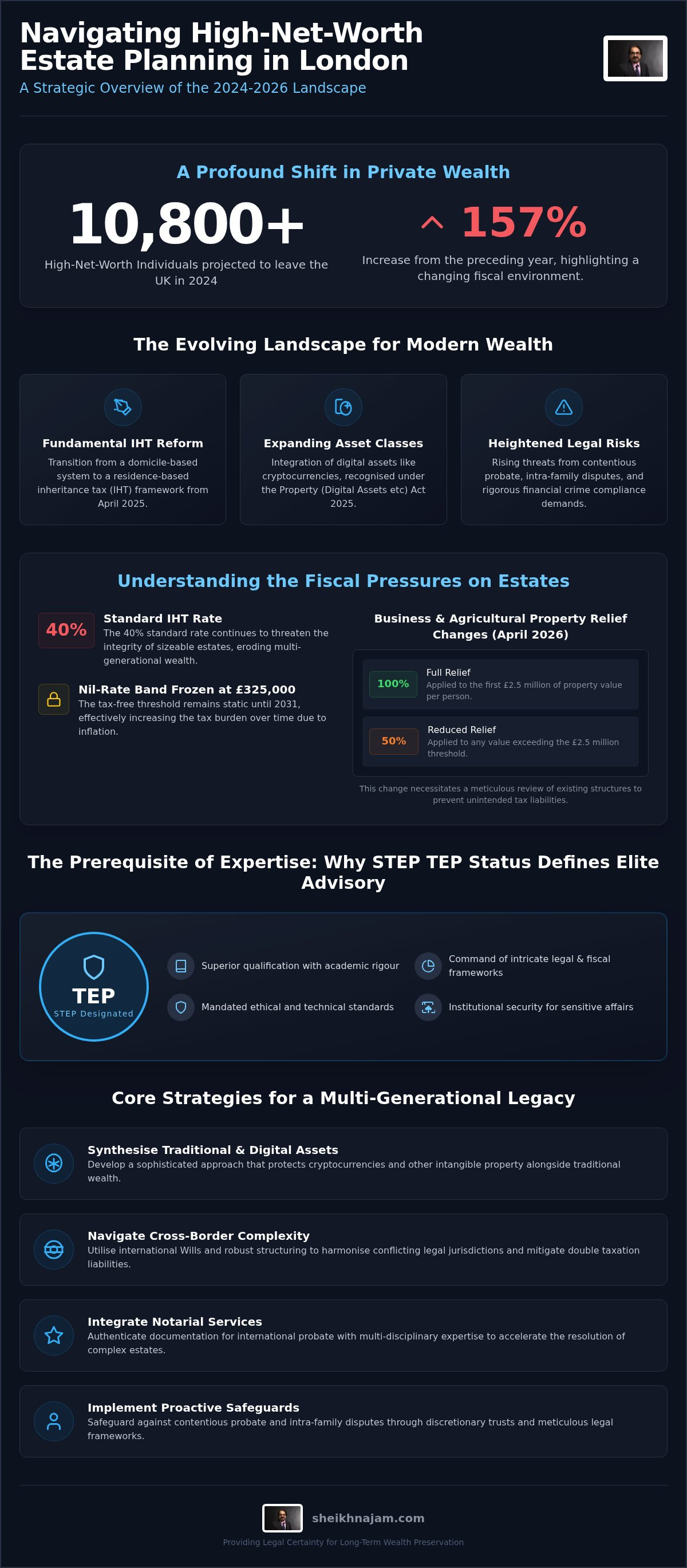
The exodus of over 10,800 high-net-worth individuals from British shores in 2024, a figure representing a 157% increase from the preceding year, underscores a profound shift in the fiscal and regulatory environment governing private wealth. You likely recognise that the transition from a domicile-based to a residence-based inheritance tax system has fundamentally altered the calculus of wealth preservation for those with significant international interests and complex family structures. This framework provides a rigorous analysis of high net worth estate planning London, ensuring that your global assets, including the burgeoning category of digital property recognised under the Property (Digital Assets etc) Act 2025, remain protected against excessive fiscal erosion and legal volatility.
We shall examine the sophisticated synthesis of international trust structures, notarial precision, and the strategic mitigation of contentious probate to secure a definitive, multi-generational legacy within the City’s complex legal landscape. By integrating multi-disciplinary legal expertise with meticulous tax structuring, this advisory framework addresses the modern challenges of crypto-assets and cross-border succession with absolute precision, providing the legal certainty required for long-term wealth preservation.
Table of Contents
The Landscape of High Net Worth Estate Planning in the City of London
The Prerequisite of Expertise: Why STEP TEP Status Defines Elite Advisory
Beyond the Will: Integrated Structuring of Trusts and Digital Assets
Navigating Cross-Border Complexity and Contentious Probate Risks
Strategic Succession: Professional Legal and Notarial Integration
The Landscape of High Net Worth Estate Planning in the City of London
Estate planning for the ultra-high-net-worth individual in 2026 is no longer a peripheral administrative task; it's a core strategic imperative that demands a departure from traditional, static methodologies. The City of London maintains its status as a preeminent global centre for wealth preservation, yet the legal environment has become increasingly sophisticated. Static Will-writing is insufficient for portfolios that span multiple jurisdictions and asset classes. Effective high net worth estate planning London requires a multi-disciplinary approach that anticipates regulatory shifts and international tax treaties with academic rigour. The institutional weight of the City provides the necessary infrastructure for these complex arrangements, but the practitioner must possess the foresight to manage assets that are as fluid as the global markets themselves.
The Complexity of Modern Wealth Structures
Modern wealth is rarely static or geographically confined. It exists as a complex interplay between domestic real estate, international private equity, and offshore trust interests. The legislative transition in April 2025 from a domicile-based system to a residence-based inheritance tax regime has created significant exposure for long-term UK residents. Under current UK Inheritance Tax regulations, the nil-rate band remains frozen at £325,000 until 2031, whilst the 40% standard rate continues to threaten the integrity of sizeable estates. The primary risks to wealth erosion are no longer limited to taxation; they encompass the escalating threat of contentious probate and the rigorous demands of financial crime compliance. A strategic framework must account for these variables, ensuring that domestic property and international investments are harmonised within a singular, robust structure.
Strategic Objectives: Preservation, Succession, and Compliance
The primary objective of an elite framework is to balance immediate liquidity with the demands of multi-generational succession. This requires the involvement of a private client solicitor London who understands the granular details of business property relief. As of April 2026, 100% relief for business and agricultural property is capped at £2.5 million per person, with any value above this threshold receiving only 50% relief. This change necessitates a meticulous review of existing structures to prevent unintended tax liabilities. Beyond tax mitigation, practitioners must integrate financial crime and compliance advisory into the estate's structure. This ensures that assets are not only preserved but are also legally robust in an era of heightened transparency. Every decision must be methodical and deliberate, prioritising legal certainty across both domestic and international jurisdictions to prevent future litigation amongst heirs.
The Prerequisite of Expertise: Why STEP TEP Status Defines Elite Advisory
The Society of Trust and Estate Practitioners (STEP) serves as the preeminent global professional body for those specialising in inheritance and succession planning. For individuals engaged in high net worth estate planning London, the distinction between a generalist solicitor and a Trust and Estate Practitioner (TEP) is not merely semantic; it's a fundamental divergence in technical capability. Achieving the TEP designation requires a profound commitment to the STEP Diploma in Trusts and Estates, a programme characterised by its academic intensity and practical depth. This qualification ensures that a practitioner possesses the requisite command over the intricate legal and fiscal frameworks that govern substantial private wealth. The ethical and technical standards mandated by STEP provide a layer of institutional security, reassuring clients that their most sensitive affairs are handled with absolute precision.
The Multi-Disciplinary Advantage of a TEP
A TEP operates at the intersection of tax law, accounting principles, and trust administration, offering a synthesis of expertise that generalists cannot replicate. This multi-disciplinary approach is essential when navigating the 'Private Wealth Diploma' level of complexity, where domestic regulations often collide with international obligations. By maintaining a deep familiarity with official Inheritance Tax guidance, a TEP facilitates smoother interactions with HMRC and foreign tax authorities, anticipating potential challenges before they escalate into disputes. This proactive stance is particularly vital for estates involving multi-jurisdictional assets, where a failure to harmonise legal structures can lead to catastrophic fiscal erosion. When considering the long-term security of a multi-generational legacy, engaging a practitioner with these specific credentials ensures that your affairs are managed with the requisite Trust and Estate Planning expertise.
Identifying an Estate Planning Solicitor in the City of London
Selecting the appropriate advisor in the City of London requires a discerning evaluation of credentials, niche expertise, and geographic focus. Whilst large firms offer a broad spectrum of services, they often suffer from departmentalisation, where the client's affairs are fragmented across various junior associates. In contrast, a sole practitioner or a boutique specialist provides bespoke attention, ensuring that a single, authoritative mind oversees the entire strategic framework. High-net-worth individuals should prioritise practitioners who demonstrate a proven track record in both domestic probate and international succession. The ability to provide a tailored, meticulous service is the hallmark of an elite advisor. The TEP designation serves as the global gold standard for inheritance and succession professionals.
Beyond the Will: Integrated Structuring of Trusts and Digital Assets
A simple testamentary document is fundamentally insufficient for the ultra-high-net-worth individual whose interests span various asset classes and jurisdictions. High net worth estate planning London necessitates the deployment of discretionary and interest-in-possession trusts to facilitate robust asset protection and fiduciary stewardship. These vehicles provide a sophisticated mechanism for managing Inheritance Tax (IHT) liabilities whilst maintaining nuanced control over the distribution of capital. The nil-rate band, currently frozen at £325,000 until April 2031, offers only negligible relief for substantial estates, making the strategic utilisation of trusts a prerequisite for fiscal efficiency and the mitigation of the 40% standard tax rate.
Sophisticated Trust Structures for Wealth Mitigation
Trusts serve as the cornerstone of multi-generational succession, allowing for the preservation of wealth across several layers of descent. By utilising detailed letters of wishes and formal family governance frameworks, a settlor can ensure that their strategic intentions remain respected long after their passing. This is particularly relevant for those requiring international tax planning for business owners London, where assets are frequently held within complex corporate entities and offshore structures. Modern family dynamics, including blended families and dependents residing in diverse legal jurisdictions, require the flexibility and security that only a meticulously drafted trust can provide; for those seeking professional guidance, Northeast Legal Team provides the comprehensive estate planning services required to manage such complex family and financial structures.
The 'digital shadow' cast by modern wealth represents a significant and often overlooked legal frontier. Cryptocurrencies, non-fungible tokens (NFTs), and online intellectual property are no longer peripheral curiosities; they are core components of the contemporary high-net-worth portfolio. The Property (Digital Assets etc) Act 2025 has formally recognised these assets as a distinct category of personal property, yet their intangible and decentralised nature presents unique challenges for executors and personal representatives.
Fiduciary access to digital accounts requires more than just legal authority; it requires technical foresight and precise documentation. Drafting specific digital codicils is essential to manage private key succession and ensure that beneficiaries can actually access the underlying value of the estate. Practitioners must also rigorously address anti-money laundering (AML) regulations during the transfer of these assets to prevent legal complications or the freezing of funds by financial institutions. The strategic importance of digital asset structuring London in 2026 cannot be overstated, as the absence of a clear digital legacy plan often results in the permanent loss of significant wealth. Precision in these technical matters is the hallmark of the master advisor.
Navigating Cross-Border Complexity and Contentious Probate Risks
The administration of an estate comprising multi-jurisdictional assets demands an analytical rigour that transcends domestic legal practice. For individuals engaged in high net worth estate planning London, the primary challenge lies in the reconciliation of conflicting succession laws and the mitigation of double taxation liabilities. International estates are frequently subject to the lex situs, the law of the place where property is situated, for immovable assets, whilst movable property may be governed by the lex domicilii or the law of habitual residence. This dichotomy requires the drafting of international wills London that are meticulously structured to harmonise assets across divergent legal regimes, ensuring that the testator's intentions remain enforceable in every relevant jurisdiction.
International Succession and Conflict of Laws
The impact of the EU Succession Regulation, known as Brussels IV, remains a critical consideration for UK-based high-net-worth individuals, despite the United Kingdom's status as a non-participating third state. By making a formal choice of law in their testamentary documents, individuals can often bypass the restrictive forced heirship rules prevalent in civil law jurisdictions, such as France or Spain. Managing immovable property in these regions necessitates local notarial coordination to ensure that documentation is authenticated and recognised by foreign land registries. The objective is to provide a seamless transition of ownership that avoids the delays and fiscal penalties associated with uncoordinated cross-border administration. This strategic foresight is essential for preserving the integrity of globalised portfolios against external legal interference.
Mitigating Contentious Probate through Strategic Drafting
For those with interests extending to other key markets, such as the Middle East and North America, the Israel Cross Border Law Firm provides essential support in managing the legal intricacies of business and investment between Israel and the United States.
High-value estates are increasingly prone to litigation, with claims of undue influence, lack of testamentary capacity, or 'breach of trust' becoming more prevalent amongst disappointed beneficiaries. The rise in contentious probate London cases underscores the necessity for strategic drafting that anticipates potential disputes before they escalate into costly court proceedings. Rather than focusing solely on the cure of litigation, an elite practitioner prioritises prevention through the use of 'no-contest' clauses and the integration of mediation and arbitration provisions. These mechanisms allow for the discreet resolution of estate disputes, protecting the family's privacy and the estate's capital from the public gaze of the Chancery Division. If you require a robust framework to safeguard your international interests, consider the specialised Probate and Estate Administration services provided by this practice.
Strategic Succession: Professional Legal and Notarial Integration
The integration of notarial precision with strategic legal advisory represents the final, critical pillar of a robust succession framework. For those engaged in high net worth estate planning London, the administrative burden of authenticating documents for foreign jurisdictions can become a significant bottleneck if not managed by a practitioner with dual expertise. A Notary Public, appointed by the Court of Faculties, serves as the authoritative voice in the authentication of international Wills and affidavits of law. This role's indispensable when dealing with offshore assets situated in jurisdictions that require strict adherence to formal legalisation protocols. Consolidating these functions ensures that the transition of global wealth remains uninterrupted by administrative friction.
The Notary’s Role in Global Estate Administration
Integrated notarial services accelerate the administration of cross-border estates by ensuring that all testamentary documents, powers of attorney, and corporate resolutions are prepared to the exacting standards required by foreign courts and financial institutions. The necessity of obtaining an apostille or navigating the specific legalisation requirements of non-Hague Convention countries demands a meticulousness that generalist firms often struggle to maintain. It's not merely about witnessing a signature; it's about the formal verification of capacity and authority that foreign registrars demand. By providing these services in-house, the master advisor provides a seamless conduit between the City of London and international probate registries.
Lasting Powers of Attorney for the HNW Individual
Succession planning must also account for the potential loss of mental capacity, a risk that threatens the continuity of both personal wealth and business operations. Lasting Powers of Attorney (LPAs) are frequently misunderstood as mere welfare documents; however, for the modern HNWI, they're sophisticated instruments of financial governance. An LPA for property and financial affairs should be structured to accommodate complex investment vehicles, private equity interests, and significant business shareholdings. Practitioners don't just draft these documents; they engineer them to ensure that attorneys possess the requisite literacy to manage sophisticated portfolios. A Lasting Power of Attorney serves as an essential safeguard that guarantees the uninterrupted management of complex global assets whilst providing the legal framework for fiduciaries to act with absolute authority during the donor's lifetime.
The appointment of a professional executor provides a final layer of security, balancing technical precision with the neutrality required to mediate amongst diverse beneficiaries. A professional executor, particularly one with TEP status and notarial qualifications, manages the estate's liabilities and distributions with a level of objectivity that family members often cannot achieve. This professional oversight's vital for high net worth estate planning London where the risk of contention is high and the technical requirements of HMRC are exhaustive. Through this multi-disciplinary lens, the strategic polymath ensures that every facet of the estate is protected, authenticated, and seamlessly transitioned to the next generation.
Securing Global Legacies in an Era of Regulatory Transformation
The transition towards a residence-based tax system and the formal legal recognition of digital property necessitate a sophisticated evolution in high net worth estate planning London. Success in the modern era doesn't rest on isolated legal documents; instead, it requires a multi-disciplinary framework that synthesises international trust law with meticulous notarial authentication. By prioritising the expertise of a STEP Trust and Estate Practitioner, you'll ensure that your globalised assets remain protected against fiscal erosion and the escalating risks of contentious probate. This strategic precision provides the legal certainty required to manage complex international successions whilst maintaining the absolute integrity of your multi-generational legacy. Your affairs deserve the command and control that only a master advisor, operating at the intersection of several complex fields, can provide.
Secure your legacy with elite estate planning from Sheikh Najam TEP. As an appointed Notary Public and specialist in international succession, I remain committed to handling your most intricate affairs with absolute precision and strategic foresight. The preservation of your family's prosperity is entirely attainable through methodical, deliberate planning.
Frequently Asked Questions
What defines high net worth estate planning in London versus standard Will-writing?
Standard Will-writing focuses on the singular distribution of domestic assets, whereas high net worth estate planning London involves a multi-disciplinary synthesis of international trust law, corporate structuring, and tax mitigation. It addresses the interplay between various jurisdictions and asset classes, including private equity and digital property. This strategic framework prioritises the preservation of capital against fiscal erosion and legal volatility, ensuring that complex wealth structures remain robust across several generations of succession.
How does STEP TEP status benefit a client with complex international assets?
The TEP designation signifies that a practitioner has achieved the highest level of academic and professional rigour in the field of trusts and estates. For clients with complex international assets, this status provides an assurance of technical depth and a sophisticated understanding of cross-border tax treaties. TEPs are uniquely qualified to navigate the intricacies of the Society of Trust and Estate Practitioners standards, facilitating smoother interactions with HMRC and foreign tax authorities during the administration of global portfolios.
Can digital assets like cryptocurrency be included in a traditional UK Will?
Whilst digital assets can be included in a traditional Will, they require specific provisions such as 'Digital Codicils' to ensure technical access and fiduciary authority. The Property (Digital Assets etc) Act 2025 formally recognises cryptocurrencies as personal property, yet executors still face the challenge of private key succession. A comprehensive plan must include precise instructions for accessing decentralised accounts whilst maintaining compliance with anti-money laundering regulations to prevent the permanent loss of intangible wealth.
What are the primary inheritance tax considerations for non-domiciled individuals in 2026?
Following the legislative reforms in April 2025, the UK has transitioned from a domicile-based system to a residence-based inheritance tax regime. Individuals who have been resident in the UK for at least 10 out of the last 20 tax years now face IHT on their worldwide assets. This fundamental shift necessitates a rigorous review of offshore trust structures and international holdings to mitigate exposure to the 40% standard rate, particularly as the nil-rate band remains frozen until 2031.
How can I avoid contentious probate in a high-value estate?
Mitigating the risk of litigation requires strategic drafting that incorporates 'no-contest' clauses and the clear articulation of the testator's intentions through detailed letters of wishes. Appointing a professional executor with neutral standing can prevent intra-family disputes from escalating into formal court proceedings. Additionally, the inclusion of mediation and arbitration provisions allows for the private resolution of conflicts, protecting the estate's capital and the family's privacy from the public scrutiny of the Chancery Division.
Why is a Notary Public essential for cross-border estate planning?
A Notary Public is essential for the authentication and legalisation of testamentary documents intended for use in foreign jurisdictions. Many civil law countries require an apostille or formal legalisation to recognise the validity of a UK-drafted Will or affidavit of law. An integrated notarial service ensures that documentation is prepared to the exacting standards of foreign registries, thereby accelerating the administration of cross-border estates and preventing administrative friction during the transition of international property.
What is the role of an executor in a complex, multi-jurisdictional estate?
In a multi-jurisdictional estate, the executor acts as the central fiduciary responsible for harmonising the administration across various legal regimes. Their role involves managing local tax filings, coordinating with foreign legal counsel, and ensuring the accurate valuation of diverse assets. A professional executor provides the necessary technical precision and objectivity to mediate amongst beneficiaries whilst fulfilling exhaustive reporting requirements to HMRC. This oversight is vital for maintaining the structural integrity of high-value estates during the probate process.
How often should a high-net-worth estate plan be reviewed for regulatory compliance?
A high-net-worth estate plan should undergo a formal review every two to three years or immediately following significant legislative changes, such as the 2025 tax reforms. Regular audits ensure that the strategic framework for high net worth estate planning London remains compliant with evolving regulatory standards and continues to reflect the client's current asset profile. Given the fluidity of global financial markets, proactive maintenance is required to safeguard the estate against unforeseen legal or fiscal liabilities.


Comments