Hindi & Urdu Speaking Will Writing Solicitor in London

Updated: Aug 26
Does your current estate plan truly speak the language of your legacy, or is it merely a functional translation that risks eroding your multi-generational wealth through avoidable fiscal oversight? For high-net-worth families within the South Asian diaspora, the challenge of preserving capital whilst honouring complex cultural dynamics is often compounded by the dense, often impenetrable, nature of English probate law. You likely feel that a standard, "off-the-shelf" testamentary document is insufficient to address the nuances of cross-border domicile issues or the precise requirements of Shariah-compliant distribution. As a Hindi/Urdu speaking Will Writing Solicitor serving UK based clients from Indian and Pakistani heritage, I provide the meticulous legal oversight required to bridge these gaps, with video consultations available for clients based anywhere in the United Kingdom to ensure total accessibility.
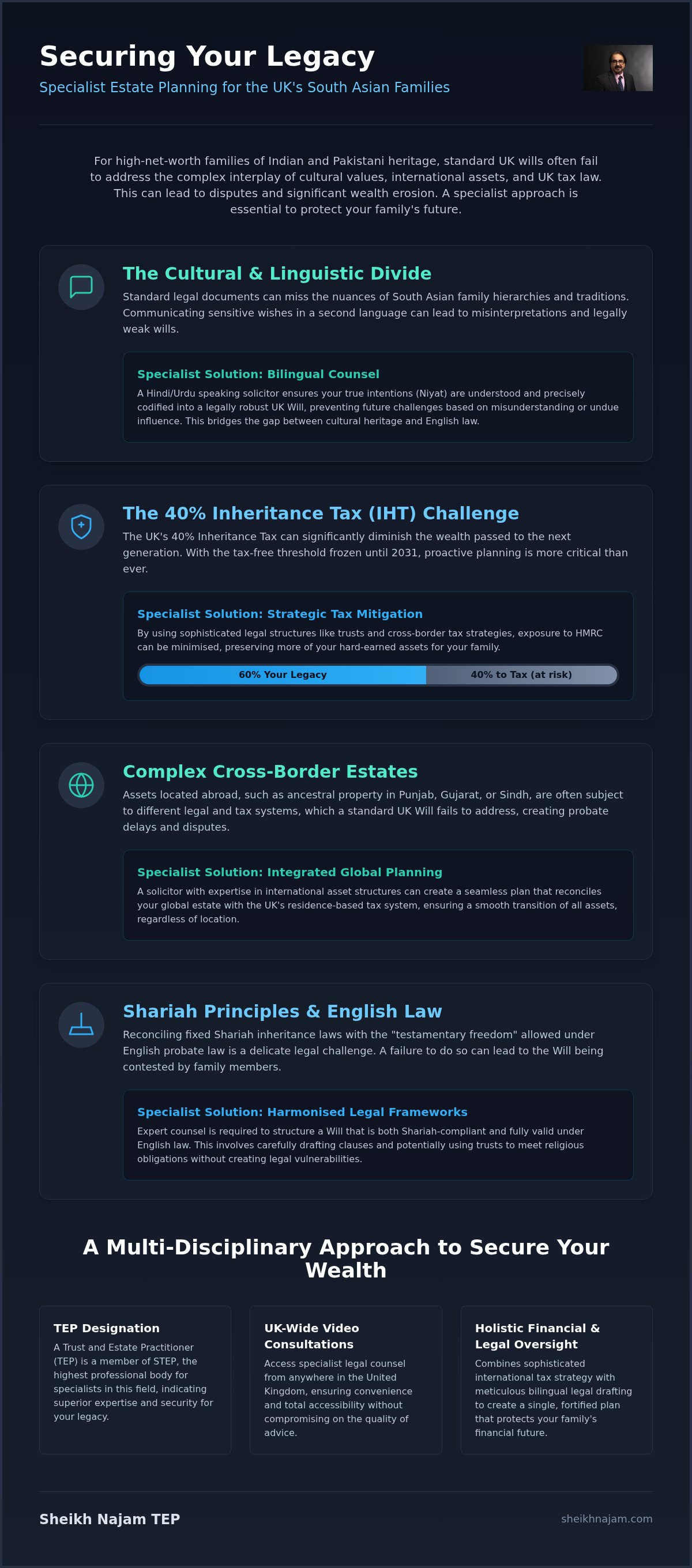
This article examines how a sophisticated synthesis of international tax strategy and bi-lingual legal counsel can secure your assets against the 40% Inheritance Tax threshold, which remains frozen until 2031. We shall explore the critical importance of reconciling international asset structures with the UK's residence-based tax system, ensuring your global estate remains robust. By the conclusion of this discussion, you'll understand how to achieve a legally fortified UK Will that reflects your heritage with absolute precision, whilst simultaneously minimising your exposure to HMRC through strategic, multi-disciplinary planning.
Table of Contents
The Cultural Imperative: Why a Hindi or Urdu Speaking Solicitor is Essential for Your Will
Strategic International Will Structuring and UK Inheritance Tax Planning
Modern Legal Delivery: Video Consultations for Clients Across the United Kingdom
Sheikh Najam TEP: A Strategic Polymath for Your South Asian Estate
The Cultural Imperative: Why a Hindi or Urdu Speaking Solicitor is Essential for Your Will
The creation of a Last Will and Testament is a profound exercise in personal agency, yet for many within the South Asian diaspora, the rigid structures of English law often fail to capture the subtle complexities of familial obligations and heritage. A Hindi/Urdu speaking Will Writing Solicitor serving UK based clients from Indian and Pakistani heritage provides more than mere translation; they offer a sophisticated synthesis of cultural comprehension and legal rigour. Video consultations available for clients based anywhere in the United Kingdom allow for this intricate dialogue to occur regardless of geographic constraints, ensuring that the testator's Niyat, or true intention, isn't merely understood but is legally codified with absolute precision. Without this linguistic and cultural bridge, the risk of a document being successfully challenged on the grounds of lack of testamentary capacity or undue influence increases significantly, particularly where complex family dynamics are involved.
Bridging the Linguistic Divide for Indian and Pakistani Families
Discussing one's mortality and the subsequent distribution of wealth is an inherently sensitive endeavour that demands a high degree of psychological security. For many elderly family members, the ability to articulate their wishes in their mother tongue isn't just a matter of convenience; it's a prerequisite for legal validity. When a practitioner can explain technical concepts such as "probate," "discretionary trusts," or "inheritance tax" through familiar cultural parallels, the veil of legal opacity is lifted. This clarity is vital. It prevents the "lost in translation" errors that frequently occur when second-generation family members attempt to act as informal interpreters. By engaging a solicitor who possesses bi-lingual proficiency, you ensure that every nuance of the testator's voice is preserved, thereby insulating the estate against future claims of misunderstanding or misinterpretation.
Cultural Nuance in Testamentary Dispositions
South Asian estate planning frequently involves assets that transcend national borders, such as ancestral property in the Punjab, Gujarat, or Sindh regions. These holdings often carry significant emotional weight and are subject to informal family agreements that English law doesn't naturally recognise. A specialist advisor understands the role of the extended family and the "unspoken" hierarchies that govern succession in Indian and Pakistani households. We don't simply draft a document; we integrate these traditional values into modern UK legal structures. This might involve the strategic use of life interest trusts to protect a surviving spouse whilst securing the ultimate passage of the family home to the next generation. By addressing these cross-border complexities with a practitioner who understands the regional specifics of the Indian subcontinent, you create a seamless transition of wealth that respects both your cultural roots and your UK tax obligations.
Strategic International Will Structuring and UK Inheritance Tax Planning
The preservation of multi-generational wealth within the South Asian diaspora necessitates a profound understanding of the UK Inheritance Tax rules, particularly as they pertain to individuals with significant global footprints. For many families of Indian and Pakistani heritage, the presence of assets in the subcontinent—ranging from ancestral agricultural land to complex commercial holdings—introduces a layer of fiscal complexity that standard domestic Wills cannot adequately address. Engaging a Hindi/Urdu speaking Will Writing Solicitor serving UK based clients from Indian and Pakistani heritage ensures that these cross-border nuances are handled with the requisite academic rigour, whilst video consultations available for clients based anywhere in the United Kingdom provide a secure platform for discussing sensitive financial structures. Without such precision, the risk of double taxation or the erosion of the estate through avoidable tax liabilities becomes a tangible threat to your family's future security.
Effective planning often requires the drafting of international wills London tailored to specific jurisdictions. This approach avoids the significant delays often encountered during cross-border probate, where a single UK document might struggle to gain recognition in foreign courts. By utilising discretionary trusts, we can also shield assets from third-party claims, ensuring that the legacy remains within the family lineage as intended. For those seeking to secure their global interests, bespoke estate planning offers the precision required to navigate these intricate thresholds.
Navigating Cross-Border Probate and Domicile
Since the shift to a residence-based system in April 2025, individuals who've been UK tax residents for at least 10 of the previous 20 years are subject to Inheritance Tax on their worldwide assets. This makes the distinction between UK and overseas domicile increasingly critical for those maintaining strong links to India or Pakistan. We provide strategic counsel on managing double taxation treaties, ensuring that assets located in the subcontinent aren't unfairly eroded by competing tax authorities. Clear, bi-lingual communication is essential here to ensure that every aspect of your international residency history is accurately documented for HMRC compliance.
Advanced Inheritance Tax Mitigation Strategies
To protect your estate from the standard 40% tax rate, we explore the application of Business Property Relief (BPR) and Agricultural Property Relief (APR) for qualifying assets. Strategic use of Potentially Exempt Transfers (PETs) also allows for the tax-efficient transfer of wealth during your lifetime, provided the seven-year survival rule is met. In the 2026 tax year, Inheritance Tax is levied at 40% on the value of an estate exceeding the combined nil-rate bands, which remain frozen at £325,000 and £175,000 respectively, applying to the worldwide assets of those meeting the 10-year UK residency criteria. These strategies require a meticulous, multi-disciplinary approach to ensure they remain robust against future regulatory shifts.
Reconciling Shariah Principles with English Probate Law
The English legal system is founded upon the principle of absolute testamentary freedom, a doctrine that grants individuals the liberty to bequeath their assets to any beneficiary of their choosing. This flexibility stands in direct contrast to the fixed inheritance mandates of Shariah law, which prescribe specific shares for certain heirs. For families seeking to honour their faith whilst ensuring their wishes are enforceable under the Wills Act 1837, the synthesis of these two systems requires exceptional jurisprudential skill. A Hindi/Urdu speaking Will Writing Solicitor serving UK based clients from Indian and Pakistani heritage. Video consultations available for clients based anywhere in the United Kingdom. provides the necessary linguistic and legal bridge to navigate this complexity. By adhering to the Law Society's guidance on Shariah-compliant wills, we ensure that your religious obligations are codified within a framework that remains robust against challenges in the UK courts. Failure to reconcile these principles correctly can lead to the precarious territory of contentious probate London, where the absence of a clearly defined, legally valid distribution can result in protracted litigation amongst heirs.
The Mechanics of Shariah-Compliant Succession
A Shariah-compliant Will typically divides the estate into two distinct portions. The first is the Wasiyyah, which allows the testator to bequeath up to one-third of their assets to individuals or charities who aren't prescribed heirs under the Faraid system. The remaining two-thirds must be distributed according to the fixed shares determined by the degree of kinship. We facilitate this by drafting flexible trust provisions that mirror these religious requirements whilst remaining fully compliant with UK tax law. Appointing culturally aware executors is vital here. They must possess the integrity and understanding to manage the estate's distribution in a way that respects both the letter of English law and the spirit of the testator's faith.
Preventing Intrafamily Estate Disputes
The Inheritance (Provision for Family and Dependants) Act 1975 allows certain individuals to claim against an estate if they feel they haven't been provided for adequately. This represents a significant risk for Shariah-compliant Wills, where fixed shares may not meet the "reasonable financial provision" standard required by the Act. To mitigate this, we utilise clear, bi-lingual documentation that explains the rationale behind the distribution, thereby reducing the likelihood of claims based on "undue influence" or "lack of capacity." When conflicts do arise, we prioritise mediation and arbitration to resolve matters privately. This approach avoids the financial and reputational damage of a public court battle, ensuring that the family legacy remains intact and the testator's intentions are honoured without compromise.
Modern Legal Delivery: Video Consultations for Clients Across the United Kingdom
The evolution of professional legal practice has necessitated a sophisticated shift towards digital delivery, ensuring that elite private wealth advisory is no longer geographically tethered to the traditional confines of the City of London. For sophisticated families residing in Manchester, Birmingham, Leeds, or Glasgow, the ability to engage a Hindi/Urdu speaking Will Writing Solicitor serving UK based clients from Indian and Pakistani heritage. Video consultations available for clients based anywhere in the United Kingdom. represents a significant advancement in the accessibility of high-level expertise. This delivery model meticulously preserves the personal, bi-lingual connection essential for articulating intricate family dynamics, whilst simultaneously leveraging enterprise-grade encryption architectures and remote identity verification protocols to maintain the absolute sanctity of client confidentiality.
How Remote Consultations Work for Complex Estates
The trajectory of a remote engagement begins with a secure, encrypted diagnostic phase, followed by a comprehensive video consultation where the complexities of the estate are analysed with academic rigor. We utilise robust, multi-factor authenticated communication channels to protect the integrity of sensitive financial disclosures, ensuring that the testator's privacy isn't merely a preference but a structural guarantee. In cases involving overseas assets, the role of notarial services becomes paramount; we facilitate the strategic authentication and apostille of international documents to satisfy the requirements of foreign registries. This digital workflow allows for the iterative review of testamentary instruments, ensuring that the final document is jurisprudentially sound and resistant to future litigation.
The Benefits of Digital Legal Advisory
Beyond the obvious convenience, digital legal advisory provides direct, unhindered access to a TEP-qualified specialist whose niche expertise in cross-border succession and international tax strategy is frequently unavailable in regional practices. High-net-worth professionals and multi-generational households find the flexibility of remote appointments invaluable, as it's an avenue that permits the inclusion of key family members without the logistical burden and time-cost of traditional travel. This methodical approach doesn't just enhance efficiency; it also aligns with the strategic foresight expected of a modern practitioner. To begin this process, you may book a confidential consultation to discuss your specific requirements.
Sheikh Najam TEP: A Strategic Polymath for Your South Asian Estate
The preservation of a high-value estate requires more than a mere understanding of the law; it demands the strategic foresight of a practitioner who operates at the intersection of several complex fields simultaneously. Sheikh Najam TEP embodies the role of the "Strategic Polymath," providing a multifaceted approach that synthesises international tax planning, trust structuring, and commercial dispute resolution into a single, cohesive strategy. For families of Indian and Pakistani heritage, this expertise is delivered with the cultural sensitivity and linguistic precision that only a Hindi/Urdu speaking Will Writing Solicitor serving UK based clients from Indian and Pakistani heritage. Video consultations available for clients based anywhere in the United Kingdom. can provide. By eschewing the "friendly guide" persona in favour of an elite, authoritative register, Sheikh Najam provides a high-level command over intricate legal landscapes, ensuring that every testamentary instrument is drafted with absolute academic rigour and institutional weight.
Elite Qualifications in Private Wealth
The TEP (Trust and Estate Practitioner) designation is the global hallmark of professional excellence in private wealth, signifying a depth of knowledge in trusts and estates that is rigorously tested and internationally recognised amongst the legal elite. This qualification is particularly vital for high-net-worth individuals whose estates involve complex cross-border succession issues and multi-jurisdictional tax liabilities that standard practitioners often overlook. As a Public Officer appointed by The Court of Faculties, Sheikh Najam integrates notarial authority with succession planning, providing a seamless service for the authentication of international assets that regional firms simply can't match. This meticulousness extends to financial crime and compliance advisory, ensuring that your wealth structures remain robust against the increasingly stringent regulatory environments and transparency requirements of the 2026 tax year.
Securing Your Legacy with Absolute Precision
In an era where digital assets and complex global holdings are the norm, a generic template is a significant fiscal liability that risks the erosion of your family's capital. We provide bespoke solutions for digital asset structuring, ensuring that your cryptocurrency holdings, digital intellectual property, and international commercial interests are protected alongside traditional real estate. Our commitment is to build a long-term relationship as a master advisor, providing the stability and strategic foresight required to navigate future shifts in UK probate law and international tax treaties. To secure your multi-generational legacy with the absolute precision and multi-disciplinary expertise it deserves, you should Consult with Sheikh Najam TEP for your Will and Estate planning.
Securing Your Global Legacy with Jurisprudential Precision
The preservation of multi-generational wealth within the South Asian diaspora necessitates a synthesis of cultural sensitivity and rigorous legal strategy. We've explored how linguistic proficiency ensures that your testamentary intentions are codified without the risk of semantic error, whilst strategic planning mitigates the erosion of global assets by the 40% UK Inheritance Tax threshold. By reconciling the fixed mandates of Shariah law with the flexibility of English probate, you ensure a legacy that's both spiritually compliant and legally unassailable. As a Hindi/Urdu speaking Will Writing Solicitor serving UK based clients from Indian and Pakistani heritage, I provide the authoritative oversight necessary to bridge these complex legal landscapes, with video consultations available for clients based anywhere in the United Kingdom. As a TEP-qualified practitioner specialising in international tax and contentious probate, I offer the multi-disciplinary expertise required to safeguard your interests against future volatility. Secure your multi-generational legacy: Book a bi-lingual consultation with Sheikh Najam TEP today. Your family's future is a profound responsibility, and it's our honour to help you protect it with absolute precision.
Frequently Asked Questions
Can I write a Will in the UK that covers my property in India or Pakistan?
Yes, you can include international assets within a UK testamentary document, but it's often strategically disadvantageous to rely on a single instrument for multiple jurisdictions. Whilst English law permits the distribution of worldwide assets, the practicalities of obtaining probate in India or Pakistan for a UK document can lead to protracted delays and complex legal hurdles. We typically recommend drafting separate, jurisdiction-specific Wills to ensure that immovable property is handled according to local succession laws whilst maintaining overall coherence with your UK estate plan.
Is a Shariah-compliant Will legally binding under English law in 2026?
A Shariah-compliant Will is fully enforceable in England and Wales provided it adheres strictly to the formal requirements of the Wills Act 1837. English law's principle of testamentary freedom allows you to distribute your estate according to religious mandates, such as fixed shares for specific heirs, as long as the document is in writing, signed by the testator, and witnessed by two people physically present. It's vital that these documents are drafted with precision to withstand potential claims under the Inheritance (Provision for Family and Dependants) Act 1975.
How do video consultations for Will writing work if I am based in Manchester or Birmingham?
As a Hindi/Urdu speaking Will Writing Solicitor serving UK based clients from Indian and Pakistani heritage. Video consultations available for clients based anywhere in the United Kingdom., we utilise secure, end-to-end encrypted platforms to conduct comprehensive diagnostic sessions. This digital delivery model allows families in Manchester or Birmingham to access elite City of London expertise without the logistical burden of travel. We facilitate the entire process remotely, from the initial analysis of your global footprint to the digital review of draft instruments, ensuring that your legacy is secured with absolute academic rigour.
What are the Inheritance Tax implications for a non-UK domiciled individual?
Since the regulatory shift in April 2025, your domicile status is no longer the sole determinant of your Inheritance Tax liability. If you've been a UK tax resident for at least 10 of the previous 20 years, you're now subject to UK Inheritance Tax on your worldwide assets, regardless of your links to the subcontinent. This includes the standard 40% rate on the value of your estate exceeding the £325,000 nil-rate band, which remains frozen until 2031. Strategic planning is essential to manage these cross-border liabilities and utilise available reliefs effectively.
Do I need a separate Will for my assets in the UK and my assets overseas?
Maintaining separate Wills for different jurisdictions is the gold standard for high-net-worth individuals with international holdings. This approach permits the simultaneous administration of your estate in both the UK and the subcontinent, preventing the significant delays associated with re-sealing a single Grant of Probate across borders. It also ensures that your dispositions for land and property in India or Pakistan are compliant with specific regional requirements that might differ from English law, providing a more robust shield for your multi-generational wealth.
Can Sheikh Najam TEP help with challenging a Will that was not culturally sensitive?
Yes, our expertise in contentious probate allows us to represent heirs in disputes where a Will fails to account for the complex family dynamics or cultural nuances of South Asian heritage. We provide the strategic command required to challenge documents on the grounds of lack of testamentary capacity, undue influence, or failure to provide reasonable financial provision. Our bi-lingual proficiency allows us to meticulously analyse evidence and witness statements in their original linguistic context, providing a distinct advantage in high-stakes estate litigation.
Why is it important to have a bi-lingual Hindi or Urdu speaking solicitor for my estate planning?
The precision afforded by a Hindi/Urdu speaking Will Writing Solicitor serving UK based clients from Indian and Pakistani heritage. Video consultations available for clients based anywhere in the United Kingdom. ensures that technical legal terminology is matched with cultural concepts that an English-only practitioner might overlook. This linguistic bridge is vital for elderly family members who need to discuss sensitive matters in their mother tongue to ensure total clarity. It eliminates the "lost in translation" risks that can lead to successful legal challenges, ensuring your Niyat is accurately codified in English law.
What is the difference between a standard Will and a Shariah-compliant Will in the UK?
A standard UK Will is governed by total testamentary freedom, allowing you to bequeath your assets to anyone without restriction. In contrast, a Shariah-compliant Will incorporates fixed inheritance shares (Faraid) for prescribed heirs and limits your discretionary bequests (Wasiyyah) to one-third of the estate. Reconciling these fixed shares with English law requires a sophisticated trust structure to ensure the distribution is both religiously valid and legally robust against third-party claims from dependants who might feel excluded under traditional mandates.


Comments