Inheritance tax on gifts in the UK: rules and exemptions

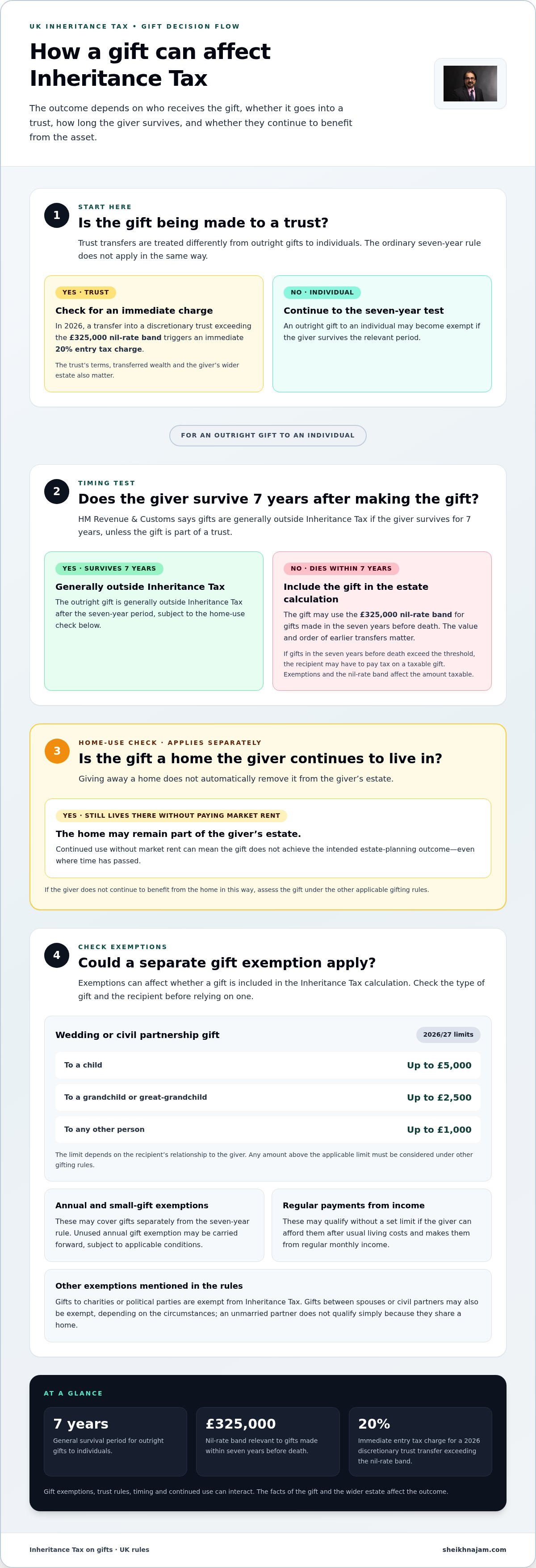
Giving your house to your children does not automatically remove it from inheritance tax. Inheritance tax on gifts in the UK in 2026 generally depends on whether the donor survives seven years: according to HM Revenue & Customs, gifts are usually outside Inheritance Tax after that period, unless they are made as part of a trust. A home may remain part of the giver’s estate if they continue living there without paying market rent.
The question is not simply whether you can make a gift, but how its form, timing and continued use affect your estate. This guide explains key exemptions, including annual and wedding gifts, and how the seven-year rule and taper relief may affect tax due and who pays it. It also covers considerations for gifts of a home or overseas assets, so you can assess whether a proposed gift supports your wider estate-planning objectives.
Table of Contents
Are there any gifting exemptions?
Several exemptions can keep gifts outside an estate for Inheritance Tax purposes. The gifting rules described here apply across the UK, including Scotland, Wales and Northern Ireland.
Small gifts exemption
The small-gifts exemption can cover modest gifts to individuals without adding them to the donor’s estate for Inheritance Tax purposes. It is relevant when making occasional gifts to children or others, separately from the annual gift exemption. For example, a parent making modest gifts to several children should consider each gift against the relevant exemption and the wider gifting record.
Annual gift exemption and carry-forward
According to HM Revenue & Customs, the annual Capital Gains Tax allowance is £3,000. Unused annual gift exemption may be carried forward, subject to applicable conditions. The UK tax year runs from 6 April to 5 April the following year.
Two spouses can combine their exemptions to give up to £6,000 per year. If neither used the previous year’s allowance, they could give up to £12,000 using the combined exemptions. Regular payments from income may also qualify without a set limit, provided the donor can afford them after usual living costs and makes them from regular monthly income. HM Revenue & Customs states that the annual Capital Gains Tax allowance is £3,000; this is separate from the Inheritance Tax gift exemption.
Potentially Exempt Transfers and the seven-year rule
A Potentially Exempt Transfer is an outright gift to an individual that may become exempt if the donor survives the relevant period. According to HM Revenue & Customs, gifts are generally outside Inheritance Tax if the donor survives for 7 years after giving them, unless the gift is part of a trust. If the donor dies sooner, the gift may use the £325,000 nil-rate band for gifts made in the seven years before death. This makes the timing and value of earlier transfers relevant to the estate’s overall tax position.
Gifts to trusts
Gifts to trusts are treated differently from outright gifts to individuals, so the ordinary seven-year rule does not apply in the same way. In 2026, a transfer into a discretionary trust exceeding the £325,000 nil-rate band triggers an immediate 20% entry tax charge. Trust transfers can therefore create an immediate liability as well as affecting later Inheritance Tax calculations. The trust’s terms, the transferred wealth and the donor’s wider estate all matter when assessing the consequences.
Are there rules for wedding or civil partnership gifts?
Wedding and civil partnership gifts have recipient-based exemptions, separate from gifts between spouses or civil partners. The applicable limit depends on the recipient’s relationship to the giver.
Wedding and civil partnership gifts
A qualifying gift for a wedding or civil partnership can be exempt from Inheritance Tax up to a limit determined by the recipient’s relationship to the giver. This may apply when relatives contribute to a celebration or give money or assets to the couple. Identify the recipient and their relationship to the giver before treating the gift as exempt. Any amount above the applicable limit needs to be considered under the other gifting rules.
Gift allowances for weddings and civil partnerships
For 2026/27, HM Revenue & Customs states that a tax-free wedding or civil partnership gift can be up to £5,000 to a child. The corresponding limits are £2,500 to a grandchild or great-grandchild, and £1,000 to any other person. These limits turn on the recipient’s relationship to the giver, not the value of the whole celebration.
For example, a parent giving a child £5,000 may fall within the specific allowance. A gift above that amount is not covered in full by this exemption, although another exemption may apply. Keep the recipient and occasion clear in your records, particularly where several family members contribute different sums.
Exempt gifts between spouses and civil partners
Gifts between spouses or civil partners may be exempt from Inheritance Tax, depending on the circumstances. The conditions matter: an unmarried partner does not qualify for this exemption simply because they share a home. Confirming the legal relationship and the recipient’s permanent UK residence is central to applying the rule.
Gifts to charities or political parties are also exempt from Inheritance Tax. This is a separate exemption, not an extension of the wedding allowance. A gift to a charity should not be treated as a wedding gift, even if made around the time of a family celebration.
A separate transfer rule applies to agricultural and business property relief. Unused relief for qualifying agricultural and business property may be transferable between spouses and civil partners. The transfer applies after both have died, and only if the first spouse did not use their full allowance. This relief concerns qualifying property, not wedding gifts.
Where family gifts, charitable transfers and qualifying property intersect, advice on trust and estate planning can help assess how the separate exemptions apply to the wider estate.
How is Inheritance Tax on a gift paid?
Tax on gifts depends on their value, timing and any available relief. The key calculation combines gifts made within seven years, the £325,000 nil-rate band and any applicable taper relief.
Who may have to pay?
If gifts made in the seven years before death exceed the £325,000 Inheritance Tax threshold, the recipient may have to pay tax on a taxable gift. This does not mean every gift creates a bill: exemptions and the nil-rate band affect how much value is taxable. The value and order of transfers matter, because earlier gifts can use the available threshold before later gifts.
When making several substantial gifts, consider their combined value rather than assessing each transfer in isolation. Keep records of recipients, dates, values and any relief claimed. These records help the estate establish whether tax is due and whether taper relief affects the amount.
How taper relief affects the calculation
Taper relief may reduce tax on a taxable gift when the donor dies within seven years of making it. It applies only if gifts made during that period total more than the £325,000 threshold. It reduces the tax rate on the taxable amount, not the value of the gift itself. If the gifts do not exceed the threshold, taper relief does not create an additional exemption.
For gifts on which Inheritance Tax is due, the applicable rates depend on the time between the transfer and death:
Within three years, the rate is 40%.
From three to four years, taper relief reduces the rate to 32%.
From four to five years, the rate is 24%.
From five to six years, the rate is 16%.
From six to seven years, the rate is 8%.
For instance, a taxable gift made five years before death falls within the 16% taper-relief rate. Gifts made well before death may fall outside the period in which taper relief applies.
Business and Agricultural Property Relief
Qualifying agricultural and business property may receive relief that changes the taxable value of a transfer. From 6 April 2026, 100% relief is capped at a combined £1 million per person. Qualifying property above that cap receives 50% relief, leaving an effective Inheritance Tax rate of 20% where the standard rate applies.
The £1 million allowance can be transferred between spouses and civil partners. This transfer applies after both have died, and only where the first spouse did not use their full allowance. These limits make the asset type, ownership and previous use of relief central to the estate’s calculation.
Gifts with reservation of benefit
A gift with reservation of benefit occurs when someone gives away an asset but continues to benefit from it. For example, a parent may transfer a home to their children but continue living there without paying market rent. The home may then remain part of the giver’s estate for Inheritance Tax purposes. The legal form of the transfer does not, by itself, determine its tax treatment.
The key issue is whether the donor continues using the property after the gift. If a parent gives a house to a child but continues living there rent-free, the parent retains a benefit connected with the asset. The home may therefore remain relevant when the estate is assessed, even though the child received it during the parent’s lifetime. This matters when assessing whether the gift has reduced the taxable estate.
Paying market rent changes the factual arrangement relevant to this rule. The question is whether the giver continues occupying the home without paying market rent, not simply whether ownership has been transferred. Distinguish a genuine change in ownership and occupation from a transfer that leaves the giver enjoying the same home. The actual living arrangements and rent payments are important evidence.
The seven-year rule is not an automatic solution to a reservation of benefit. A home given away may remain part of the giver’s estate if they continue living there without paying market rent. Surviving seven years does not, by itself, resolve whether the giver retained a benefit. Consider the timing of the gift alongside the donor’s continued use of the property.
Before transferring a home, set out the arrangement clearly. Record who will occupy it, whether the giver will remain, and whether market rent will be paid. Keep relevant documents and payment records together so the estate’s representatives can understand the arrangement. These details help distinguish an outright gift from a transfer where the donor continues enjoying the property.
If the home remains within the estate for tax purposes, its value can affect the estate’s taxable total and the available rate band. The outcome may differ from expectations based only on the transfer date or title documents. A lifetime review should consider ownership, occupation, rent and the donor’s wider estate together. These facts also help representatives explain the property’s treatment during estate administration.
How is taper relief calculated on gifts made three to seven years before death
Taper relief reduces the Inheritance Tax rate on certain gifts, rather than reducing their value. It applies where the donor dies within seven years and the total gifts in that period exceed the £325,000 threshold. The calculation therefore has two stages: establish whether tax is due on the gifts, then apply the rate determined by the time between each gift and death.
First, assess gifts made during the seven-year period and account for the available nil-rate band. Taper relief does not apply just because a gift was made several years before death. If the gifts do not exceed the threshold, there is no tax on those gifts for taper relief to reduce. If the threshold is exceeded, calculate tax on the taxable amount, then apply the relevant taper rate to each gift.
The applicable rates are based on complete intervals between the gift and death:
For a gift made less than three years before death, the rate is 40% if tax is due.
For a gift made 3 to 4 years before death, HM Revenue & Customs states that taper relief reduces the tax rate on taxable gifts to 32%.
For a gift made 4 to 5 years before death, the rate is 24%.
For a gift made 5 to 6 years before death, the rate is 16%.
For a gift made 6 to 7 years before death, the rate is 8%.
Consider a taxable gift that falls into the 3 to 4-year interval. The 32% rate applies to the taxable amount after the nil-rate band calculation, not to the gift’s full value automatically. A gift partly covered by the threshold may therefore produce a different tax figure from a gift wholly above it. The estate’s records must show the gift date, its value and how earlier transfers affect the available band.
Each gift has its own timeline. If a donor made gifts at different times, the estate should assess each transfer against its own interval, rather than applying one rate to the entire gifting history. Gifts made seven or more years before death have a 0% taper-relief tax rate. That treatment is distinct from the calculation for gifts still within the seven-year period.
For a reliable calculation, organise records chronologically, then identify exemptions, taxable amounts and the relevant rate for each gift. The personal representatives and recipients may need this information to establish the tax due and responsibility for payment. Discuss your gift and estate tax position where several transfers or a substantial taxable gift complicate the calculation.
Sheikh Najam TEP: Notarial Services
Sheikh Najam TEP provides Notarial Services alongside Inheritance Tax Planning and Trust and Estate Planning for people assessing gifts, trusts and estate arrangements. These services are relevant when considering a proposed transfer in the context of the donor’s wider wealth, the recipient’s circumstances and the estate’s long-term structure.
Advice may be particularly useful when gifts involve trusts, overseas assets or continued use of a transferred home, as each can affect how the estate is assessed. Sheikh Najam TEP can help examine these connected considerations and support informed planning before a transfer, or clarify their significance during estate administration.
For guidance on your gifting and estate arrangements, contact Sheikh Najam TEP.
Make your next transfer part of a considered plan
Planning for inheritance tax on gifts in the UK in 2026 is not solely a question of reducing the estate’s taxable value. A transfer can affect family arrangements, ownership and future access to wealth, so its legal and financial consequences should be considered together before decisions are implemented.
Sheikh Najam TEP’s Inheritance Tax Planning and Trust and Estate Planning can support this wider assessment. Notarial Services may be relevant when formal documents require notarial attention. The appropriate focus depends on the assets involved, the intended recipients and how the proposed gift relates to your existing estate arrangements.
For advice tailored to your circumstances, contact Sheikh Najam TEP. A carefully structured discussion can help you approach your next decision with greater clarity and confidence.
Frequently Asked Questions
Can I give my house to my children to mitigate Inheritance Tax?
You can transfer a home to your children, but the transfer alone may not remove it from your estate. If you continue living there without paying market rent, the home may remain relevant for Inheritance Tax. Also consider Capital Gains Tax, as a gift or sale below market value can have separate tax consequences. If you sell to a child below market value, the shortfall is treated as a gift, so ownership, occupation and value all matter.
How much is Inheritance Tax in the UK in 2026?
The standard Inheritance Tax rate is 40%, with the standard nil-rate band at £325,000. According to HM Revenue & Customs, the nil-rate band applies when calculating tax on gifts made within seven years before death. An eligible estate may also qualify for a residence nil-rate band of up to £175,000 per person when a qualifying main residence passes to direct descendants. The final liability depends on the estate and available reliefs.
What do HMRC consider to be a gift?
A gift can be money, property or another asset transferred without receiving its full value in return. For example, if you sell a home to your child below market value, the difference between the price paid and the market value is treated as a gift. Record the asset, recipient, transfer date and consideration paid. These details help establish the value transferred and how the transaction should be assessed.
What is taper relief?
Taper relief reduces the Inheritance Tax rate applied to a qualifying taxable gift, rather than reducing the gift’s value. It becomes relevant when the donor dies within seven years and the gifts in that period exceed the £325,000 threshold. The applicable rate depends on the interval between the gift and death. It does not create a tax reduction where the gifts do not exceed the threshold.
What is the Seven Year Rule?
The Seven Year Rule concerns certain gifts made during the donor’s lifetime. According to HM Revenue & Customs, gifts are generally outside Inheritance Tax if the donor survives for 7 years after giving them, unless the gift is part of a trust. For estate records, note each transfer’s date and recipient. The gift’s treatment can also depend on whether the donor continued benefiting from the asset.
Who pays Inheritance Tax and when is it due?
For inheritance tax on gifts in the UK in 2026, the recipient may have to pay if the donor gave more than £325,000 in gifts during the seven years before death. The estate’s personal representatives need details of lifetime transfers to establish whether tax is due and how the available threshold applies. Payment becomes relevant once the donor has died and the liability has been assessed. Allocation between recipients and the estate depends on the gifts and estate circumstances.
Are there any small gift exemptions?
Yes. A separate small-gifts exemption may apply to qualifying modest gifts, distinct from the general annual gifting exemption. It can be relevant when making separate presents to family members or friends, rather than transferring a larger asset. Keep a record of each recipient and gift, as well as other exemptions used. This helps distinguish small presents from transfers requiring assessment under the broader gifting rules.
What UK inheritance tax rules apply to gifts made in 2026?
For inheritance tax on gifts in the UK in 2026, assess the recipient, asset, transfer date and any continuing benefit retained by the donor. The UK tax year runs from 6 April to 5 April the following year, which matters when recording tax-year exemptions. Gifts involving overseas assets may also require consideration of the donor’s circumstances and the asset’s location. Trust transfers follow different treatment from outright gifts to individuals.



Comments