International Tax Compliance for Individuals: A Strategic 2026 Checklist

Updated: Aug 26
The era of financial opacity hasn't merely concluded; it's been superseded by a regime of absolute transparency where a single oversight in international tax compliance for individuals can precipitate catastrophic regulatory consequences and irreversible reputational damage. You likely recognise that the shifting landscape of residence and domicile rules, compounded by the January 2026 implementation of the 1% excise tax on physical remittance transfers, creates a precarious environment for your global portfolio. This strategic checklist provides a rigorous, multi-disciplinary framework designed to secure absolute regulatory certainty whilst mitigating the punitive risks of double taxation on foreign-sourced income.
We'll examine the meticulous alignment of your global assets with evolving UK law, the critical implications of the 2026 Common Reporting Standard (CRS) self-certification mandates, and the precise mechanisms required to defend your wealth against HMRC’s heightened scrutiny. By adopting this structured approach, you ensure that your most complex cross-border affairs are handled with the precision and strategic foresight that elite wealth management demands. This isn't merely a matter of administrative adherence; it's a fundamental pillar of wealth preservation in an increasingly interconnected and scrutinised financial world.
Table of Contents
Determining Tax Residency and Domicile Status
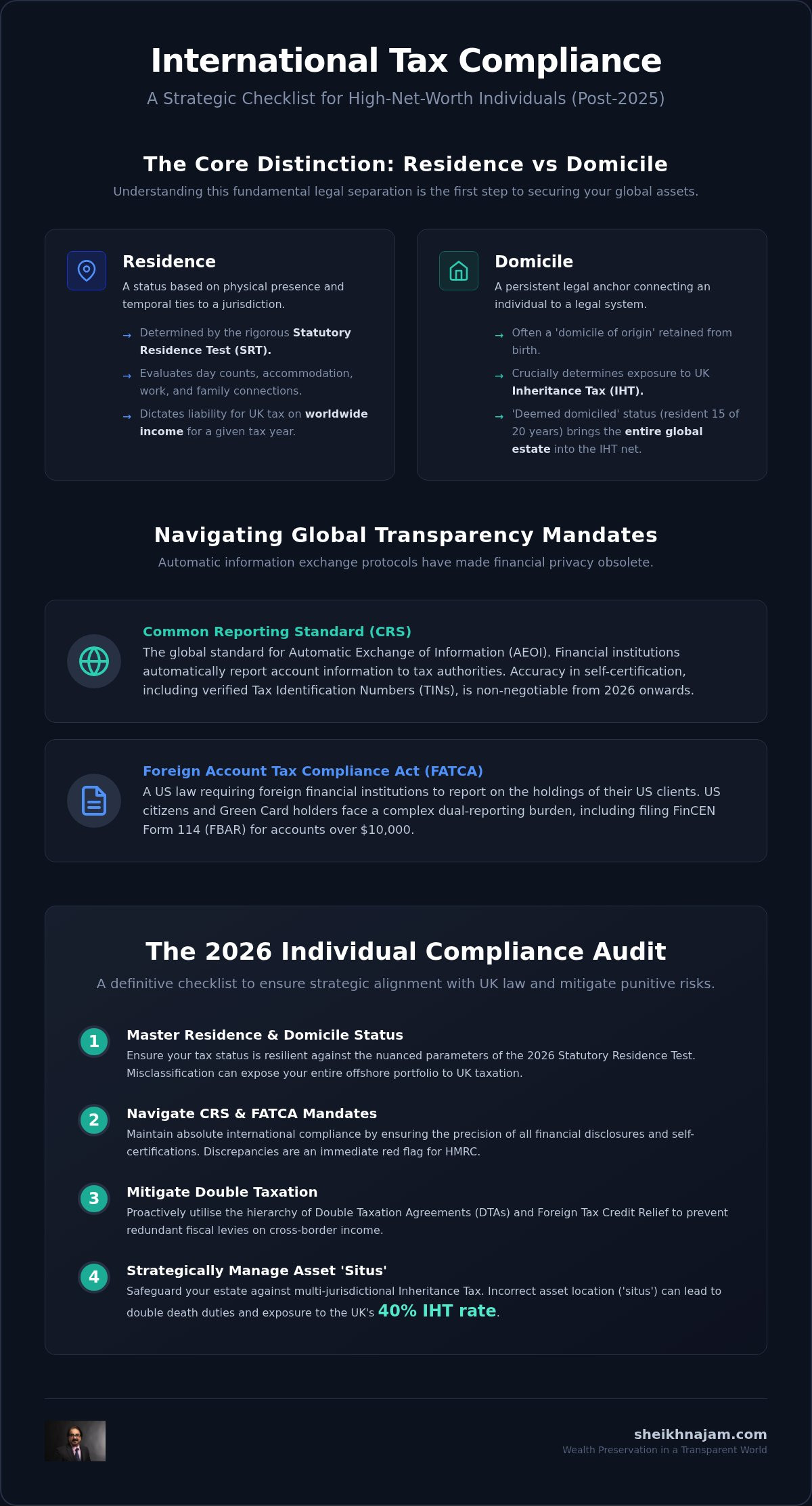
The foundation of international tax compliance for individuals within the United Kingdom rests upon a sophisticated legal distinction between residence and domicile. Whilst residence is primarily a function of physical presence and temporal ties, domicile represents a more profound, almost immutable legal connection to a specific jurisdiction. This distinction isn't merely academic; it dictates the extent of HMRC’s reach over your global estate. For the high-net-worth individual, misinterpreting these concepts can lead to inadvertent exposure of offshore assets to the UK’s progressive tax rates, particularly as we move into the 2026 fiscal year with heightened global transparency.
The Statutory Residence Test Framework
The Statutory Residence Test serves as the definitive mechanism for determining UK tax liability, providing a structured legislative framework to evaluate an individual's fiscal connection to the jurisdiction. In the 2026 tax year, the application of this test remains rigorous, necessitating a precise calculation of day counts and a thorough analysis of the 'automatic overseas test'. If these primary criteria aren't met, the 'sufficient ties test' examines factors such as accommodation, work, and family connections to establish residency status. For those transitioning between jurisdictions, the 'split year' treatment may offer a vital mechanism to partition the tax year, ensuring that only the portion of the year spent in the UK is subject to domestic taxation on worldwide income.
Domicile and its Long-term Tax Consequences
Domicile functions as a persistent legal anchor, often retained from birth as a 'domicile of origin' unless explicitly superseded by a 'domicile of choice'. Its significance can't be overstated, as it determines the scope of global Inheritance Tax (IHT) exposure. Under current regulations, individuals who've been resident in the UK for at least 15 of the previous 20 tax years are classified as 'deemed domiciled'. This status effectively eliminates the remittance basis of taxation, bringing the individual’s entire global asset portfolio within the remit of the UK’s 40% IHT rate. Precise international tax compliance for individuals involves not only managing current residency but also strategically anticipating the long-term implications of these domicile rules to protect multi-generational wealth from excessive fiscal erosion.
Global Transparency: Navigating CRS and FATCA Reporting
The global paradigm of fiscal oversight has undergone a profound transformation, evolving from a framework of requested disclosure to a regime of mandatory, automatic information exchange that leaves no room for ambiguity. For the sophisticated high-net-worth individual, maintaining international tax compliance for individuals is no longer a passive exercise in annual filing; it's a proactive defensive strategy against the intrusive capabilities of the Common Reporting Standard (CRS) and the Foreign Account Tax Compliance Act (FATCA). The systemic integration of financial institutions into the global regulatory apparatus ensures that every movement of capital is catalogued with forensic precision, rendering the historical concept of bank secrecy entirely obsolete.
Automatic Exchange of Information (AEOI) Protocols
Financial institutions now operate as the primary conduits for regulatory scrutiny, identifying 'reportable persons' through a meticulous analysis of residency and controlling interests. The 2026 updates to CRS self-certification requirements mandate the collection of verified Tax Identification Numbers (TINs) for both account holders and controlling persons, a measure designed to eliminate the remaining vestiges of anonymity within offshore structures. Accuracy in these disclosures is paramount, as discrepancies between self-certifications and the data held by HMRC can trigger immediate investigations. Ensuring your structures are transparent and fully documented is a core component of international tax planning for the modern era.
US citizens and Green Card holders residing in the City of London face a particularly complex dual-reporting burden under FATCA. Failure to file FinCEN Form 114 (FBAR) when aggregate foreign account balances exceed the equivalent of $10,000 at any point during the calendar year can result in severe civil penalties. Similarly, the receipt of foreign gifts or bequests exceeding $100,000 requires the submission of Form 3520, a requirement that often catches international families off guard during significant wealth transfers.
Compliance for Digital and Crypto Assets
HMRC’s evolving stance on the situs of digital assets creates additional layers of complexity, particularly when such assets are held within multi-jurisdictional trusts or underlying entities. The 2026 regulatory environment treats the location of the owner as the primary determinant of the asset's situs, meaning that UK-resident individuals must report global capital gains on crypto transactions with absolute precision. This intersection of digital asset structuring and tax transparency requires a sophisticated understanding of how these assets are viewed across different legal regimes. For a deeper analysis of these emerging frameworks, you may consult our guide on 2026 international tax structuring for private clients. Maintaining international tax compliance for individuals in this space necessitates a rigorous audit of all digital holdings to ensure they align with the latest HMRC reporting mandates and global transparency standards.
Mitigating Double Taxation on Cross-Border Income
The risk of juridical double taxation, which arises when two or more sovereign authorities assert a concurrent taxing right over the same quantum of income, represents a primary threat to the integrity of a global wealth portfolio. International tax compliance for individuals is predicated on the strategic invocation of Double Taxation Agreements (DTAs), and for performers or creative professionals working internationally, Performance Accountancy provides the specialist support needed to navigate these complex treaty provisions. These treaties function as the supreme arbiters in resolving fiscal conflicts by allocating taxing rights between the state of residence and the state of source, providing the essential legal framework for claiming Foreign Tax Credit Relief (FTCR), a mechanism that ensures tax paid in a foreign jurisdiction is appropriately offset against the UK liability, thereby preventing the redundant and confiscatory erosion of international investment yield.
Utilising Double Taxation Agreements
Determining which jurisdiction holds the primary taxing right necessitates a tiered analysis of treaty tie-breaker clauses, which evaluate an individual’s permanent home, centre of vital interests, and habitual abode. To secure these treaty benefits, it's frequently necessary to obtain a formal Certificate of Residence from HMRC, a process requiring a meticulous evidentiary demonstration of one's fiscal nexus to the United Kingdom. The recent integration of the OECD Multilateral Instrument (MLI) into the global treaty network has introduced the Principal Purpose Test, a rigorous standard designed to eliminate treaty abuse and ensure that fiscal benefits are only accorded to arrangements that possess genuine commercial or personal substance.
The Remittance Basis of Taxation
For non-domiciled individuals, the remittance basis remains a sophisticated, albeit increasingly circumscribed, component of international tax compliance for individuals. This regime allows foreign-sourced income and gains to remain outside the UK tax net, provided such funds aren't brought into, or enjoyed in, the United Kingdom. In the 2026 regulatory environment, the definition of a remittance is notably expansive, encompassing not only the direct transfer of funds but also the indirect enjoyment of foreign wealth through credit card settlements or the use of foreign-sourced income to acquire UK-situs assets.
Success in this area requires the forensic segregation of offshore funds into distinct accounts comprising clean capital, foreign income, and foreign gains. By funding UK lifestyle requirements exclusively from clean capital, an individual can effectively manage their exposure to the remittance basis charge whilst preserving the tax-efficient status of their broader offshore holdings. This level of precision is equally vital when managing foreign pension schemes and offshore investment bonds, where the specific classification of distributions under the relevant DTA can determine whether a withdrawal is subjected to income tax or treated as a non-taxable return of capital.
Succession and Inheritance Tax in a Multi-Jurisdictional Context
The devolution of a multi-jurisdictional estate necessitates a forensic examination of the nexus between residency, domicile, and the physical or legal location of assets. For the high-net-worth individual, international tax compliance for individuals extends beyond lifetime income to the strategic mitigation of 'death duties' across competing sovereign territories. Without a rigorous succession framework, an estate risks the catastrophic erosion of value through double inheritance taxation, particularly where the deceased is deemed domiciled in the UK whilst holding significant 'situs' assets in foreign territories that assert their own primary taxing rights.
For individuals looking to diversify their global holdings with high-value real estate, you can discover Keys to Israel to receive professional support throughout the property search and acquisition process in Israel.
Situs of Assets and IHT Planning
Determining the legal location, or situs, of an asset is a complex undertaking, particularly regarding intangible property such as digital holdings, debts, or shares in offshore closely-held corporations. Whilst real property possesses a fixed physical situs, the location of a debt is generally determined by the residence of the debtor, and the situs of registered shares is typically the jurisdiction where the share register is maintained. The situs of an asset often dictates the primary jurisdiction for inheritance tax. Consequently, international wills must be meticulously drafted to align with the local tax compliance mandates of each jurisdiction where assets are held. For those managing complex portfolios, international tax planning for London business owners provides a necessary perspective on how corporate structures impact personal IHT exposure. For non-domiciled individuals, the strategic use of excluded property trusts remains a vital mechanism to ring-fence foreign-situs assets from the UK’s 40% inheritance tax net, provided these structures are established prior to the individual attaining deemed domicile status.
Cross-Border Succession Treaties
The United Kingdom maintains a limited but powerful network of inheritance tax treaties with jurisdictions such as India, Pakistan, and Italy, which can override domestic legislation to prevent double taxation. These treaties often employ specific tie-breaker rules to determine which state has the ultimate right to tax the worldwide estate, offering a layer of protection not available under general DTAs. Navigating the conflict of laws in testamentary dispositions requires not only legal expertise but also the precise authentication of documents. The role of professional notarial services is indispensable in this regard, ensuring that international wills and powers of attorney are recognised by foreign registries and tax authorities during the probate process. Maintaining international tax compliance for individuals in a succession context demands this level of multi-disciplinary precision to ensure the seamless transfer of wealth across borders. If you require a robust strategy to protect your global legacy, our specialists can assist with comprehensive inheritance tax planning tailored to multi-jurisdictional estates.
The 2026 Individual Compliance Audit: A Definitive Checklist
The culmination of a robust fiscal strategy resides in the execution of a rigorous annual audit, a process that transcends mere clerical verification to become a sophisticated defensive exercise. In the current regulatory climate, international tax compliance for individuals necessitates a forensic review of one’s global footprint to ensure that every asset, entity, and transaction remains aligned with the shifting paradigms of UK and international law. This audit isn't a discretionary undertaking; it's a fundamental requirement for the preservation of wealth against the backdrop of the January 2026 Common Reporting Standard (CRS) updates and the increasingly aggressive investigative posture of HMRC. Each component of your global portfolio must be scrutinised to ensure that historical structures haven't been rendered obsolete by the rapid evolution of transparency mandates.
Pre-Tax Year End Preparations
The period preceding the April 5th deadline requires a methodical analysis of residency ties, specifically the precise calculation of day counts to manage status under the Statutory Residence Test. This is the optimal window to execute strategic gifting of assets, utilising annual exemptions across multiple jurisdictions to reduce the prospective inheritance tax burden. It's equally vital to review the status of any offshore holding structures in light of the 2026 changes to global regimes, such as the adjusted GILTI effective tax rates which now range between 12.6% and 14% for those with US interests. Individuals must also verify that their financial activities don't intersect with jurisdictions on the evolving OECD 'blacklist', as transactions involving non-cooperative territories now attract heightened scrutiny and potential reporting disallowances. If your portfolio includes digital assets, ensure their situs is correctly attributed to prevent inadvertent non-disclosure of capital gains.
Documentation and Evidence Retention
Maintaining a comprehensive 'defence file' is a critical component of international tax compliance for individuals, providing the necessary evidentiary weight to repel HMRC residency enquiries or challenges to domicile status. This file should contain contemporaneous records of travel, including flight manifests and accommodation receipts, alongside formal documentation such as certified translations of foreign tax assessments. The role of professional notarial services is paramount here, as the strategic authentication of international legal documents ensures their validity across sovereign borders. Securing multi-disciplinary financial crime and compliance advisory allows for the harmonisation of global tax positions, ensuring that self-certifications provided to financial institutions are beyond reproach. By institutionalising this audit process, you provide your estate with a layer of precision that secures both regulatory certainty and long-term fiscal stability.
Securing Your Global Legacy in an Era of Transparency
The landscape of international tax compliance for individuals has transitioned into a regime of absolute transparency, where the strategic intersection of residency, domicile, and cross-border reporting dictates the security of one's global estate. Navigating the 2026 fiscal environment requires more than administrative diligence; it demands a multi-disciplinary approach to mitigate double taxation and align multi-jurisdictional assets with the precise requirements of UK law. By institutionalising a definitive compliance audit and leveraging the protections of international succession treaties, you ensure your wealth remains resilient against shifting regulatory currents.
As a specialist in complex cross-border estate administration with extensive expertise in high-value contentious probate, I provide the authoritative oversight necessary to manage your most intricate affairs. My standing as a Public Officer appointed by The Court of Faculties reinforces a commitment to the highest standards of precision and legal rigor. You're invited to Instruct Sheikh Najam TEP for a Strategic International Tax Consultation to fortify your global position. Proactive planning today secures the enduring stability of your legacy for generations to come.
Frequently Asked Questions
What is the Statutory Residence Test and how does it affect my international tax compliance?
The Statutory Residence Test is the definitive legislative framework used to determine an individual's UK tax status based on physical presence and social or economic ties. It categorises taxpayers through automatic overseas tests, automatic UK tests, and the sufficient ties test. Precise adherence to these parameters is essential for international tax compliance for individuals, as residency dictates the extent of HMRC’s jurisdiction over your worldwide income and gains during a specific tax year.
Can I be taxed in two countries at once on the same income?
Yes, juridical double taxation occurs when two sovereign jurisdictions assert a concurrent right to tax the same income, often based on residency in one state and the source of income in another. This fiscal conflict is typically resolved through Double Taxation Agreements, which allocate taxing rights or provide for Foreign Tax Credit Relief. Without strategic intervention, you risk redundant levies that can significantly erode the net yield of your global investment portfolio.
What are the penalties for failing to disclose foreign assets to HMRC?
HMRC imposes severe financial penalties for the non-disclosure of offshore assets, which can reach up to 200% of the tax underpaid, depending on the jurisdiction's transparency level. Beyond fiscal levies, individuals may face criminal prosecution or public naming under the 'deliberate defaulters' regime. These punitive measures underscore the necessity of absolute precision in your annual disclosures to maintain a robust standing with the UK’s regulatory authorities and avoid irreversible reputational damage.
How does my domicile status impact my global Inheritance Tax exposure?
Your domicile status serves as the primary determinant for the scope of UK Inheritance Tax, with domiciled individuals facing a 40% levy on their global estate. Those who've been resident in the UK for 15 of the last 20 years are deemed domiciled, bringing even foreign-situs assets into the UK tax net. Strategic international tax compliance for individuals involves managing this status through excluded property trusts or domicile of choice arguments to protect multi-generational wealth from fiscal erosion.
What is the Common Reporting Standard (CRS) and who is affected?
The Common Reporting Standard is an OECD-led global initiative for the automatic exchange of financial account information between participating jurisdictions to combat tax evasion. It affects any individual holding financial accounts outside their country of residence, as banks are mandated to report balances and income to local authorities, who then share this data with HMRC. This system renders historical offshore anonymity entirely obsolete, requiring forensic accuracy in all self-certification documentation provided to financial institutions.
Is the remittance basis of taxation still available for non-doms in 2026?
The remittance basis remains a complex component of the UK tax system in 2026, though it's subject to increasingly stringent legislative restrictions and substantial annual charges for long-term residents. Non-domiciled individuals can still elect to be taxed only on UK-sourced income and foreign funds brought into the country, provided they haven't yet attained deemed domicile status. However, the 2026 regime necessitates meticulous segregation of 'clean capital' to avoid inadvertent and punitive tax triggers on your global wealth.
How do Double Taxation Agreements (DTAs) prevent overpayment of tax?
Double Taxation Agreements prevent overpayment by establishing a legal hierarchy that determines which nation has the primary right to tax specific income streams. These treaties often reduce withholding tax rates on dividends, interest, and royalties whilst providing mechanisms for tax credits where both nations claim a portion of the liability. Utilising these agreements effectively requires a formal Certificate of Residence from HMRC to validate your entitlement to treaty benefits under international law and prevent redundant fiscal leakage.
Do I need to report my overseas crypto holdings for UK tax purposes?
You're legally required to report global crypto-asset holdings to HMRC, as the situs of these digital assets is generally determined by the residency of the beneficial owner. UK residents are liable for Capital Gains Tax on the disposal of digital assets, regardless of where the exchange or private wallet is technically located. Failure to disclose these transactions can lead to forensic investigations, particularly as HMRC’s data-gathering capabilities increasingly encompass decentralised financial networks and international crypto exchanges.


Comments