International Tax Planning Guide for London Residents

Updated: Aug 26
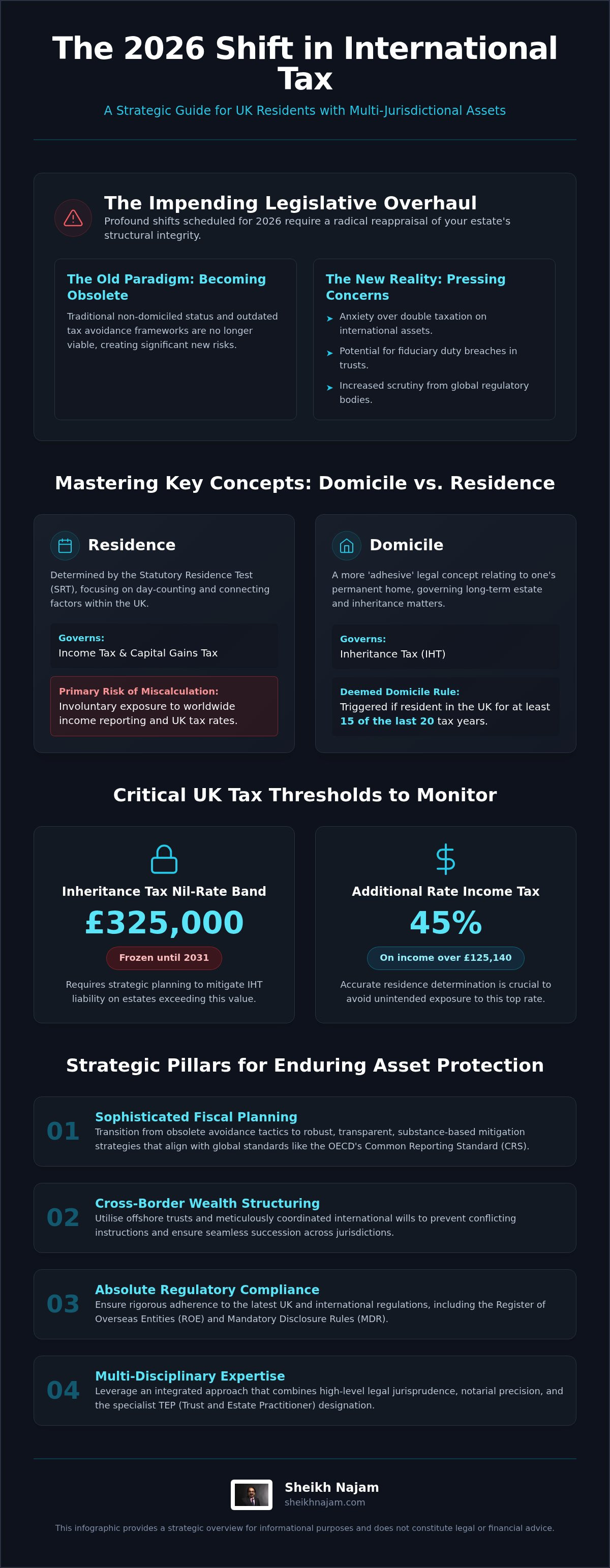
Could the structural integrity of your multi-jurisdictional estate withstand the profound legislative shifts scheduled for 2026? For the sophisticated London resident, International Tax Planning has transcended the realm of mere fiscal optimisation; it's now a critical exercise in defensive legal architecture. You're likely aware that the impending obsolescence of traditional non-domiciled status requires a radical reappraisal of how assets are held and transferred. The anxiety regarding double taxation and the potential for fiduciary duty breaches in international trusts is not merely a theoretical concern but a pressing reality for those whose interests span multiple borders.
This guide offers a comprehensive analysis of the complexities inherent in modern fiscal strategy, providing the clarity required to navigate the intricacies of domicile and residence. By integrating notarial precision with strategic foresight, we'll explore how to achieve enduring fiscal efficiency and ensure a seamless succession for your international assets. We'll examine the specific mechanisms required to maintain legal certainty whilst protecting your estate from the encroaching pressures of global regulatory transparency and domestic threshold freezes.
Table of Contents
The Evolving Landscape of International Tax Planning for Global Citizens
Navigating Domicile and Residence: Fiduciary Considerations for the London Private Client
Cross-Border Wealth Structuring: Trusts, International Wills, and Asset Protection
Regulatory Compliance and the Mitigation of Global Fiscal Risk
The Sheikh Najam TEP Multi-Disciplinary Approach to International Tax Strategy
The Evolving Landscape of International Tax Planning for Global Citizens
The contemporary discipline of International Taxation has undergone a fundamental transformation, transitioning from a peripheral administrative concern to the very core of global wealth management. In its most rigorous form, International Tax Planning is defined as the strategic organisation of an individual's fiscal affairs across multiple jurisdictions to ensure absolute compliance whilst enhancing capital efficiency. We've moved decisively beyond the era of aggressive tax avoidance; the regulatory paradigm of 2026 demands a shift toward transparent, substance-based mitigation. This evolution is largely driven by the OECD’s Common Reporting Standard (CRS), which now mandates a level of financial disclosure that leaves no room for ambiguity in one's cross-border holdings, particularly with the 2026 inclusion of electronic money products.
London remains the preeminent epicentre for global wealth structuring, even as regulatory frameworks tighten. This endurance isn't accidental. It's the result of a sophisticated legal infrastructure that provides a stable foundation for the most complex fiduciary arrangements. The City's institutional weight offers a sense of security that few other jurisdictions can replicate, especially for those managing assets that span several continents and require the meticulous oversight of a Public Officer appointed by The Court of Faculties.
The Intersection of Fiscal Policy and Private International Law
The efficacy of any fiscal strategy relies upon its alignment with private international law. One must understand how bilateral tax treaties interact with local inheritance laws to prevent the erosion of an estate through double taxation. This requires a multi-disciplinary expertise that bridges the gap between purely financial advice and high-level legal jurisprudence. Fiscal transparency, in the stringent climate of 2026, represents the systematic and mandatory exchange of comprehensive financial data between jurisdictions to ensure that all global assets are visible to the relevant domestic tax authorities.
Strategic Objectives for High-Net-Worth Individuals
For the high-net-worth individual, the primary objective is the preservation of capital across generations. This is increasingly difficult for UK residents who must contend with worldwide income reporting and the freezing of the Inheritance Tax nil-rate band at £325,000 until 2031. Comprehensive International Tax Planning must also address the necessity of maintaining liquidity within an international estate to settle tax liabilities without the forced sale of illiquid assets. It's about creating a robust architecture that survives the transition of wealth whilst adhering to the 45% additional rate threshold for income exceeding £125,140. Effective strategies ensure that fiduciary duties are met without compromising the long-term viability of the family's global portfolio.
Navigating Domicile and Residence: Fiduciary Considerations for the London Private Client
The Statutory Residence Test (SRT) remains the definitive mechanism for determining UK tax liability, requiring a meticulous analysis of day-counting and connecting factors. For the global citizen, this is not merely a box-ticking exercise; it is a fundamental pillar of International Tax Planning. Whilst the core SRT rules remain stable for 2026, the consequences of miscalculation have intensified as HMRC increases its scrutiny of multi-jurisdictional ties. Failure to accurately quantify one's presence in the UK can lead to involuntary exposure to the 45% additional rate on income exceeding £125,140, a risk that demands constant vigilance.
One must distinguish between 'residence', which primarily dictates income tax liability, and 'domicile', the far more adhesive concept governing inheritance tax. Under the current regime, individuals who have been resident in the UK for at least 15 of the last 20 tax years are deemed domiciled for all tax purposes. This threshold triggers a 40% liability on worldwide assets above the nil-rate band, making it imperative to understand the nuances of UK tax on foreign income before such thresholds are breached. The shift towards a residence-based system of taxation, accelerated by the 2025 reforms, has made the distinction between these two statuses more critical than ever for long-term residents.
A common objection amongst high-net-worth individuals is whether one can maintain fiscal efficiency whilst adhering to these stringent regulations. The answer lies in the precision of the legal architecture. Compliance is not an obstacle to efficiency; rather, it is the only sustainable foundation for it. By aligning one's global affairs with the prevailing jurisprudence, it's possible to achieve significant mitigation without compromising one's standing with the revenue authorities.
The Jurisprudence of Domicile in 2026
The determination of a 'domicile of choice' requires more than a mere change of residence; it necessitates a demonstrable, documented intent to reside in a new jurisdiction indefinitely. The 'centre of vital interests' and the maintenance of a 'permanent home' are pivotal in treaty interpretations and the resolution of double taxation disputes. Our private wealth advisory London frequently addresses these domicile risks by formalising the objective evidence of a client's intentions, ensuring that their lex domicilii is clearly established and defensible.
Mitigating the 'Non-Dom' Transition Risks
The transition away from the remittance basis of taxation represents a significant fiscal risk for many long-term residents. Excluded property trusts remain a vital instrument for protecting non-UK assets from the UK inheritance tax net, provided they are structured with absolute precision before the individual becomes deemed domiciled. Preparing for HMRC enquiries requires a proactive approach to record-keeping, ensuring that every jurisdictional tie is documented with notarial rigour. For those seeking to fortify their position, a consultation with a specialist in international tax and trust law can provide the necessary strategic oversight to manage these complex transitions.
Cross-Border Wealth Structuring: Trusts, International Wills, and Asset Protection
The architectural integrity of a global estate relies upon the meticulous integration of diverse legal instruments, where International Tax Planning functions as the definitive governing logic. Offshore trusts, when established with rigorous adherence to OECD international tax standards, remain preeminent vehicles for achieving fiscal neutrality and robust asset protection against multi-jurisdictional claims. These structures must be harmonised with a series of coordinated international wills to ensure that testamentary instructions in one territory don't inadvertently trigger legal conflicts or unforeseen tax liabilities in another. The execution of such complex instruments necessitates the intervention of specialised notarial services, which provide the strategic authentication required for cross-border recognition and validity. As we progress through 2026, the inclusion of digital assets and electronic money products within the scope of global reporting frameworks necessitates a sophisticated approach to wealth structuring. It's no longer sufficient to manage physical holdings; one must ensure that digital estates are both secure and fully compliant with evolving transparency mandates.
Fiduciary Duty and Tax Efficiency
Trustees now operate under an increasingly onerous burden of disclosure, requiring them to be cognisant of their reporting obligations across multiple sovereign jurisdictions to avoid the severe penalties associated with non-compliance. A failure to document tax structures with absolute precision frequently precipitates contentious probate London, where beneficiaries may challenge the administration of an estate based on perceived fiscal mismanagement. The strategic employment of a 'Letter of Wishes' provides essential guidance to trustees, yet it must be drafted with sufficient legal weight to be effective whilst remaining non-binding to preserve the trust's discretionary nature. This balance is critical to maintaining the protective qualities of the trust whilst ensuring the settlor’s long-term objectives are respected.
The Role of Double Taxation Agreements (DTAs)
Double Taxation Agreements serve as the vital mechanisms that prevent the same income or gains from being taxed by two different sovereign authorities, thereby facilitating the free movement of capital for the global citizen. Navigating the 'Tie-Breaker' clauses within these treaties is essential for individuals whose residence or domicile status might be contested under the domestic laws of competing jurisdictions. Whilst the 'Credit Method' permits a taxpayer to offset tax already paid in a foreign jurisdiction against their domestic liability, the 'Exemption Method' provides for the complete exclusion of specific foreign-sourced income from the domestic tax base, provided that the precise criteria of the relevant treaty are satisfied. Correct application of these methods is fundamental to achieving a truly efficient international estate.
Regulatory Compliance and the Mitigation of Global Fiscal Risk
The implementation of the Register of Overseas Entities (ROE) has fundamentally altered the landscape for non-UK corporate vehicles holding domestic real estate, effectively ending the era of anonymity. This regulatory framework requires the identification of ultimate beneficial owners, ensuring that the veil of corporate secrecy is no longer a viable component of any sophisticated fiscal strategy. This shift is further reinforced by the Mandatory Disclosure Rules (MDR), which necessitate the reporting of specific cross-border arrangements designed to circumvent global transparency standards. Within this rigorous environment, International Tax Planning must be predicated on absolute compliance rather than jurisdictional opacity. Anti-Money Laundering (AML) protocols have matured into a foundational prerequisite for International Tax Planning, ensuring that every fiscal structure is underpinned by verified data and legitimate intent. Secrecy is dead. Transparency has become the only sustainable form of security for the global citizen.
Financial Crime and Compliance in Wealth Management
Family offices must navigate an increasingly complex global sanctions landscape, where the penalty for oversight is severe. The provision of comprehensive Source of Wealth (SoW) and Source of Funds (SoF) documentation is a critical fiduciary requirement that cannot be ignored. As a Public Officer appointed by The Court of Faculties, a Notary Public plays an indispensable role in this process by authenticating and certifying compliance documentation to satisfy the stringent standards of foreign regulatory bodies. This notarial rigour ensures that your international filings are recognised as authentic and legally sound across different jurisdictions.
Mitigating Dispute Risks in International Estates
Proactive planning is the most effective deterrent against the high costs and reputational damage associated with contentious probate. By ensuring that every tax-driven structure is documented with meticulous precision, one significantly reduces the surface area for future legal challenges from disgruntled beneficiaries or revenue authorities. Should conflicts arise within an international estate, the strategic use of mediation and arbitration offers a private, authoritative alternative to the unpredictability of public litigation. It's essential that all cross-border arrangements are rendered 'litigation-proof' before the London courts to preserve the integrity of the succession. For those requiring a robust defence of their global interests, our Financial Crime & Compliance Advisory provides the strategic oversight necessary to mitigate these multifaceted risks.
The Sheikh Najam TEP Multi-Disciplinary Approach to International Tax Strategy
The efficacy of a global fiscal mandate rests upon the seamless integration of disparate professional disciplines into a single, cohesive strategic command. Sheikh Najam TEP offers a unique synthesis of legal jurisprudence, tax expertise, and notarial precision, ensuring that no element of a client's estate is viewed in isolation. This multi-disciplinary framework is essential for the elite London resident, whose affairs often span jurisdictions with conflicting legal traditions. By operating at the intersection of these fields, the practitioner provides a level of oversight that traditional, fragmented advisory models cannot replicate. International Tax Planning, when executed through this lens, becomes a comprehensive exercise in risk mitigation and legacy preservation, rather than a series of disconnected compliance tasks.
The TEP (Trust and Estate Practitioner) designation serves as the definitive hallmark of expertise in this specialised arena. It signifies a profound understanding of the fiduciary responsibilities and technical complexities inherent in high-value wealth management. This qualification is particularly vital when navigating the nuances of bespoke succession planning. Whilst common law jurisdictions like the UK prioritise testamentary freedom, many civil law territories impose rigid forced heirship regimes. Reconciling these divergent legal philosophies requires the steady hand of a Master Advisor who can architect structures that respect local mandates whilst achieving the client’s overarching objectives for their global holdings.
A Legacy of Precision and Strategic Foresight
The advantage of engaging a sole practitioner with multi-disciplinary qualifications lies in the absolute focus and personal accountability brought to every instruction. This 'Strategic Polymath' perspective ensures that every fiscal move is anchored in sound legal jurisprudence and authenticated with notarial rigour. There's no dilution of expertise; instead, there's a concentrated application of high-level theory to practical, high-stakes resolution. It's an approach rooted in the tradition of the City of London, yet it remains sharply focused on the future of global wealth structuring.
Securing Your Global Estate for 2026 and Beyond
In a volatile global regulatory environment, the only constant is the necessity for regular, rigorous reviews of one's fiscal architecture. The legislative shifts scheduled for 2026 demand a proactive stance. A comprehensive international tax audit is the only mechanism to ensure that your preparations are not merely reactive but strategically sound. This process involves a meticulous examination of all existing trusts, wills, and corporate holdings to identify potential vulnerabilities before they manifest as liabilities. To ensure your affairs are managed with absolute precision, you may Consult with Sheikh Najam TEP on your International Tax Planning requirements.
Strategic Fortification of Your Global Legacy
The transition towards a residence-based fiscal paradigm, coupled with the stringent disclosure mandates of 2026, necessitates a departure from traditional, siloed advisory models. We've established that the architectural integrity of a global estate depends upon the meticulous calibration of domicile and residence status, alongside the rigorous authentication provided by specialised notarial services. Effective International Tax Planning is no longer a luxury but a fundamental requirement for the preservation of multi-jurisdictional assets, whilst ensuring that fiduciary structures remain resilient against both regulatory scrutiny and the complexities of cross-border inheritance law. It's an ongoing commitment to precision that protects the interests of your beneficiaries across sovereign boundaries.
As a TEP Qualified Practitioner and an Appointed Notary Public, Sheikh Najam operates at the intersection of these critical fields, providing the authoritative command necessary to navigate this shifting landscape. By integrating the roles of a Specialist in International Fiduciary Law with strategic fiscal oversight, he ensures that your legacy is both compliant and efficiently structured for future generations. Secure your global wealth with the expert guidance of Sheikh Najam TEP. Your proactive engagement today is the surest safeguard for your family's financial security tomorrow.
Frequently Asked Questions
What is the primary difference between tax residence and domicile in the UK?
Tax residence is a status determined by the Statutory Residence Test, which focuses on the number of days spent in the country and the specific ties an individual maintains within the jurisdiction. In contrast, domicile is a more adhesive legal concept relating to an individual's permanent home and long-term intentions, which dictates whether their worldwide estate is subject to the 40% inheritance tax rate once they're deemed domiciled after 15 years of residence.
How do Double Taxation Agreements (DTAs) prevent me from being taxed twice on the same income?
Double Taxation Agreements function by allocating taxing rights between sovereign jurisdictions or by providing specific mechanisms, such as the credit method or the exemption method, to mitigate overlapping fiscal liabilities. These treaties ensure that high-net-worth individuals aren't penalised for the cross-border movement of capital, provided that the precise tie-breaker clauses are correctly interpreted and applied by a practitioner with multi-disciplinary expertise.
What are the reporting requirements for UK residents with offshore bank accounts in 2026?
As of 1 January 2026, the updated Common Reporting Standard mandates that financial institutions report a broader range of electronic money products alongside traditional holdings to the relevant authorities. UK residents must ensure that all offshore income and gains are accurately disclosed via their annual self-assessment returns, as HMRC utilises automated data exchange to identify discrepancies and enforce compliance across global financial interests.
Can an international trust still be effective for inheritance tax planning after recent legislative changes?
International trusts remain highly effective vehicles for International Tax Planning, particularly when structured as excluded property trusts before an individual attains deemed domicile status. These arrangements protect non-UK assets from the domestic inheritance tax net, though they require meticulous administration to ensure they don't fall foul of evolving anti-avoidance legislation or the increased transparency requirements of the 2026 regulatory landscape.
Why is a Notary Public essential for international tax and estate planning?
A Notary Public is indispensable for the strategic authentication of cross-border documents, ensuring that international wills, trust deeds, and compliance certifications are recognised as legally valid by foreign sovereign authorities. As a Public Officer, the notary provides an essential layer of security by verifying the provenance of documents, a requirement that is increasingly critical under global anti-money laundering and transparency mandates.
What happens to my international tax strategy if the UK government changes the 'Non-Dom' rules again?
Any further legislative shift away from the remittance basis towards a purely residence-based system would necessitate a radical reappraisal of existing wealth structures to prevent unforeseen fiscal drag. Robust International Tax Planning must incorporate sufficient flexibility to adapt to such volatile regulatory environments, ensuring that asset protection strategies remain anchored in current legal jurisprudence rather than obsolete tax categories.
How does the Common Reporting Standard (CRS) affect high-net-worth individuals in London?
The Common Reporting Standard subjects high-net-worth individuals to unprecedented levels of fiscal transparency by facilitating the automatic exchange of financial information between participating jurisdictions. This mechanism ensures that HMRC receives comprehensive data regarding offshore interests, making it imperative that all international affairs are organised with absolute precision and fully documented to withstand meticulous regulatory scrutiny.
Is it necessary to have separate wills for assets held in different countries?
Whilst a single worldwide will is legally possible, the execution of separate situs wills for assets held in different jurisdictions is frequently the more prudent strategy for avoiding complex conflicts of law. Coordinated international wills, when precisely drafted, ensure that probate is accelerated and that testamentary instructions in one territory don't inadvertently revoke or contradict the legal requirements of another sovereign jurisdiction.


Comments