International Tax Planning in London: A Strategic Treatise for Global Private Clients (2026)

Updated: Aug 26
Does the definitive abolition of the historical non-domiciled status represent an existential threat to your global wealth, or is it simply the catalyst for a more rigorous approach to international tax planning London? For the global private client, the year 2026 marks a pivotal juncture where traditional fiscal assumptions must be discarded in favour of a more robust, multidisciplinary strategy. You likely recognise that the increasing complexity of the Statutory Residence Test and the looming spectre of double taxation on overseas gains require more than mere administrative oversight; they demand a profound synthesis of legal jurisprudence and strategic foresight.
This treatise promises to provide the technical clarity necessary to navigate these intricate cross-border regulations, offering authoritative insights into residence, domicile, and the protection of high-value assets within the City of London’s elite legal framework. We shall explore the transition toward a residence-based regime, the exacting standards of HMRC reporting, and the methodologies for achieving fiscal efficiency across diverse jurisdictions. By the conclusion of this analysis, you will possess a comprehensive understanding of how to maintain legal certainty for estate succession whilst ensuring absolute compliance with international fiscal standards.
Table of Contents
The Evolving Landscape of International Tax Planning in London
International tax planning London is not merely a method of fiscal mitigation; it's an exacting discipline involving the strategic arrangement of global affairs to ensure absolute compliance with evolving statutory requirements whilst optimising cross-border efficiency. London continues to serve as a preeminent global nexus for private wealth, underpinned by a legal infrastructure that offers unparalleled depth in jurisprudence and multi-disciplinary expertise. As we approach 2026, the necessity for a comprehensive reassessment of one's global affairs has never been more acute, particularly as the United Kingdom moves away from its centuries-old domicile-based system.
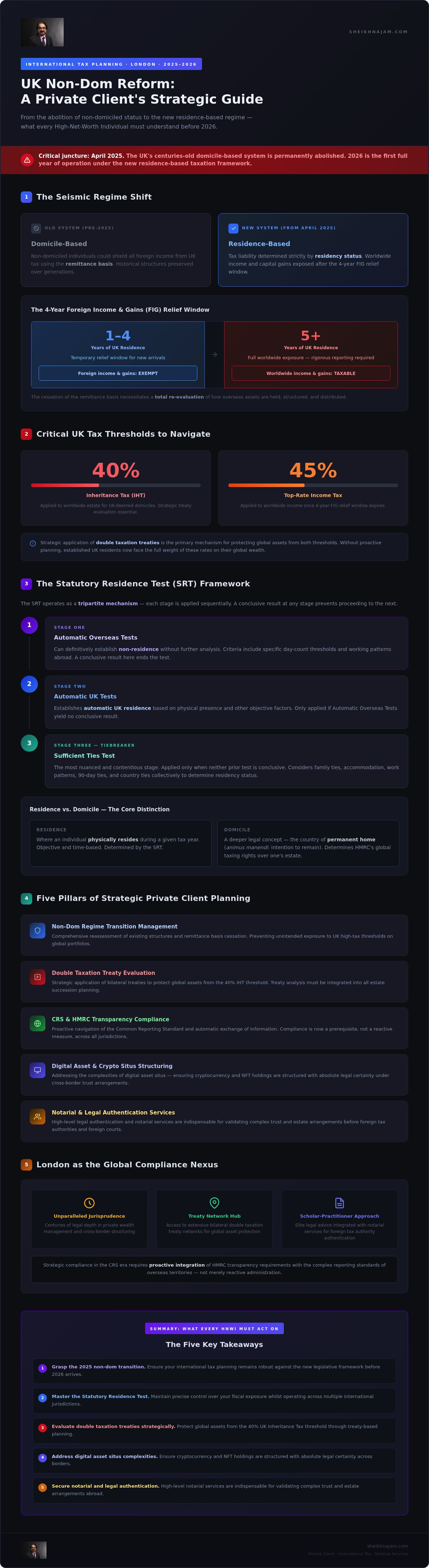
The year 2026 represents a critical juncture for High-Net-Worth Individuals (HNWIs) because it marks the first full year of operation under the new residence-based taxation framework. The definitive transition from the traditional remittance basis of taxation, which historically allowed non-domiciled individuals to shield foreign income from UK tax, to a regime based strictly on residency status, fundamentally alters the fiscal landscape. For the global citizen, this period demands a meticulous review of existing structures to prevent unintended exposure to the UK's high tax thresholds, which can reach 40% for inheritance tax and 45% for top-rate income tax.
The Shift from Domicile to Residence-Based Taxation
The legislative pivot away from domicile status significantly impacts long-term UK residents who've historically relied on their non-dom status to manage their global tax footprint. Under the new regulations effective from April 2025, individuals who've been resident in the UK for more than four years will find themselves subject to UK tax on their worldwide income and capital gains. This shift necessitates a sophisticated understanding of the four-year Foreign Income and Gains (FIG) regime, which provides a temporary window of relief for new arrivals but leaves established residents facing a much more rigorous reporting environment. Strategic planning must now account for the cessation of the remittance basis, requiring a total re-evaluation of how overseas assets are held and distributed.
London's Role in Global Fiscal Compliance
In an era defined by the Common Reporting Standard (CRS) and the automatic exchange of information, London legal practices act as the vital bridge between UK statutory requirements and foreign jurisdictional mandates. Strategic compliance is no longer a reactive measure; it's a proactive necessity that requires the integration of elite legal advice with notarial services to authenticate documents for foreign tax authorities. Effective international tax planning London now requires a scholar-practitioner approach to navigate the intersection of HMRC’s transparency initiatives and the complex reporting standards of overseas territories. This multidisciplinary synthesis ensures that global portfolios remain compliant with both domestic law and international treaties, providing the legal certainty required for long-term wealth preservation.
Navigating Domicile, Residence, and the Statutory Residence Test
In the sophisticated sphere of international tax planning London, it's essential to distinguish with absolute precision between the concepts of residence and domicile. Whilst residence generally refers to the jurisdiction where an individual physically resides during a tax year, domicile is a more profound legal concept, representing the country an individual considers their permanent home, or where they possess an animus manendi (intention to remain). These distinctions are not merely academic; they form the bedrock of your global tax liability, determining whether HMRC may claim taxing rights over your worldwide estate or merely your UK-sourced income.
The Statutory Residence Test (SRT) provides a rigorous framework for determining residency, moving away from the historical ambiguity of 'common law' residence. It functions as a tripartite mechanism, beginning with the Automatic Overseas Tests, which can definitively establish non-residence, and proceeding to the Automatic UK Tests. If neither category provides a conclusive result, the Sufficient Ties Test is applied. For individuals transitioning between global capitals, Split Year treatment often provides a vital mechanism to divide the tax year, ensuring that income arising before arrival or after departure isn't caught within the UK's fiscal net. Engaging with a specialist in international tax planning ensures that these transitions are managed with the requisite level of strategic foresight.
The Mechanics of the Statutory Residence Test
Precise day-counting is paramount under the SRT, where the 'midnight principle' dictates that a day is generally counted if the individual is present in the UK at the end of the day. However, the complexity deepens when identifying 'Sufficient Ties', which include:
The Accommodation Tie: Available UK accommodation for a continuous period of 91 days.
The Work Tie: Working in the UK for at least 40 days in a tax year.
The Family Tie: Having a relevant relationship with a UK resident person, such as a spouse or minor child.
The 90-Day Tie: Spending more than 90 days in the UK in either of the two previous tax years.
It's clear that lifestyle choices, such as the frequency of visits or the maintenance of a London pied-à-terre, directly impact your residency status and, consequently, your global tax exposure.
Domicile of Origin vs. Domicile of Choice
Domicile of origin is acquired at birth and possesses a remarkable legal tenacity; it's notoriously difficult to displace. Establishing a domicile of choice requires more than mere residence; it demands a total severance of ties with the former jurisdiction and a demonstrable intent to reside in a new jurisdiction permanently, a process that forms a cornerstone of effective international tax planning London. We must also consider the 'Deemed Domicile' rule, which categorises individuals as domiciled for all tax purposes once they've been resident in the UK for 15 of the prior 20 tax years. This status triggers a significant shift in exposure to UK Inheritance Tax, making proactive estate structuring an absolute necessity for long-term residents.
Strategic Mitigation of Global Inheritance Tax and Estate Succession
The imposition of a 40% Inheritance Tax (IHT) on worldwide assets represents a formidable challenge for the global elite, particularly those whose estates fall within the scope of UK fiscal jurisdiction through domicile or long-term residence. Effective international tax planning London necessitates a meticulous analysis of how these charges apply to non-UK situs assets, ensuring that the transition of wealth doesn't trigger punitive tax events. Strategic mitigation often involves the sophisticated utilisation of Potentially Exempt Transfers (PETs), where lifetime gifts may escape the IHT net provided the donor survives for a period of seven years. For the cross-border client, the simple application of domestic exemptions is rarely sufficient; one must consider the profound interplay of international treaties and the legal characterisation of assets in foreign territories.
Treaty Relief and Double Taxation Agreements
The United Kingdom possesses an extensive network of Double Taxation Agreements (DTAs) designed to prevent the same estate from being taxed by multiple jurisdictions. These treaties are especially critical when dealing with high-value assets in the USA, Switzerland, or the Middle East, where the criteria for tax exposure may differ fundamentally from UK standards. In instances where a formal treaty doesn't exist, one must look toward unilateral relief, a mechanism by which HMRC allows credit for foreign taxes paid on overseas property. Navigating these agreements requires a high level of technical precision to ensure that credits are correctly applied and that the estate doesn't suffer from a lack of jurisdictional coordination.
Succession Planning for Non-UK Assets
A primary friction point in global estate management is the conflict of laws between lex situs (the law of the place where the property is situated) and lex domicilii (the law of the individual's domicile). Whilst English law generally respects the principle of testamentary freedom, many civil law jurisdictions impose forced heirship rules that can disrupt even the most carefully drafted plans. Integrating international wills London into the broader strategy allows for a multidisciplinary approach that accounts for these jurisdictional variances. By utilising trusts and foundations, clients can achieve a level of asset protection that transcends borders, whilst simultaneously addressing the risks of contentious probate London through proactive, legally sound structuring. This strategic foresight ensures that the devolution of an estate remains a private, efficient, and legally certain process, regardless of the geographic distribution of the underlying wealth.
Structuring Digital Assets and Cross-Border Trust Arrangements
The burgeoning presence of digital assets, including cryptocurrencies and non-fungible tokens (NFTs), within the portfolios of global private clients has necessitated a fundamental recalibration of international tax planning London. These decentralised instruments, whilst offering significant growth potential, introduce profound questions regarding the situs of assets and the consequent fiscal obligations of the holder. To mitigate these risks, the implementation of cross-border trust arrangements provides an essential framework for asset segregation and long-term fiduciary oversight, ensuring that digital wealth is managed with the same degree of meticulousness as traditional real estate or equity holdings.
According to current HMRC guidance, the tax situs of crypto-assets is determined by the residency of the beneficial owner, meaning that a UK-resident individual is liable for UK taxation on their global digital holdings regardless of the decentralised nature of the ledger.
Fiduciary Management of Digital Wealth
The fiduciary administration of cryptographic interests necessitates an unparalleled degree of technical and legal precision, particularly regarding the secure transmission of private keys and the custodial management of hardware wallets within a testamentary framework. Fiduciaries must now account for the nuances of 'staking' income and gains derived from decentralised finance (DeFi) platforms, which HMRC frequently classifies as miscellaneous income rather than capital gains, depending on the nature of the activity and the degree of risk involved. This classification significantly impacts the effective tax rate, requiring a meticulous approach to record-keeping and valuation to ensure the estate remains compliant with both UK and international reporting standards.
Compliance and Financial Crime Advisory
In an environment of heightened regulatory scrutiny, the transfer of high-value digital assets must be underpinned by rigorous Anti-Money Laundering (AML) protocols and comprehensive financial crime advisory. Family offices and private clients face unique risks associated with the provenance of digital wealth, necessitating a proactive stance on disclosure and transparency to satisfy both domestic and international regulatory bodies. Protecting client privacy whilst adhering to the mandates of the Common Reporting Standard requires a sophisticated synthesis of cryptographic security and legal jurisprudence. Individuals seeking to institutionalise their digital holdings should consider professional Digital Asset Structuring to ensure their arrangements meet the highest standards of fiscal and regulatory integrity.
The Necessity of Notarial and Professional Legal Advisory
The assumption that accounting advice alone provides a sufficient shield against the complexities of global fiscal oversight is a common, yet potentially perilous, misconception held by many high-value clients. The efficacy of international tax planning London is fundamentally predicated upon a multidisciplinary synthesis that transcends mere arithmetic calculation; it requires the rigorous application of legal jurisprudence and the meticulous authentication of documents for foreign jurisdictions. Whilst an accountant may provide the requisite fiscal calculations, they often lack the statutory authority to validate those structures in a manner recognised by overseas registries and tax authorities. This is where the intersection of legal expertise and notarial authority becomes paramount, ensuring that every element of a cross-border strategy is both fiscally efficient and legally unassailable.
The vital role of notarial services becomes apparent when one considers the necessity of authenticating cross-border declarations, trust deeds, and corporate resolutions. Without this formal authentication, documents often fail to meet the stringent evidentiary standards of foreign tax bodies, leading to protracted disputes and potential fiscal penalties. Engaging a specialist who operates as a Strategic Polymath ensures that the nuances of tax law are seamlessly integrated with the formal requirements of international document validation, providing a level of security that single-discipline firms simply cannot match.
Authentication and Apostille Services for Global Tax
A Notary Public, appointed by the Court of Faculties, serves as a critical intermediary in the international legal order, providing the necessary certification for powers of attorney and tax declarations intended for use abroad. This process often involves the attainment of an apostille through the Foreign, Commonwealth & Development Office, ensuring that documents possess the requisite legal weight in jurisdictions signatory to the Hague Convention. For the global client, this authentication is indispensable for ensuring that international wills are seamlessly recognised by foreign probate registries. By securing these legalisations early, you avoid the jurisdictional friction and administrative delays that frequently compromise the efficient devolution of a multi-jurisdictional estate.
The Integrated Advisory Model
The Strategic Polymath approach integrates tax strategy with civil and commercial dispute resolution, often utilising mediation to resolve complex trust or inheritance conflicts before they escalate into costly litigation. When selecting a master advisor, the TEP (Trust and Estate Practitioner) designation serves as the gold standard, signifying a profound level of expertise in the technicalities of estate succession and fiduciary management. As the fiscal year 2026 approaches, the final imperative for any global private client is to conduct a comprehensive international tax planning London health check. This proactive review ensures that all structures, from digital asset holdings to multi-jurisdictional trusts, remain fully compliant with HMRC and international reporting standards, providing the legal certainty required to protect a legacy across generations.
Strategic Fortification of Global Wealth in a Residence-Based Era
The transition toward a residence-based fiscal regime in 2026 necessitates a profound recalibration of how global affairs are structured. You've observed that the mere possession of a non-domiciled status no longer provides the historical shield it once did, making meticulous international tax planning London an absolute prerequisite for wealth preservation. Success in this new landscape depends upon the seamless integration of notarial authentication with strategic legal foresight, ensuring that every asset, from traditional real estate to complex digital holdings, remains protected against jurisdictional friction and punitive tax thresholds.
Securing your legacy across multiple borders requires a master advisor who operates at the intersection of several complex fields simultaneously. As a TEP accredited practitioner and an appointed Notary Public by The Court of Faculties, Sheikh Najam TEP provides the multi-jurisdictional legal jurisprudence necessary to navigate these high-stakes transitions with absolute precision. Precision is the bedrock of global security. Instruct Sheikh Najam TEP for Expert International Tax and Estate Advisory to conduct a comprehensive health check of your global affairs. Your commitment to rigorous compliance today ensures the unassailable security of your estate for generations to come.
Frequently Asked Questions
What is the Statutory Residence Test and how does it affect my UK tax status?
The Statutory Residence Test (SRT) is the definitive legislative framework utilised by HMRC to determine an individual's tax residency status with absolute precision. It operates through a series of hierarchical tests, including automatic overseas and UK tests, followed by the sufficient ties test where necessary. Your residency status dictates the extent of your liability to UK taxation on worldwide income and gains. It's a cornerstone of any robust strategy for international tax planning London.
How has the 2025 removal of the 'Non-Dom' regime changed international tax planning in London?
The 2025 legislative shift marks the definitive transition from a domicile-based system to a residence-based taxation framework. This reform removes the remittance basis for individuals resident in the UK for more than four years, subjecting their worldwide income to UK tax. Effective international tax planning London now requires a proactive reassessment of how overseas assets are structured to mitigate exposure to the 45% top-rate income tax and capital gains liabilities.
Can I be taxed on the same income in two different countries?
Dual taxation remains a significant risk for global private clients where jurisdictions assert competing taxing rights over the same income or capital gains. Double Taxation Agreements (DTAs) are strategic instruments designed to mitigate this risk by allocating taxing rights or providing tax credits. In the absence of a treaty, unilateral relief may be available through HMRC. It's essential to ensure that foreign tax payments are correctly documented to claim these vital offsets.
What are the tax implications of owning digital assets like Bitcoin in the UK?
HMRC treats digital assets as property, meaning disposals are generally subject to Capital Gains Tax at rates of up to 20%. The situs of these assets is determined by the residency of the beneficial owner, which brings worldwide digital holdings into the UK tax net for residents. Complexities arise with 'staking' and DeFi activities, which may be classified as miscellaneous income. Meticulous record-keeping is required to ensure compliance with digital asset reporting standards.
Is an international will necessary if I already have a UK will?
A UK will often proves insufficient for assets situated in foreign jurisdictions, particularly those governed by civil law and forced heirship rules. An international will ensures that your testamentary intentions are recognised across multiple borders, preventing the application of lex situs laws that might contradict your wishes. This approach provides legal certainty for estate succession. It mitigates the risk of jurisdictional friction and potential trust or probate disputes in foreign courts.
How does a Notary Public assist with international tax and estate matters?
A Notary Public provides the essential authentication and certification required for legal documents to be recognised by foreign tax authorities and probate registries. This process often includes obtaining an apostille to satisfy the requirements of the Hague Convention. Without this high-level validation, powers of attorney or trust deeds may be rejected by overseas jurisdictions. It's a critical component of ensuring that your international legal arrangements possess the necessary evidentiary weight.
What is the current Inheritance Tax rate for non-UK domiciled individuals?
The standard rate of Inheritance Tax (IHT) is 40% on the value of an estate exceeding the £325,000 nil-rate band. Whilst non-domiciled individuals were historically taxed only on UK-situs assets, the new residence-based rules pull worldwide assets into the IHT net after 15 years of residency. Strategic mitigation requires the sophisticated use of trusts and potentially exempt transfers. These measures ensure that global wealth isn't disproportionately eroded by UK death duties.
Can mediation help resolve international tax or trust disputes?
Mediation offers a sophisticated, private alternative to the public and adversarial nature of High Court litigation for resolving complex trust or tax disputes. It allows parties to reach a mutually acceptable resolution under the guidance of a Master Advisor, preserving family relationships and protecting sensitive financial information. This multidisciplinary approach is particularly effective in multi-jurisdictional matters where legal nuances differ. It provides a strategic mechanism for achieving closure without the costs of protracted legal proceedings.


Comments