International Tax Structuring for Private Clients: A Strategic Legal Framework (2026)
- S Najam
- 3 hours ago
- 12 min read

The mere accumulation of capital has been superseded by the necessity for its rigorous legal fortification, as the 2026 global fiscal landscape demands a level of multi-disciplinary precision that traditional wealth management often fails to provide. You're likely aware that the intricacies of the UK Statutory Residence Test, alongside the stringent oversight of the FATF Travel Rule, have transformed the pursuit of fiscal efficiency into a high-stakes exercise in regulatory navigation. This article offers a comprehensive analysis of international tax structuring for private clients, presenting a sophisticated framework for multi-jurisdictional tax mitigation and the strategic deployment of fiduciary vehicles.
We'll explore the integration of digital assets within robust estate plans, the mitigation of inheritance and capital gains tax liabilities, whilst detailing the specific methodologies required to ensure long-term security amongst shifting international jurisdictions. By synthesising academic rigour with practical legal foresight, we provide the clarity needed to manage your most intricate global affairs with absolute certainty. This discourse serves as a definitive guide for the sophisticated individual seeking to reconcile multi-generational wealth preservation with the uncompromising demands of modern compliance and global transparency.
Table of Contents
The Jurisprudence of International Tax Structuring for Private Clients
Strategic Fiduciary Vehicles: Trusts, Foundations, and Holding Companies
Navigating the UK Statutory Residence Test and Double Taxation Treaties
Modern Compliance: Digital Asset Structuring and AML Protocols
The Integrated Approach: Notarial Authority and Specialist Advisory
The Jurisprudence of International Tax Structuring for Private Clients
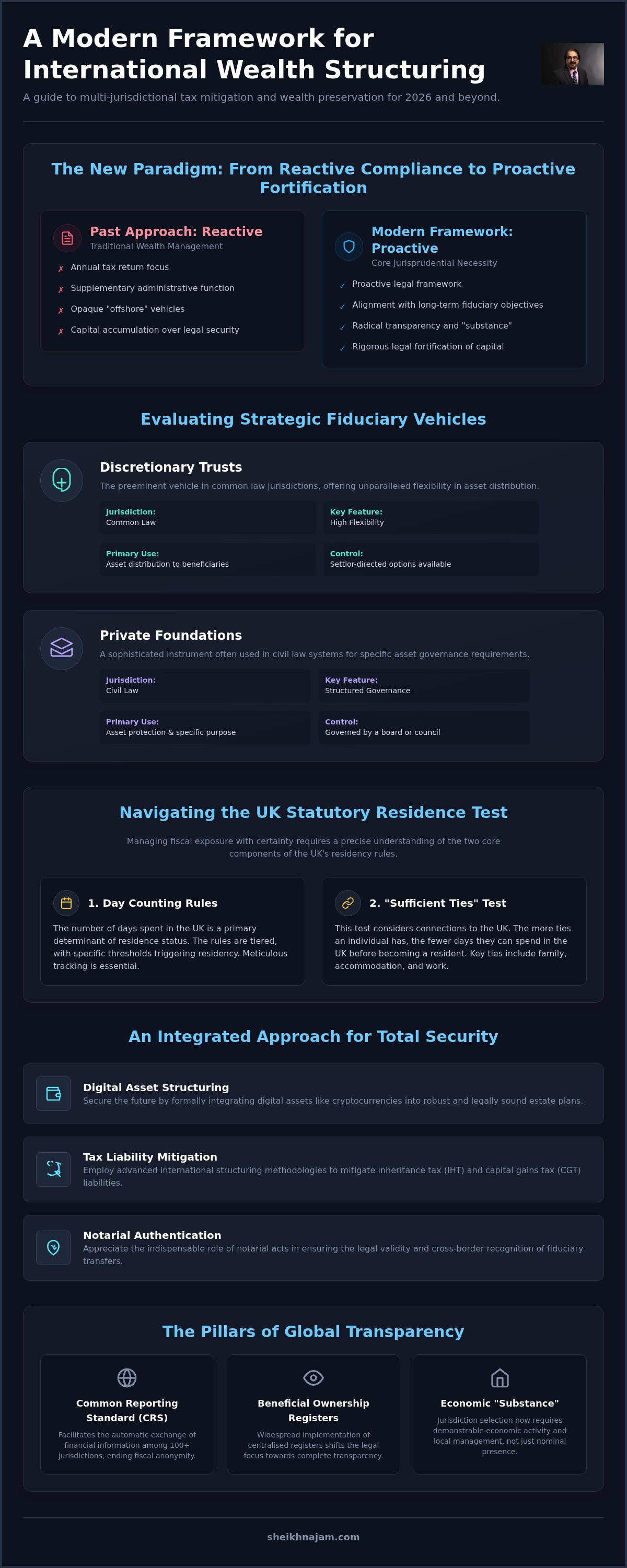
The discipline of international tax structuring for private clients has transitioned from a supplementary administrative function into a core jurisprudential necessity. It's no longer sufficient to react to annual tax returns; instead, one must construct a proactive legal framework that anticipates the inherent friction between disparate legal systems. This strategic alignment ensures that cross-border asset holdings aren't merely compliant but are fundamentally integrated with the client’s broader fiduciary objectives. The modern practitioner acts as a Strategic Polymath, synthesising principles of international tax planning with trust law and regulatory compliance to protect multi-generational wealth. This meticulous organisation of capital serves as a defensive bulwark against the volatility of international fiscal policy.
The Evolution of Fiscal Transparency and Global Standards
The era of opaque "offshore" vehicles has been definitively superseded by a regime of radical transparency. The Common Reporting Standard (CRS) facilitates the automatic exchange of financial information amongst over 100 jurisdictions, rendering the concept of fiscal anonymity a relic of the past. By 2026, the widespread implementation of centralised beneficial ownership registers across major global financial centres has shifted the focus toward "substance" as a primary legal requirement. Selection of a jurisdiction now requires demonstrable economic activity and local management rather than mere nominal presence. This evolution demands a meticulous approach to structure where legitimacy is derived from transparency, ensuring that every vehicle within a client's portfolio serves a genuine commercial or fiduciary purpose.
Fiduciary Responsibility in a Multi-Jurisdictional Context
Asset protection for high-net-worth families rests upon the twin pillars of legal robustness and ethical management. One must balance the pursuit of fiscal efficiency with the absolute necessity of maintaining clear legal title and control across multiple borders. The advisor’s role is to ensure that the architecture of a trust or holding company can withstand the simultaneous scrutiny of multiple revenue authorities, particularly when navigating the tension between common law and civil law interpretations of ownership. International tax structuring is the methodical organisation of wealth to mitigate fiscal leakage whilst ensuring absolute regulatory adherence. This integrated approach provides the necessary security for assets to transition seamlessly across generations, safeguarding the family's legacy from the erosion caused by administrative instability or legal ambiguity.
Strategic Fiduciary Vehicles: Trusts, Foundations, and Holding Companies
Effective international tax structuring for private clients necessitates a meticulous selection of fiduciary vehicles that serve as the definitive architecture for cross-border wealth preservation. These entities aren't merely administrative shells; they're sophisticated legal instruments designed to operate within the increasingly rigorous OECD international tax framework. Whilst holding companies are frequently utilised to mitigate capital gains and withholding tax liabilities, their true value lies in providing a centralised nexus for global asset governance. For UK-resident investors, Dutch holding company structures offer a particularly compelling mechanism for reconciling international investment activities with domestic tax obligations, provided they're established with genuine economic substance and professional oversight.
The Common Law Trust: Flexibility and Control
The discretionary trust remains the preeminent vehicle for those operating within common law jurisdictions, offering unparalleled flexibility in the distribution of assets amongst beneficiaries. Settlor-directed trusts allow for active participation in investment strategy whilst maintaining the necessary legal separation for robust asset protection. However, the practitioner must navigate the complexities of the UK "relevant property" regime, where ten-year anniversary charges and exit charges can significantly erode the fiscal efficiency of the structure if not meticulously planned. Trustees today must balance their traditional fiduciary duties with a need for strategic foresight in a market defined by rapid regulatory shifts. Should you require a bespoke review of your existing arrangements, a formal consultation can ensure your fiduciary structures remain robust against future legislative changes.
Civil Law Foundations and Hybrid Structures
In jurisdictions where the concept of the trust isn't natively recognised, such as in continental Europe or the Middle East, the private foundation provides a robust alternative. Unlike a trust, a foundation possesses its own distinct legal personality, which can simplify the holding of non-financial assets like real estate and fine art across multiple borders. We're seeing an increasing emergence of hybrid vehicles that synthesise the transparency of foundations with the flexibility of trusts to satisfy both civil and common law requirements simultaneously. This strategic entity selection is vital for the seamless transmission of wealth, ensuring that legal title remains secure whilst facilitating a structured succession plan for the next generation. By choosing the correct vehicle, the private client ensures that their legacy is not only preserved but is also capable of adapting to the legal nuances of the jurisdictions in which their heirs reside.
Navigating the UK Statutory Residence Test and Double Taxation Treaties
For the internationally mobile individual, the efficacy of international tax structuring for private clients is inextricably linked to their personal tax nexus. One's physical presence and social ties are no longer matters of casual observation; instead, they're subject to the rigid parameters of the UK Statutory Residence Test (SRT). This legislative framework dictates that an individual is automatically considered a UK resident if they spend 183 or more days in the UK during a tax year. Even when automatic overseas tests appear satisfied, the "sufficient ties" test can inadvertently draw an individual into the UK tax net. This necessitates a methodical approach to managing one's global footprint to preserve the fiscal integrity of the broader wealth structure.
The Statutory Residence Test: A Meticulous Approach
The "sufficient ties" test operates on a sliding scale where the number of days spent in the UK is balanced against the strength of one's connections, such as family, accommodation, and work. For the high-net-worth individual, contemporaneous record-keeping isn't merely a recommendation; it's a defensive necessity. Precise logs of travel, boarding passes, and lease agreements must be maintained to rebut any HMRC enquiry under the updated RDR3 guidance as of June 2026. A shift in residence status isn't a neutral event. It often triggers immediate reporting obligations or exit taxes on unrealised gains, requiring a strategic review of asset valuations well in advance of any relocation.
Double Taxation Protocols and Treaty Relief
Whilst the SRT determines domestic residency, Double Taxation Treaties (DTAs) serve as the primary mechanism to prevent the erosion of wealth by competing jurisdictions. These treaties often contain "tie-breaker" clauses to resolve instances where an individual is considered a resident under the domestic laws of two different countries. Effective international tax structuring for private clients utilises these protocols to claim relief on dividends, interest, and capital gains, ensuring that tax paid in one jurisdiction is credited against liabilities in another. It's particularly pertinent for those approaching "deemed domicile" status, occurring after 15 years of UK residence, as their global estate becomes subject to UK inheritance tax. Treaty relief is not automatic but requires precise notarial and legal substantiation.
Modern Compliance: Digital Asset Structuring and AML Protocols
The integration of cryptoassets and non-fungible tokens (NFTs) into a sophisticated wealth portfolio presents a paradigm shift in the discipline of international tax structuring for private clients. These assets, characterised by their decentralised nature and jurisdictional fluidity, bypass traditional financial intermediaries, thereby creating significant challenges for valuation and reporting. By 2026, the market capitalisation of stablecoins has exceeded $300 billion, a figure that underscores the necessity for rigorous legal governance. Precision is required here. Strategic protocols must be established to ensure that digital portfolios are not only compliant with domestic revenue authorities but are also fortified against the inherent risks of the digital frontier. This involves the meticulous documentation of acquisition costs and the implementation of secure custody solutions that permit fiduciary access without compromising the security of the underlying private keys.
Structuring Digital Wealth for Succession
A primary concern for the high-net-worth individual is the potential loss of digital wealth due to incapacity or the absence of a structured inheritance plan. Traditional testamentary instruments are often insufficient to manage the technical specificities of blockchain-based assets. One must synchronise digital asset protocols with international wills to ensure a seamless transition of legal title. Digital asset trusts have emerged as a robust mechanism for this purpose, providing a framework where trustees can manage assets according to specific instructions whilst maintaining the requisite legal separation. These vehicles must be drafted with precision. They must be recognised across disparate jurisdictions, particularly those that have yet to codify the legal status of virtual property.
Regulatory Compliance and Risk Mitigation
The global regulatory environment has become increasingly hostile to opaque financial flows, necessitating a proactive approach to Anti-Money Laundering (AML) and Know Your Customer (KYC) protocols. As of June 2026, the Financial Action Task Force (FATF) Travel Rule requires virtual asset service providers to ensure that accurate originator and beneficiary information accompanies any crypto transaction exceeding $1,000. For the private client, this means that source-of-wealth (SoW) documentation is no longer a formality but a cornerstone of international banking relationships. Standards are rising globally. Designing internal compliance frameworks that exceed these global standards mitigates both legal and reputational risks. Should you require a bespoke analysis of your digital holdings, you may contact our specialist advisory team to ensure your estate remains both secure and fully compliant with current international standards.
The Integrated Approach: Notarial Authority and Specialist Advisory
The efficacy of international tax structuring for private clients remains a purely theoretical exercise unless it's supported by the rigorous authentication of the underlying legal documentation. In a multi-jurisdictional context, the validity of a trust deed or a corporate resolution is entirely contingent upon its recognition by foreign revenue authorities and financial institutions. This is where the synthesis of notarial authority and specialist legal advisory becomes indispensable. By ensuring that every instrument is executed with the requisite formality, the practitioner provides a level of security that mere tax advice cannot achieve. It's about creating a structure that's not only fiscally efficient but legally unassailable across disparate legal systems, providing a defensive bulwark against future jurisdictional challenges.
The Notary as a Gatekeeper of Global Legal Integrity
The Notary Public acts as a vital gatekeeper of global legal integrity, particularly when managing the complexities of the Apostille and consular legalisation. These processes are not mere administrative hurdles; they're the definitive mechanisms by which a document's legal standing is transmitted across borders. Whether establishing a power of attorney for a property transaction in a civil law jurisdiction or validating a trust's capacity to hold assets, the Notary's verification of capacity and intent is paramount. This meticulous attention to detail prevents the failure of international structures due to procedural deficiencies or challenges to the validity of execution. In an era of heightened transparency, the role of the Notary in validating corporate authorities and cross-border transfers ensures that the chain of legal title remains unbroken and beyond reproach.
Securing the Future: A Comprehensive Fiduciary Strategy
A comprehensive fiduciary strategy requires a multi-disciplinary perspective that extends far beyond transactional advice. One must integrate tax planning with dispute resolution and mediation to protect the unity of the family and the longevity of the estate. Internal conflicts amongst beneficiaries can be as damaging to wealth as external tax liabilities; therefore, a proactive approach to mediation ensures that the structure remains resilient against the friction of multi-generational wealth transfer. This level of oversight is the hallmark of the Strategic Polymath, where academic rigour is applied to the preparation of complex legal opinions and the management of intricate global affairs. To ensure your structures are established with absolute precision and foresight, you are invited to consult with Sheikh Najam TEP and secure a framework that protects your legacy for the generations to follow.
Fortifying Your Global Legacy Through Strategic Precision
The mastery of international tax structuring for private clients in 2026 requires more than a passing familiarity with fiscal code; it demands the synthesis of multi-jurisdictional jurisprudence, meticulous fiduciary management, and the proactive integration of emerging asset classes. We've established that the security of a global estate is predicated upon the alignment of robust structures, such as discretionary trusts and foundations, with the stringent demands of the UK Statutory Residence Test and international AML protocols. This framework is only as strong as its weakest link, which is why the authentication provided by notarial authority remains a cornerstone of successful cross-border transfers.
As a member of the Society of Trust and Estate Practitioners (TEP) and a Public Officer appointed by The Court of Faculties, I specialise in the resolution of complex cross-border fiduciary disputes and the creation of unassailable wealth structures. Your legacy deserves the precision of a master advisor who operates at the intersection of law, finance, and technology. You're invited to arrange a strategic consultation for your international tax affairs to ensure your interests are protected with absolute meticulousness. Fortifying your future is a deliberate act of strategic foresight.
Frequently Asked Questions
What is the primary benefit of international tax structuring for a private client?
The primary benefit lies in the methodical organisation of wealth to mitigate fiscal leakage whilst ensuring absolute regulatory adherence across multiple jurisdictions. By establishing a proactive legal framework, international tax structuring for private clients allows you to align global holdings with long-term fiduciary objectives. This approach provides a defensive bulwark against the volatility of international fiscal policy and ensures that assets transition seamlessly across generations without being eroded by unforeseen liabilities or administrative instability.
How does the UK Statutory Residence Test affect my global tax liability?
The UK Statutory Residence Test serves as the definitive determinant of your fiscal nexus within the United Kingdom. If you satisfy the automatic residency criteria, such as spending 183 or more days in the UK, your worldwide income and gains become subject to UK taxation. Even for those spending fewer days, the sufficient ties test can trigger residency based on family, accommodation, or work connections. Precise day counting is essential to manage this exposure effectively.
Can I use a trust to hold digital assets like Bitcoin for inheritance purposes?
You can certainly utilise a trust to hold digital assets like Bitcoin, provided the instrument is drafted with the technical precision required for blockchain-based property. Digital asset structuring ensures that private keys are managed within a fiduciary framework, preventing the loss of wealth due to incapacity or the absence of a succession plan. These vehicles must be synchronised with international wills to ensure legal recognition and a seamless transfer of title to your chosen beneficiaries.
What is the difference between a trust and a private foundation for international planning?
A private foundation possesses its own distinct legal personality, whereas a trust is a fiduciary relationship between a settlor, trustees, and beneficiaries. Foundations are often favoured in civil law jurisdictions or the Middle East where the concept of the trust isn't natively recognised. Whilst trusts offer unparalleled flexibility in common law contexts, foundations can simplify the holding of non-financial assets like real estate and fine art across disparate legal systems due to their corporate-like structure.
How do double taxation treaties protect my income from being taxed twice?
Double taxation treaties function as primary mechanisms to prevent the erosion of wealth by competing revenue authorities. These protocols often include tie-breaker clauses that resolve instances of dual residency and provide tax credits for liabilities paid in foreign jurisdictions. By utilising these treaties, you ensure that dividends, interest, and capital gains aren't taxed twice. However, claiming this relief isn't automatic; it requires precise legal substantiation and, frequently, notarial authentication to satisfy international standards.
Why do international tax structures require notarial authentication?
Notarial authentication is the cornerstone of cross-border document recognition. Without the official seal of a Notary Public, international tax structuring for private clients may fail when presented to foreign registries or financial institutions. Processes like the Apostille and consular legalisation verify the capacity and intent of the parties involved, ensuring that trust deeds and powers of attorney are legally unassailable. This validation is essential for the seamless transmission of assets across disparate legal jurisdictions.
What are the AML compliance requirements for setting up an offshore structure?
Modern compliance demands robust Anti-Money Laundering protocols, including the meticulous documentation of your source of wealth. Under the 2026 global standards, such as the FATF Travel Rule, virtual asset service providers must verify originator information for transactions exceeding $1,000. Setting up an international structure now requires comprehensive Know Your Customer frameworks to satisfy banking regulations. These internal compliance measures mitigate reputational risks and ensure your fiduciary structures remain both secure and fully transparent to authorities.
How often should an international tax structure be reviewed for regulatory changes?
An international tax structure should be reviewed annually to account for the rapid evolution of global fiscal policy. Significant shifts, such as the 2026 implementation of OECD Pillar Two rules or the permanent changes introduced by the US One Big Beautiful Bill Act, can fundamentally alter the efficiency of existing vehicles. Regular oversight by a Master Advisor ensures that your estate remains compliant with shifting transparency standards and that your fiduciary objectives aren't compromised by legislative amendments.


Comments