Using a Dutch Holding Company for UK Residents: A Strategic Analysis of International Tax Structuring
- S Najam
- 15 hours ago
- 13 min read

The assumption that traditional offshore jurisdictions remain the pre-eminent choice for international asset preservation is increasingly being challenged by the sophisticated regulatory frameworks of the European mainland. For the high-net-worth individual residing in the United Kingdom, the strategic advantages of using a Dutch holding company for UK residents represent a paradigm shift from mere tax mitigation toward a holistic model of global corporate governance. You likely recognise that the contemporary fiscal environment, characterised by the tightening of Controlled Foreign Company (CFC) rules and the Transfer of Assets Abroad (TOAA) legislation, demands a structure that offers genuine economic substance rather than superficial convenience.
This analysis provides a comprehensive examination of the fiscal and legal implications inherent in Dutch corporate structures for those seeking to insulate international dividend streams from double taxation. We shall explore the meticulous requirements of the Dutch participation exemption, the impact of the 19 per cent corporate tax rate on initial profits, and the indispensable role of notarial authentication in maintaining cross-border compliance. Ultimately, you will possess a strategic blueprint for integrating Dutch entities into a robust UK estate plan, ensuring that your global subsidiaries remain both legally protected and fiscally efficient within the 2026 regulatory landscape.
Table of Contents
The Jurisprudence of Dutch Holding Structures for International Wealth
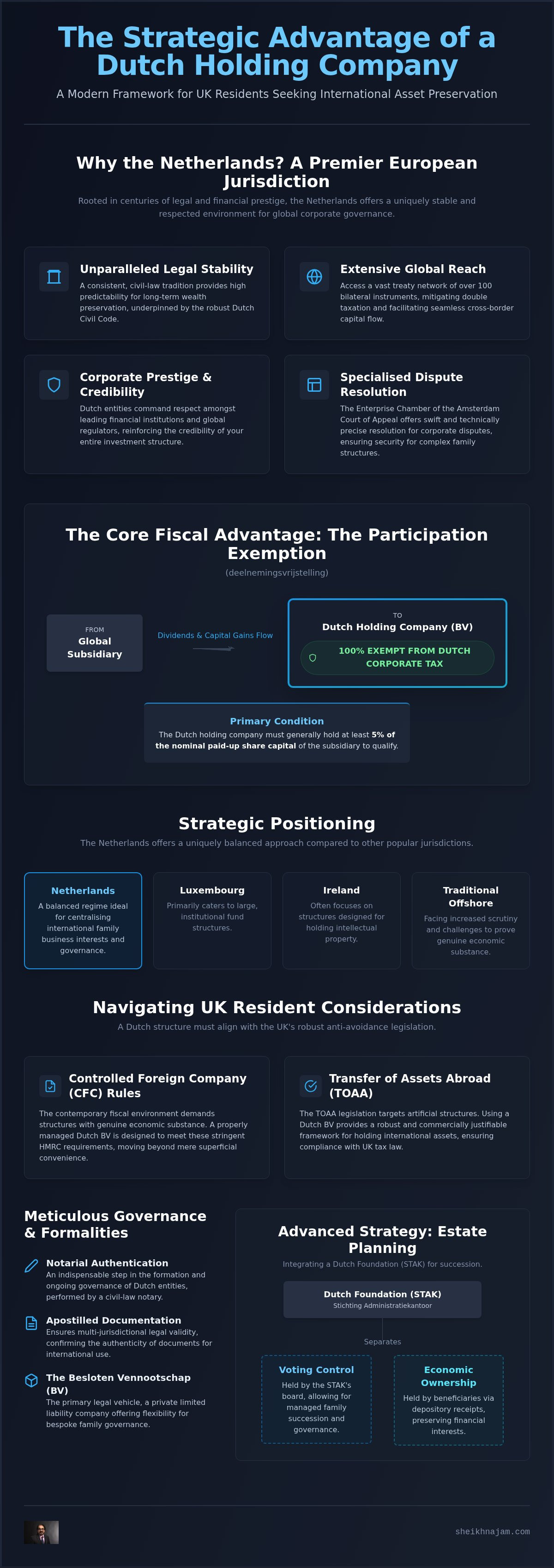
The historical trajectory of the Netherlands as a pre-eminent jurisdiction for the consolidation of global capital is not merely a product of fiscal opportunism; it's rooted in a sophisticated legal evolution that spans several centuries. Since the era of the Dutch East India Company, the nation has refined a legal environment that prioritises the stability of corporate structures and the protection of private property. For the discerning high-net-worth individual, using a Dutch holding company for UK residents provides a gateway to a treaty network that encompasses over 100 bilateral instruments, facilitating the seamless flow of capital across borders whilst mitigating the risks of jurisdictional overreach. The primary vehicle for such endeavours is the Besloten Vennootschap met beperkte aansprakelijkheid (BV), a private limited liability company that offers the requisite flexibility for bespoke family governance.
The stability of the Dutch legal system is a cornerstone of its prestige amongst European jurisdictions. Unlike many contemporary financial hubs that may be subject to sudden regulatory shifts, the Netherlands maintains a consistent, civil-law tradition that provides a high degree of predictability for long-term wealth preservation. This institutional weight is particularly valuable when managing global subsidiaries that require a neutral, well-regarded parent jurisdiction to facilitate international trade and investment. It's this combination of historical gravitas and modern efficiency that secures the BV's position as the gold standard for cross-border holding structures, offering a level of security that resonates with sophisticated investors nationwide.
The Strategic Rationale for UK-Resident Principals
For UK-resident principals, a Dutch entity serves as a critical nexus for consolidating international family business interests. Whilst Luxembourg often caters to institutional fund structures and Ireland focuses on intellectual property, the Dutch regime offers a uniquely balanced approach to international tax planning. From a Master Advisor perspective, the choice of the Netherlands is a strategic decision to align with a jurisdiction that commands respect amongst leading financial institutions and global regulatory bodies. It allows for the centralisation of governance, ensuring that diverse international assets are managed under a single, cohesive legal framework that respects the nuances of UK residency without compromising on global operational efficiency.
Legal Stability and the Dutch Civil Code
The Dutch Civil Code offers a level of granular protection for minority shareholders that is frequently absent in more aggressive jurisdictions. A significant feature of this legal landscape is the Enterprise Chamber (Ondernemingskamer) of the Amsterdam Court of Appeal, a specialised tribunal capable of resolving corporate disputes with remarkable speed and technical precision. This provides an underlying sense of security for wealth structures involving multiple family branches or external partners. The prestige associated with Dutch corporate entities ensures that your global affairs are conducted with a level of authority that reinforces the credibility of the entire investment structure, providing a robust foundation for long-term asset preservation.
The Participation Exemption and Fiscal Advantages
The cornerstone of the Netherlands' fiscal appeal for the sophisticated investor is the participation exemption, or deelnemingsvrijstelling. This regime ensures that all benefits derived from a qualifying shareholding, including dividends and capital gains, are entirely exempt from Dutch corporate income tax. To invoke this exemption, the Dutch entity must generally hold at least 5 per cent of the nominal paid-up share capital of the subsidiary. This threshold is a fundamental pillar for those using a Dutch holding company for UK residents, as it prevents the repetitive taxation of corporate profits as they move through a multi-tiered international structure. The exemption applies regardless of whether the subsidiary is located within or outside the European Union, provided it isn't a low-taxed portfolio investment company.
The treatment of capital gains is equally significant. Unlike many jurisdictions that tax the disposal of subsidiaries, the Dutch participation exemption extends to the full amount of the gain realised upon sale. This provides a tax-neutral environment for the realignment of global portfolios. It's essential to consult the UK-Netherlands tax treaty to understand how these provisions interface with British domestic law, particularly regarding the residence of the company and the prevention of fiscal evasion. Strategic implementation of a structure using a Dutch holding company for UK residents requires a meticulous approach to ensure that the entity isn't merely a pass-through vehicle but a substantive component of your global governance, respected by tax authorities nationwide.
Inbound Dividend and Capital Gains Protocols
Qualifying participations are defined by several criteria, primarily the 5 per cent ownership stake and the requirement that the subsidiary is subject to a tax on its profits. The prevention of double taxation is achieved through the total exclusion of these profits from the Dutch tax base, rather than a mere credit for foreign taxes paid. This provides a level of fiscal certainty that is highly valued by professional advisors across the United Kingdom. The following table illustrates the comparative treatment of foreign dividends:
Withholding Tax Mitigation Strategies
Navigating outbound payments requires a precise understanding of the 2026 conditional withholding tax regulations. While the standard dividend withholding tax remains at 15 per cent, exemptions often reduce this to 0 per cent for qualifying corporate shareholders. However, a conditional withholding tax of 25.8 per cent now applies to interest, royalties, and dividends paid to entities in jurisdictions with a statutory corporate tax rate of less than 9 per cent. This meticulous approach ensures compliance with the Multilateral Instrument (MLI) and its Principal Purpose Test, which scrutinises the underlying commercial rationale of the structure. If you require a detailed analysis of how these exemptions apply to your specific asset classes, you may arrange a formal consultation to discuss your requirements.
UK Resident Considerations: Navigating HMRC and CFC Rules
The transition from the advantageous Dutch fiscal landscape to the United Kingdom's rigorous anti-avoidance architecture requires a meticulous alignment of corporate reality with statutory expectations. For the individual principal, using a Dutch holding company for UK residents isn't a passive endeavour; it's a structural commitment that must withstand the scrutiny of His Majesty's Revenue and Customs (HMRC). Central to this is the Controlled Foreign Company (CFC) regime, which seeks to tax the undistributed profits of foreign entities controlled by UK residents. Fortunately, the Dutch corporate tax rates for 2026, set at 19 per cent for the initial €200,000 and 25.8 per cent thereafter, generally satisfy the "tax exemption" test, as the local liability exceeds 75 per cent of the corresponding UK corporation tax rate of 25 per cent. This safety net doesn't preclude the application of the Transfer of Assets Abroad (TOAA) provisions, which can attribute the income of the Dutch entity directly to the UK resident individual if the structure is deemed to lack a genuine commercial purpose.
Determining the tax residence of the Besloten Vennootschap (BV) depends heavily on the concept of "Central Management and Control." If HMRC determines that the real seat of management resides within the UK, the Dutch entity could be subject to UK corporation tax on its global income, effectively nullifying the benefits of the international structure. This risk is particularly acute for directors who manage their affairs from a UK-based home or office, necessitating a clear separation between personal residency and corporate decision-making. Strategic polymaths in this field recognise that the UK's dividend tax regime also remains a critical factor, as distributions from the Dutch entity to a UK resident shareholder will be subject to UK income tax, albeit with potential credits for Dutch withholding tax paid.
The Fiduciary Duty of Substance and Management
The era of the "letterbox company" has decisively ended, replaced by a global standard of economic substance that HMRC enforces with increasing vigour. To ensure the Dutch BV isn't classified as a UK tax resident, the high-level strategic decisions must demonstrably occur within the Netherlands. This necessitates a robust local presence, including the appointment of Dutch resident directors who possess the professional capacity to exercise independent judgment. In 2026, a Director-Major Shareholder (DGA) must receive a minimum salary of €58,000, a requirement that underscores the necessity for genuine personnel. Physical board meetings conducted on Dutch soil and the maintenance of a dedicated office space are no longer optional but are foundational requirements for defending the structure's integrity.
Remittance Basis and Non-Domiciled Considerations
For those navigating the complexities of the non-domiciled regime, Dutch structures offer a sophisticated conduit for managing international wealth whilst adhering to the 2026 reporting obligations under the Common Reporting Standard (CRS). The strategic use of a Dutch holding company can facilitate the categorisation of assets as "excluded property" for Inheritance Tax (IHT) purposes, provided the legal nexus is correctly established. This is particularly relevant given the tightening of Business Property Relief (BPR), which, from 6 April 2026, introduces a £2.5 million cap on 100 per cent relief. By integrating the Dutch entity into a broader framework of international tax planning, principals can maintain a degree of fiscal insulation whilst ensuring that all distributions are handled within the parameters of the UK's dividend tax regime.
Meticulous Governance: Notarial and Compliance Requirements
The execution of corporate instruments within the Netherlands is governed by a civil-law tradition that mandates the direct involvement of a civil-law notary (notaris). This requirement is a significant departure from the administrative filing procedures common in the United Kingdom. For the principal using a Dutch holding company for UK residents, the notary serves as an essential public officer, responsible for the authentication of the Deed of Incorporation and the verification of the underlying corporate articles. This procedural rigour ensures that the entity possesses full legal personality from its inception, providing a robust shield against future jurisdictional challenges. Compliance is not a static event but a continuous obligation, requiring periodic financial crime risk assessments and adherence to both Dutch and UK anti-money laundering standards.
The authority of a Dutch notary extends beyond mere witnessing; they possess a fiduciary duty to ensure that the corporate structure does not facilitate illicit activity. This involves a thorough examination of the source of wealth and the commercial rationale for the structure. Maintaining a high-value asset base through a Dutch vehicle requires a commitment to this level of scrutiny, which in turn reinforces the prestige and stability of the entity in the eyes of international banks and regulatory bodies. It's this culture of meticulousness that distinguishes the Netherlands from less regulated jurisdictions.
The Formation Protocol for a Dutch BV
Establishing a Dutch entity involves a structured sequence of legal actions that must be coordinated with absolute precision. The process begins with the drafting and notarisation of the Deed of Incorporation, a document that defines the company's objectives and internal governance. Following this, the entity must be formally registered with the Dutch Chamber of Commerce (Kamer van Koophandel), an action that incurs a one-time registration fee of €85.15 for 2026. Finally, the structure must satisfy the transparency requirements of the Register of Shareholders and the Ultimate Beneficial Owner (UBO) register. This tiered approach ensures that every facet of the corporate structure is documented and verified by competent authorities.
Notarial Authentication for International Commerce
The management of cross-border assets necessitates the frequent use of notarised and apostilled documentation to bridge the gap between different legal systems. When a UK resident cannot be physically present in the Netherlands for incorporation, a Power of Attorney must be executed and notarised to grant the necessary authority to local representatives. Recognising the notary public for company documents as a strategic advisor is vital for maintaining the integrity of these international arrangements. Certified true copies of passports and corporate records must be prepared with meticulous care to meet the stringent standards of Dutch financial institutions. For those requiring bespoke assistance with the authentication of cross-border corporate records, you may contact the practice directly to ensure your documentation adheres to the highest standards of international jurisprudence.
Strategic Synthesis: Integrating Dutch Structures into UK Estate Planning
The culmination of a robust multi-jurisdictional strategy lies in the seamless integration of corporate vehicles with personal succession objectives. For the principal using a Dutch holding company for UK residents, the Besloten Vennootschap (BV) functions as more than a mere fiscal conduit; it's a foundational element within a broader international tax planning framework. A particularly sophisticated instrument available in the Netherlands is the Stichting Administratiekantoor (STAK), or Dutch foundation. By transferring shares to a STAK, a family patriarch or matriarch can separate legal voting rights from economic ownership. This ensures that whilst the next generation receives the financial benefits of the assets, the strategic control remains centralised amongst competent directors, thereby preventing the fragmentation of a global business empire.
Effective wealth preservation requires that Dutch corporate shares are meticulously addressed within international wills. Without such alignment, the risk of jurisdictional conflicts between Dutch corporate law and UK probate requirements increases significantly. A multi-jurisdictional approach doesn't merely seek to minimise immediate tax liabilities; it aims to build a resilient legal fortress that survives the transition between generations. This long-term perspective is what distinguishes a masterly structure from a temporary arrangement, providing a sense of security that transcends standard fiscal advice.
Succession Planning and Asset Protection
The utilisation of a Dutch BV provides a formidable layer of protection for diverse interests, including international property portfolios and sophisticated digital asset structures. By centralising these assets under a Dutch parent company, the estate can significantly mitigate the risk of contentious probate. Disputes often arise from the lack of clarity in cross-border ownership; however, the transparent yet secure nature of Dutch governance provides a clear evidentiary trail. Should disagreements amongst beneficiaries occur, the Dutch legal tradition's emphasis on mediation and arbitration offers a private, authoritative alternative to public litigation, ensuring that family business affairs remain confidential and strategically aligned.
The Master Advisor Approach to Wealth Preservation
Ensuring the longevity of a Dutch-UK structure demands a multidisciplinary synthesis of notarial, tax, and trust expertise. It's not enough to simply incorporate; one must maintain rigorous financial crime compliance to safeguard the entity's standing in an era of global transparency. Every corporate action must be documented with precision, reflecting the meticulousness expected of an elite legal practice. To ensure that your international affairs are handled with absolute command and control, you're encouraged to arrange a formal consultation. This step is essential for aligning your Dutch corporate holdings with your personal estate objectives, ensuring a legacy that is as secure as it is tax-efficient.
Securing Global Legacies through Jurisdictional Alignment
The strategic deployment of a Dutch Besloten Vennootschap represents a sophisticated evolution in the management of international wealth. By prioritising economic substance and adhering to the stringent notarial protocols of the Dutch Civil Code, you ensure your corporate architecture remains resilient against the shifting sands of global tax regulation. Using a Dutch holding company for UK residents requires an exacting alignment between Dutch participation exemptions and British anti-avoidance legislation; it's a process that demands the oversight of a master advisor. This commitment to structural integrity provides a definitive shield for your global interests.
Maintaining the security of these structures necessitates a proactive integration with your broader estate objectives. Through the synthesis of expert notarial services for international affairs and TEP-qualified international tax planning, you can insulate your global portfolio from jurisdictional friction. As a specialist in complex cross-border estate administration, the practice provides the authoritative command and control required to protect your family's future. Your legacy deserves the precision of institutional weight and strategic foresight.
Secure your global assets with a bespoke consultation with Sheikh Najam TEP. Your international affairs will be handled with absolute precision and multi-disciplinary expertise.
Frequently Asked Questions
What is the primary benefit of a Dutch holding company for a UK resident?
The primary advantage of using a Dutch holding company for UK residents is the ability to centralise global investment income within a jurisdiction that offers a robust network of over 100 double taxation treaties. This structure facilitates the tax-neutral receipt of international dividends through the participation exemption, provided the 5 per cent shareholding threshold is maintained. It provides a sophisticated legal nexus for managing diverse subsidiaries whilst ensuring that capital remains insulated from immediate fiscal friction.
Does a Dutch BV protect against UK Inheritance Tax?
A Dutch BV doesn't offer an inherent shield against UK Inheritance Tax (IHT) for those domiciled in the United Kingdom, as HMRC generally taxes the global estate of its residents. However, it can be a vital component of a broader strategy to manage Business Property Relief (BPR). From 6 April 2026, the introduction of a £2.5 million cap on 100 per cent relief necessitates the use of such structures to organise assets efficiently within a single, professionally managed framework.
What are the substance requirements for a Dutch company to be recognised by HMRC?
To satisfy HMRC that the entity isn't a mere letterbox company, the Dutch BV must demonstrate genuine economic substance and local decision-making. This requires the presence of qualified resident directors and a physical office in the Netherlands where high-level strategic meetings occur. The 2026 minimum salary requirement of €58,000 for a Director-Major Shareholder (DGA) serves as a benchmark for the level of professional engagement expected by authorities when using a Dutch holding company for UK residents.
How does the Dutch Participation Exemption work for private investors?
The Dutch participation exemption (deelnemingsvrijstelling) operates by excluding qualifying dividends and capital gains from the company's taxable profit base. For a private investor holding assets through a BV, this means the company pays 0 per cent tax on these inbound returns. It's important to distinguish this corporate-level exemption from the personal income tax liabilities that arise when the UK resident principal eventually extracts those funds as personal dividends or salary payments through the UK tax regime.
Is a Dutch civil-law notary required for all corporate transactions?
Yes, the involvement of a Dutch civil-law notary is a mandatory legal requirement for the execution of several fundamental corporate instruments. This includes the initial Deed of Incorporation, any subsequent amendments to the Articles of Association, and the formal transfer of shares. Unlike the UK's administrative filing system, the Dutch tradition relies on the notary as a public officer to verify the legality and authenticity of these high-stakes international transactions, ensuring they meet rigorous regulatory standards.
Can a UK resident manage a Dutch holding company from the UK?
Whilst a UK resident may serve as a director, managing the entity entirely from the UK risks the company being classified as a UK tax resident under the Central Management and Control test. If HMRC determines that the real seat of governance is in London, the Dutch BV becomes liable for UK corporation tax on its global income. Maintaining the structure's integrity requires that high-level board resolutions and strategic oversight are demonstrably conducted within the Netherlands to preserve its fiscal independence.
What are the reporting requirements for UK residents with Dutch entities?
UK residents must navigate a complex landscape of reporting obligations, including the disclosure of their interest in a Controlled Foreign Company (CFC) on their annual Self-Assessment tax return. The Transfer of Assets Abroad (TOAA) rules also require careful reporting to ensure HMRC is aware of any income power held over the foreign entity. Additionally, the Dutch entity will be subject to the Common Reporting Standard (CRS), facilitating the automatic exchange of financial information between the respective tax authorities.
How do Dutch foundations (STAK) differ from UK family trusts?
A Dutch foundation (STAK) differs from a UK family trust by operating as a corporate entity that issues depository receipts (certificaten) representing the economic value of the shares it holds. Whilst a UK trust relies on the fiduciary relationship between trustees and beneficiaries, a STAK uses a contractual framework to separate voting rights from financial entitlement. This allows for a more rigid and predictable governance structure, particularly useful for preserving the unity of a family business across several generations.


Comments