Islamic Wills London: Protect Your Estate & Legacy

Updated: Aug 26
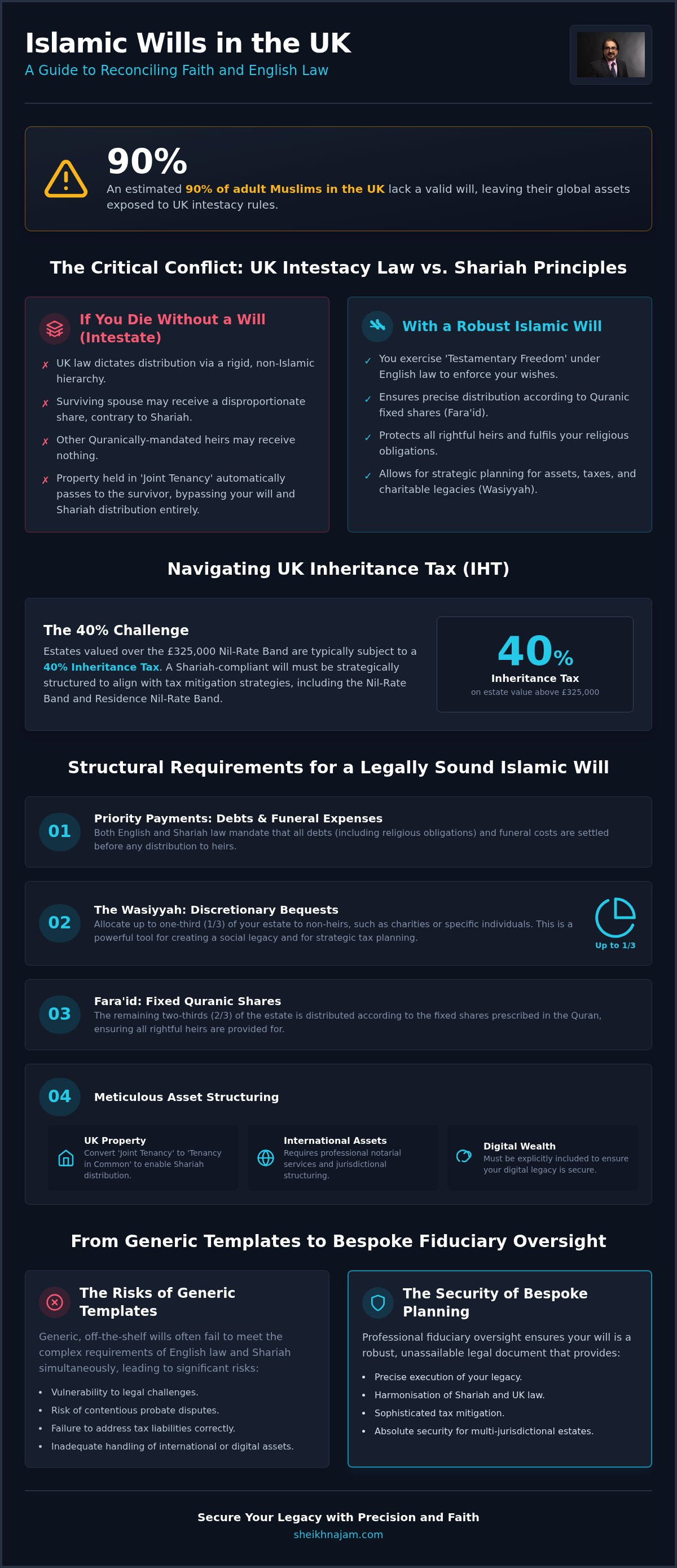
For the discerning estate owner, the preservation of a legacy represents a complex nexus where divine mandate meets the uncompromising precision of the English legal system. It's a sobering reality that approximately 90% of adult Muslims in the UK haven't secured a valid will, leaving their global assets vulnerable to the rigid, often contradictory, mechanisms of UK intestacy rules. You likely recognise that a standard testamentary document is insufficient to navigate the sophisticated requirements of Islamic Wills London and the UK whilst simultaneously addressing the 40% Inheritance Tax rate on estates exceeding the £325,000 nil-rate band. This article serves as a definitive treatise on reconciling Shariah-compliant succession with high-value estate planning, international tax mitigation, and meticulous fiduciary control. We'll explore the strategic integration of the Wasiyyah discretionary third, the protection of digital wealth, and the robust structuring required to ensure your heirs remain secure across multiple jurisdictions.
Table of Contents
The Intersection of Shariah Law and English Jurisprudence in London
The reconciliation of Islamic inheritance jurisprudence with the statutory frameworks of England and Wales represents a sophisticated challenge for the modern testator. In the absence of a robustly drafted will, the distribution of a decedent’s estate is governed by the rigid provisions of the Administration of Estates Act 1925. This statutory default often stands in direct opposition to the Quranic mandates of Fara'id, creating a jurisprudential friction that can compromise both religious obligations and familial stability. For professionals engaging with Islamic Wills London and the UK, the objective isn't merely religious compliance; it's the strategic harmonisation of theological duty with the precision of English Chancery law.
English Intestacy Rules: The Risks of Inaction
The consequences of dying intestate in the United Kingdom are particularly acute for Muslim families. Under current law, the estate is distributed according to a fixed hierarchy that ignores the nuanced allocations required by Shariah. This often results in a surviving spouse receiving a disproportionate share at the expense of other mandatory heirs, or leaving certain dependants with no legal standing at all. For those holding high-value London property, the "severance of joint tenancy" becomes a critical manoeuvre. Without converting a "joint tenancy" into a "tenancy in common," the property passes automatically to the surviving owner by right of survivorship, bypassing Shariah distribution entirely and potentially creating an un-Islamic concentration of wealth.
Testamentary Freedom and the Shariah Mandate
The English legal system operates on the principle of testamentary freedom. This allows individuals to deviate from intestacy defaults through a validly executed will. This freedom is the specific mechanism by which we enact the Shariah mandate. However, mere intent is insufficient. To survive potential challenges under the Inheritance (Provision for Family and Dependants) Act 1975, the document must be meticulously structured. It often requires a Shariah Compliance Certificate or specific expert witness clauses to establish the testator's intent for fiduciary clarity.
The Wasiyya, which allows for the discretionary bequest of up to one-third of the estate to non-heirs or charities, provides a vital tool for bespoke tax planning and social legacy. When structuring international wills London, this discretionary portion can be utilised to mitigate tax exposure whilst fulfilling the moral obligation to support causes beyond the immediate family circle. This intersection requires more than a template; it demands an advisor who understands the intersection of divine law and the King's Bench.
Structural Requirements for Robust Islamic Wills in the UK
The structural integrity of a testamentary instrument determines its survival within the crucible of the English High Court. For practitioners specialising in Islamic Wills London and the UK, the drafting process must move beyond simple religious templates to encompass a multi-disciplinary approach to asset protection. A primary consideration remains the precise sequence of estate administration. Shariah and English law both prioritise the discharge of liabilities, yet the theological weight of unsettled debt adds a layer of urgency that requires meticulous documentation by the appointed executors. It's often prudent to appoint a combination of familial executors for their intimate knowledge and professional fiduciaries for their technical precision in complex probate matters.
There has been historical controversy over Sharia succession guidance within the legal profession, particularly regarding how religious mandates interact with the equality laws of the UK. This tension underscores the necessity of appointing executors who possess both familial trust and professional fiduciary expertise to navigate potential administrative friction. Engaging a specialist advisor ensures that these structural foundations are not merely present but are legally unassailable.
Defining the Estate: Assets, Debts, and Legacies
A Shariah-compliant estate is not a monolith; it's a layered financial structure. The first layer involves the absolute discharge of funeral expenses and all outstanding debts, including religious liabilities like unpaid Zakat or Mahr. Only after these are cleared does the distribution of the Wasiyya, the discretionary one-third legacy, take place. This portion serves as a strategic tool for charitable bequests or providing for individuals who don't inherit under the fixed Fara'id rules. In the context of Islamic Wills London and the UK, these legacies must be defined with absolute clarity to prevent them from being categorised as vague or unenforceable by the Probate Registry.
Testamentary Capacity and the Risk of Challenge
One of the most significant risks to a high-value estate is the allegation of lack of testamentary capacity. The 'Golden Rule' of probate law requires that when an elderly testator or one who has suffered a serious illness makes a will, it should be witnessed or approved by a medical practitioner to confirm mental clarity. Failure to adhere to these rigorous standards often leads to will disputes London, where disgruntled parties claim undue influence or lack of knowledge and approval. The practitioner's role is to document the testator's clear intentions, ensuring that the religious distribution is seen as a deliberate, autonomous choice rather than the result of external pressure. This meticulous contemporaneous record-keeping is the primary defence against future litigation amongst heirs.
Furthermore, the witnessing protocols must strictly adhere to the Wills Act 1837. The document must be signed in the presence of two independent witnesses who aren't beneficiaries or spouses of beneficiaries. In a Shariah context, whilst there's a religious preference for certain types of witnesses, the English legal requirement is paramount for the will's validity. Ensuring both standards are met requires a sophisticated understanding of dual-jurisdictional compliance.
Inheritance Tax Mitigation and Complex Asset Management
The imposition of a 40% Inheritance Tax (IHT) on estates exceeding the statutory thresholds presents a formidable obstacle to the preservation of a Shariah-compliant legacy. Whilst religious mandates dictate specific fixed shares for heirs, the fiscal reality of the UK tax system necessitates a more nuanced approach to asset distribution. For those seeking Islamic Wills London and the UK, the strategic objective is to harmonise these divine obligations with the efficient utilisation of the Nil Rate Band, currently frozen at £325,000 until April 2031, and the Residence Nil Rate Band of £175,000. Failure to plan within these parameters often results in significant capital erosion, where the state effectively becomes a primary beneficiary at the expense of the intended Quranic heirs.
Lifetime gifting, specifically through Potentially Exempt Transfers, offers a legitimate mechanism for reducing the taxable estate, provided the donor survives the seven-year statutory period. This aligns with the proactive nature of Islamic wealth management, allowing for the redistribution of assets whilst the testator retains mental capacity. Additionally, the strategic use of charitable bequests within the Wasiyya can reduce the headline IHT rate from 40% to 36%, provided at least 10% of the net estate is bequeathed to a qualifying charity. This creates a rare convergence where theological merit and fiscal prudence are perfectly aligned.
Trusts as a Tool for Shariah-Compliant Succession
Discretionary trusts serve as a sophisticated fiduciary instrument for managing the inherent tension between fixed Shariah shares and the practicalities of UK estate administration. By placing assets into trust, the testator can ensure that the distribution mirrors the Quranic requirements whilst providing a layer of protection against the claims of creditors or the risks associated with vulnerable heirs. It's imperative that London trustees remain cognisant of their obligations under the Trust Registration Service to maintain absolute regulatory compliance. This layered approach ensures that the integrity of the succession plan is maintained across generations without succumbing to the administrative pitfalls of simpler structures.
Business Property Relief and Commercial Interests
For the Muslim entrepreneur, the protection of commercial interests from IHT liquidation is paramount. As of April 2026, the 100% relief for business and agricultural property is capped at the first £2.5 million, with a 50% relief applied thereafter. This change necessitates a rigorous review of shareholder agreements to ensure they reflect Shariah inheritance principles without triggering unnecessary tax liabilities. Integrating international tax planning London is essential for those with commercial assets spanning multiple jurisdictions, ensuring that the "situs" of the asset doesn't inadvertently expose the estate to double taxation or legal uncertainty.
Navigating International Assets and Digital Legacies
The globalised nature of modern wealth necessitates a departure from parochial estate planning, particularly for the sophisticated testator utilising Islamic Wills London and the UK. As the City of London remains a preeminent hub for the global Muslim diaspora, the complexity of 'situs', the legal location of an asset for tax and succession purposes, becomes a critical determinant in the validity of a Shariah-compliant legacy. Whether one holds real estate in Dubai, equity in a New York-listed firm, or liquid capital in a Swiss account, the interaction between English law and foreign probate regimes requires a strategic, multi-disciplinary approach to prevent the fragmentation of the estate. Structuring international wills London involves a meticulous analysis of conflict-of-laws principles to ensure that the distribution of assets mirrors the Quranic mandates without encountering legal barriers in the jurisdiction of the asset's location.
Cross-Border Probate and Conflict of Laws
English law traditionally distinguishes between 'immovable' property, such as London real estate, and 'movable' property, which includes personal possessions and financial instruments. Whilst the former is generally governed by the law of the land where the property is situated, known as lex situs, the latter usually follows the law of the deceased's domicile. The impact of the EU Succession Regulation, commonly referred to as Brussels IV, remains relevant for UK residents with assets in participating European states, as it allows for the choice of the law of one's nationality to govern the entire estate. To ensure these foreign jurisdictions recognise the authority of your UK-based executors, the role of professional notarial services is indispensable; they provide the strategic authentication required for international asset recognition and the seamless execution of cross-border probate.
Digital Assets: The New Frontier of Islamic Succession
The emergence of digital wealth, ranging from cryptocurrencies and private keys to digital intellectual property, represents the latest challenge for Islamic Wills London and the UK. From a theological perspective, these assets constitute part of the Mal, or wealth, and must be included in the Fara'id calculation. However, the technical and legal hurdles of transferring crypto-assets to heirs are significant, often requiring the use of 'Digital Memoranda' to accompany the formal will. These documents provide the necessary instructions for heirs to access private keys without compromising the security of the underlying blockchain technology. Without such precision, a significant portion of a modern legacy may remain permanently inaccessible, effectively disinheriting the rightful Quranic heirs through technical oversight. You should ensure your global and digital holdings are fully protected by scheduling a consultation for digital asset structuring today.
Fiduciary Excellence: Executing a Strategic Islamic Will
The transition from testamentary intent to fiduciary reality requires more than a standard template; it demands a practitioner who functions as a Strategic Polymath. Within the elite legal corridors of the City, the drafting of Islamic Wills London and the UK must be viewed as a high-stakes exercise in risk management. A generic document fails to account for the multi-disciplinary nuances of international tax, trust law, and the potential for domestic litigation. To ensure a legacy remains unassailable, the advisor must provide bespoke oversight that harmonises academic Shariah theory with the practicalities of high-value asset protection. Professional estate administration London is not a luxury but a necessity for High-Net-Worth Individuals whose affairs span multiple jurisdictions and complex corporate structures.
Contentious Probate: Defending the Shariah Will
The greatest threat to a Shariah-compliant estate often arises from the Inheritance (Provision for Family and Dependants) Act 1975. This legislation allows certain family members to claim that a will does not provide "reasonable financial provision," a concept that can clash with the fixed shares of Quranic inheritance. Defending against such claims requires the meticulous preparation of contemporaneous notes and professional capacity assessments at the time of drafting. Should disputes manifest amongst heirs, the utilisation of mediation and arbitration serves as a vital mechanism to resolve conflicts out of court. These alternative dispute resolution pathways preserve family harmony and adhere to Shariah values whilst avoiding the public and pecuniary costs of traditional litigation.
Initiating the Testamentary Process
The journey toward a robust legacy begins with an exhaustive initial consultation designed to map the global estate and clarify religious objectives. This is not a static process. As UK tax laws evolve and personal circumstances shift, the will must undergo periodic review to maintain its strategic efficacy. The final document requires secure storage and the formal notification of executors to ensure that, when the time for execution arrives, there is no ambiguity regarding the testator's mandates. By engaging with a practitioner who understands the intersection of divine law and English jurisprudence, you secure a legacy that is both spiritually compliant and legally invincible.
Securing Your Global Legacy and Religious Mandate
The preservation of an estate across multiple jurisdictions requires a synthesis of theological fidelity and legal precision. By addressing the structural nuances of Islamic Wills London and the UK, you ensure that your assets are distributed according to Quranic fixed shares whilst proactively mitigating the burden of a 40% Inheritance Tax. It's not merely about religious compliance; it's about the strategic defence of your family's financial future against the risks of intestacy and the complexities of modern digital wealth. This methodical approach transforms a religious obligation into a robust fiduciary instrument that survives the scrutiny of the English courts.
Navigating these complexities requires a level of oversight that transcends basic templates. As a TEP qualified practitioner and a specialist in high-value contentious probate, Sheikh Najam provides the authoritative command necessary to secure your legacy. His appointment as a Notary Public by The Court of Faculties further ensures that your international assets are recognised and protected with absolute rigour. You're invited to instruct Sheikh Najam TEP for bespoke Islamic Will structuring and elite estate planning to ensure your most complex affairs are handled with precision. Securing your legacy today provides the ultimate security for the generations that follow.
Frequently Asked Questions
Is an Islamic Will legally binding in the UK courts?
Yes, an Islamic Will is legally binding in England and Wales provided it adheres to the formal execution requirements of the Wills Act 1837. The document must be in writing, signed by the testator, and witnessed by two independent individuals. Whilst the distribution follows religious principles, the court recognises these as a valid expression of the testator's freedom of testation.
How do I calculate the fixed Shariah shares for my UK estate?
Calculating fixed Shariah shares requires a precise audit of the net estate after the discharge of all liabilities and funeral expenses. The remaining assets are then allocated to Quranic heirs according to the rules of Fara'id. Given the complexity of balancing these shares with UK property law, professional fiduciary guidance is essential to ensure mathematical and legal accuracy.
Can I leave more than one-third of my estate to charity in my Islamic Will?
The Wasiyyah, or discretionary bequest, is strictly capped at one-third of the net estate for non-heirs or charitable causes. Bequeathing more than this limit is only permissible if all mandatory heirs provide their unanimous consent following the testator's demise. Without such agreement, the excess amount is typically redistributed amongst the fixed-share heirs to maintain Shariah integrity.
What happens to my UK property if I don't have a Shariah-compliant Will?
In the absence of a valid will, your UK property is subject to the rules of intestacy, which may lead to outcomes that violate your religious obligations. For instance, the law may allocate the entire estate to a surviving spouse, thereby disinheriting parents or siblings who are entitled to specific shares under Shariah. This often creates significant theological and familial distress.
How does Inheritance Tax affect the Shariah distribution of my assets?
Inheritance Tax is a prior charge on the estate, meaning it's deducted by HMRC before the Shariah-compliant distribution occurs. For those utilising Islamic Wills London and the UK, this means the 40% tax rate on assets above the nil-rate band can significantly diminish the inheritance intended for Quranic heirs. Strategic planning is required to mitigate this fiscal erosion.
Can I appoint a non-Muslim professional as an executor of my Islamic Will?
You're legally entitled to appoint any competent individual or professional firm as an executor, regardless of their faith. Many testators opt for professional fiduciaries to manage the technical complexities of probate and tax compliance. This ensures that the administrative burden is handled with objective precision whilst the religious distribution is executed exactly as mandated.
How often should I update my Islamic Will in the UK?
It's prudent to review your testamentary arrangements every three to five years to ensure they remain aligned with evolving UK tax regulations. Significant life events, such as the birth of children or the acquisition of international assets, also necessitate an immediate update. This proactive approach prevents your will from becoming obsolete or vulnerable to legal challenge.
What is the role of a Notary Public in international Islamic estate planning?
A Notary Public serves as an essential bridge for testators with multi-jurisdictional assets, providing the necessary authentication for documents to be recognised abroad. In the context of Islamic Wills London and the UK, notarial certification ensures that your instructions regarding foreign real estate or commercial interests are treated as authoritative by overseas probate registries and legal authorities.


Comments