London Notary: International Business Authentication

Updated: Aug 26
A notary's seal in the City of London is far more than a procedural requirement; it is a quasi-judicial instrument that confers essential evidentiary weight upon corporate acts destined for foreign jurisdictions. You likely understand that the success of high-stakes commercial closings often rests upon the precision of these instruments, yet the threat of document rejection due to minor jurisdictional discrepancies remains a persistent concern for the global executive. This discussion demonstrates how engaging an expert notary for international business documents London ensures that your corporate interests are protected through rigorous authentication and seamless multi-jurisdictional compliance.
We shall explore the strategic advantages of integrating notarial services with financial crime advisory and tax planning, whilst providing a comprehensive overview of the updated 2026 FCDO legalisation protocols. By the conclusion, you'll possess a sophisticated understanding of how authoritative representation from the heart of the City secures your international documents against the complexities of the Hague Apostille Convention and diverse consular requirements.
Table of Contents
The Imperative of Notarial Authentication for International Commerce
Understanding the Strategic Role of a Notary Public for Company Documents
Categorising International Business Documents for Global Use
Navigating the Legalisation Chain: Apostilles and Consular Requirements
Strategic Advisory: Integrating Notarial Acts into Corporate Compliance
The Imperative of Notarial Authentication for International Commerce
The notarial act stands as a pillar of international commercial stability, serving as a formal certification of legal authenticity that commands recognition across disparate legal systems. Unlike a standard solicitor's certification, which primarily serves the interests of a client within a domestic framework, the intervention of a notary for international business documents London represents a public act of authentication. It's a distinction that's vital; international jurisdictions require the rigorous scrutiny of a notary to ensure corporate instruments possess the requisite probative value for cross-border enforcement. By meticulously verifying identities and corporate standing, the notary mitigates the escalating risks of international fraud and corporate identity theft. This provides a layer of security that domestic legal practitioners often can't offer, ensuring that the integrity of the City's commercial output remains beyond reproach.
The Quasi-Judicial Nature of English Notarial Acts
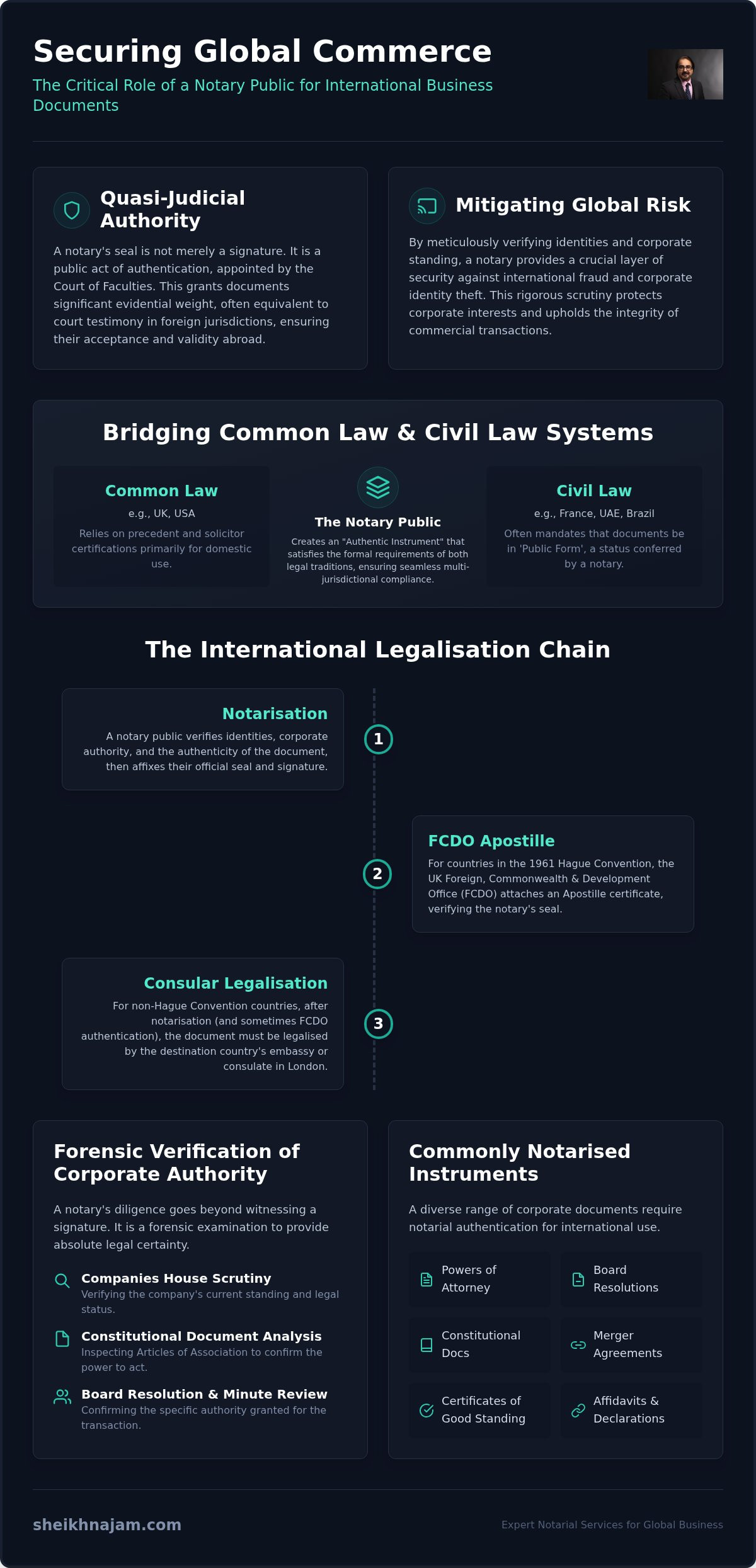
The authority of the English notary is rooted in a tradition of significant institutional weight, being appointed by the Court of Faculties of the Archbishop of Canterbury. This historical lineage imbues the notarial act with an enhanced evidential weight, often treated as equivalent to testimony given in open court within foreign jurisdictions. The Role of a Notary Public extends beyond mere witnessing; it's a quasi-judicial function where the practitioner owes a primary duty to the transaction itself. This ensures that every document, whether a complex merger agreement or a simple certificate of incumbency, carries the necessary gravitas to be accepted by foreign registries and judicial bodies without further proof of its validity. It's this impartiality that provides the "authentic instrument" status required by international law.
Bridging Common Law and Civil Law Systems
Navigating the interface between common law and civil law systems requires a high degree of strategic foresight and jurisdictional precision. In many civil law jurisdictions, such as France, the UAE, or Brazil, certain corporate and property transfers are legally void unless executed in 'Public Form' before a notary. A London notary facilitates these transactions by drafting and authenticating documents that meet the stringent formal requirements of the receiving state. Precision in linguistic nuance and an understanding of local regulatory frameworks are essential. Without this meticulous approach, even the most sophisticated international business documents risk rejection, leading to catastrophic delays in high-stakes commercial closings. It's a process that demands an expert who operates at the intersection of several complex fields simultaneously, ensuring seamless multi-jurisdictional legal compliance.
Understanding the Strategic Role of a Notary Public for Company Documents
The strategic function of a notary public transcends the mere observation of a signature; it involves a meticulous forensic examination of a company's internal governance. To provide absolute legal certainty, a notary for international business documents London must verify the 'capacity and authority' of those purportedly acting on the entity's behalf. This necessitates a thorough review of the company's standing via Companies House and an analytical inspection of its constitutional documents, such as the Articles of Association and specific board minutes. For a deeper analysis of these complexities, one should consult the comprehensive guide on The Strategic Role of a Notary Public for Company Documents in International Commerce. This level of diligence ensures that the corporate act is not merely witnessed but is legally robust enough to withstand the scrutiny of foreign judicial bodies, registries, and financial institutions.
Verifying Corporate Capacity and Authority
Proving a director's power to bind a company in a foreign contract is a rigorous requirement. It often involves the issuance of 'Certificates of Incumbency' or 'Good Standing' to satisfy the evidentiary standards of foreign registries when engaging a notary for international business documents London. If the authentication is defective, the consequences in high-value cross-border M&A can be catastrophic. Defective documents lead to the potential voiding of multi-million pound agreements, causing irremediable delays and reputational damage. The process often concludes with the UK government legalisation service, which adds the final layer of international recognition. It's a precise task. Every board resolution must be checked for a quorum and proper notice to ensure the validity of the corporate decision, particularly when dealing with jurisdictions that demand strict adherence to formal protocols.
Authentication of Digital and Crypto-Asset Structures
The contemporary legal environment increasingly demands the notarisation of instruments related to digital asset holdings and blockchain-based entities. Sheikh Najam’s cross-disciplinary expertise in digital asset structuring informs this verification process, ensuring that modern fintech entities meet traditional notarial standards whilst remaining compliant with evolving regulatory requirements. Traditional notarial acts now intersect with sophisticated fintech regulations. This high-level command over intricate legal landscapes is essential for the strategic management of corporate compliance. Precision is paramount. The notary acts as a bridge between nascent technologies and established legal frameworks, providing the certainty required by global financial institutions and regulatory bodies who require verified proof of ownership and control over digital wealth.
Categorising International Business Documents for Global Use
The categorisation of corporate instruments for international use requires a nuanced understanding of the evidentiary standards demanded by foreign registries and judicial bodies. When engaging a notary for international business documents London, the practitioner must distinguish between instruments of delegation, such as a Power of Attorney, and documents of record, such as financial statements or tax certificates. Each category carries distinct requirements for authentication to ensure multi-jurisdictional legal compliance. The objective is to provide a seamless transition from the domestic corporate framework to the requirements of the receiving state, whether that involves securing intellectual property assignments or ensuring the enforceability of commercial deeds in non-UK jurisdictions.
Powers of Attorney: These are essential for enabling foreign agents or legal counsel to act on behalf of a London entity in property acquisitions or litigation.
Intellectual Property Assignments: Notarial authentication is frequently mandatory for securing and transferring global trademark and patent rights.
Financial Statements: Verified data and certified accounts are often required by international regulatory bodies to prove fiscal solvency.
Commercial Contracts and Deeds: Authentication ensures that high-stakes agreements are recognised as 'authentic instruments' in civil law jurisdictions.
Notarising Company Resolutions in London
A strategic approach to corporate governance involves the formal certification of internal decisions to ensure they hold the necessary probative value abroad. For a detailed exploration of these procedures, please refer to Notarising Company Resolutions in London: A Strategic Guide to Corporate Authentication. It's vital to recognise the functional difference between notarising a copy of an existing resolution and notarising the execution of a new resolution. Whilst the former confirms the document is a true reflection of the company's records, the latter involves the notary witnessing the directors' signatures, thereby providing the highest level of assurance regarding the resolution's validity and the signatories' authority.
Certificates of Incorporation and Constitutional Documents
The process of authenticating a company's 'Articles of Association' or 'Certificate of Incorporation' is a prerequisite for opening foreign branch offices or establishing subsidiary entities. A notary for international business documents London performs a vital role in verifying the current status of a London-based private limited company, ensuring it hasn't been dissolved or struck off the register. This often requires the production of 'certified true copies' of statutory registers and a thorough check of the company's filings at Companies House. Such meticulousness prevents the rejection of applications by foreign commercial registries, which often demand proof of a company's existence and its current internal regulations before permitting any form of local registration or bank account opening.
Navigating the Legalisation Chain: Apostilles and Consular Requirements
The journey of an authenticated document from a notary for international business documents London to its final acceptance abroad involves a rigorous, multi-stage legalisation process. Central to this is the 1961 Hague Convention, which established the Apostille certificate as a uniform method for verifying the origin of public documents. For countries participating in this convention, the Foreign, Commonwealth & Development Office (FCDO) issues a certificate that confirms the authenticity of the notary's signature and seal. As of August 2026, the FCDO maintains a standard fee of £45 for paper-based apostilles, whilst the increasingly utilised e-Apostille carries a fee of £35. However, for jurisdictions not party to the Hague Convention, such as the United Arab Emirates or China, a more complex process of consular legalisation is mandatory. This requires the document to be presented to the relevant embassy or consulate after FCDO authentication, adding significant layers of administrative scrutiny.
The Multi-Jurisdictional Legalisation Framework
The multi-jurisdictional landscape necessitates a deep understanding of regional variations in legalisation requirements. Whilst EU member states typically adhere to the streamlined Hague protocols, transactions involving the Middle East or Asia often demand a full 'chain of authentication'. This sequence moves from the notary to the FCDO and finally to the destination state's diplomatic mission. Precise timing is essential. Urgent apostilles, currently costing £100 from the FCDO, may be required for time-sensitive matters. Delays at any stage of this chain can jeopardise high-stakes commercial closings, making the strategic coordination of these steps as critical as the authentication itself. A failure to account for the specific evidentiary standards of the receiving jurisdiction can result in the rejection of the entire document set.
Apostille Services for London Corporations
For London corporations managing high-volume document sets, efficiency in the legalisation process is paramount. Securing an Apostille through a notary for international business documents London ensures that the signature and seal are verified against the UK government's central database with absolute precision. In certain circumstances, 'bundling' multiple related documents under a single notarial certificate and Apostille may be appropriate, although this depends entirely on the requirements of the receiving jurisdiction. Expert guidance ensures that the chosen method provides maximum legal security whilst remaining cost-effective. To secure your international interests with absolute precision, consider the expert notarial services provided by Sheikh Najam, which integrate seamlessly with broader corporate compliance requirements.
Strategic Advisory: Integrating Notarial Acts into Corporate Compliance
The contemporary regulatory environment demands that notarial acts be viewed not as isolated administrative tasks, but as integral components of a robust corporate compliance framework. A notary for international business documents London serves as a sophisticated gatekeeper, operating at the intersection of private law and public regulatory duty. This role is particularly critical when navigating the stringent requirements of Anti-Money Laundering (AML) and 'Know Your Customer' (KYC) protocols. Sheikh Najam’s multi-disciplinary expertise in financial crime advisory ensures that every act of authentication is underpinned by a rigorous assessment of the transaction's legitimacy. By validating the identities of signatories and the standing of corporate entities, the notary provides an essential layer of defence against financial crime in high-stakes international transactions. This strategic oversight ensures that notarised instruments align seamlessly with broader objectives in international tax planning and corporate governance.
Financial Crime Risk Assessment in Notarial Practice
The notary’s obligation to conduct thorough due diligence is a fundamental aspect of the "Strategic Polymath" approach. This involves more than a cursory check of identity documents; it requires an analytical review of the parties involved and the nature of the transaction itself. Identifying potential regulatory red flags, such as links to sanctioned jurisdictions or unexplained complexities in ownership structures, is paramount before any authentication occurs. In the context of international trust and estate structures, transparency is not merely a preference but a legal necessity. A meticulous risk assessment prevents the unintended facilitation of illicit activity, thereby protecting the reputation and legal standing of the London-based entity. It's a proactive stance that prioritises security and compliance over procedural speed.
The Master Advisor: Beyond the Seal
Viewing notarial services as a standalone requirement is a strategic oversight in global wealth management. Instead, these services should complement sophisticated international tax planning and estate administration. Every authenticated resolution, power of attorney, or deed serves as a building block in a wider multi-jurisdictional strategy. The precision of the notarial act ensures that these components function as intended across borders, preventing the legal friction that often arises from mismatched jurisdictional requirements. For those operating at the highest levels of international commerce, the notary acts as a master advisor who provides command and control over intricate legal landscapes. To ensure your corporate and private interests are handled with absolute precision, you are invited to engage Sheikh Najam TEP for sophisticated notarial and legal advisory in the City of London.
Securing Global Commercial Interests through Strategic Authentication
The complexity of contemporary international commerce necessitates a meticulous approach to document authentication that transcends the mere observation of a signature. We've established that the intervention of a notary for international business documents London is a quasi-judicial act, conferring the enhanced evidential weight required by foreign registries and judicial bodies. This process is a strategic necessity that integrates seamlessly with financial crime compliance and multi-jurisdictional tax planning. By ensuring that every instrument meets the specific formal requirements of the receiving state, you effectively insulate your corporate interests from the risks of jurisdictional rejection and procedural delays.
As a Public Officer appointed by The Court of Faculties, Sheikh Najam possesses the multi-disciplinary expertise required to manage these intricate legal landscapes with absolute precision. From a central London presence, the practice provides the institutional weight and strategic foresight necessary to facilitate high-stakes global transactions. It's a level of service designed for those who demand absolute legal certainty. Consult with Sheikh Najam TEP for Expert Notarial Services in London to ensure your international documents are handled with the rigour they demand. Your pursuit of global commercial excellence is best served by an advisor who prioritises strategic compliance and authoritative representation.
Frequently Asked Questions
What is the difference between a Notary Public and a Commissioner for Oaths in London?
A Notary Public is a public officer whose acts carry international recognition and enhanced evidentiary weight, whereas a Commissioner for Oaths is typically a solicitor whose authority is limited to domestic UK matters. Notaries are appointed by the Court of Faculties and undergo specialised training to authenticate documents for foreign jurisdictions. Solicitors acting as Commissioners for Oaths cannot provide the "authentic instrument" status required by civil law systems or foreign registries.
Why does my international business document require an Apostille after notarisation?
An Apostille is a certificate issued by the Foreign, Commonwealth & Development Office that verifies the authenticity of the notary's signature and seal for use in Hague Convention countries. It serves as a vital secondary layer of authentication, confirming to the foreign authority that the notary for international business documents London is a validly appointed official. This streamlined process prevents the need for further diplomatic or consular legalisation within signatory states.
Can a London notary authenticate documents for use in a US state jurisdiction?
Yes, a London notary can authenticate documents for use in any US state jurisdiction, provided the authentication meets both the receiving state's requirements and federal protocols. The United States is a signatory to the Hague Convention, meaning an Apostille from the FCDO is generally sufficient for the document to be accepted by state registries or courts. For those requiring specialised document preparation for state-specific filings, Nevada State Forms & Filing Services offers professional assistance to ensure documents are correctly formatted before international authentication. Precision in the notarial certificate is essential to ensure compliance with specific state statutes regarding corporate authority.
Similarly, for those requiring legal representation for financial restructuring or insolvency within the United States, you can discover Ronald A. Davidson Attorney at Law for dedicated support regarding financial recovery in Alabama.
A corporate director must produce a valid passport or driving licence alongside proof of residential address, such as a utility bill or bank statement dated within the last three months. Additionally, the notary must verify the director's authority to bind the company. This requires an examination of the company's constitutional documents, board minutes, and a current extract from Companies House to confirm the individual's appointment and their specific powers of representation.
How long does the consular legalisation process typically take for non-Hague countries?
The duration for consular legalisation varies significantly depending on the specific embassy's administrative protocols and current backlogs. Whilst FCDO legalisation can be expedited to a next-day service, subsequent consular stages often require between five and fifteen working days. Countries like the UAE or China involve a multi-stage verification process. Strategic planning is vital to ensure these timelines align with the scheduled completion of high-stakes international commercial transactions.
Is it possible to notarise digital or electronic documents for international use in 2026?
It's entirely possible to notarise digital instruments in 2026, facilitated by the FCDO's e-Apostille service which currently carries a fee of £35 per document. This modern framework allows for the secure, electronic authentication of corporate documents, provided the receiving jurisdiction possesses the technical capacity to verify the digital signature. Sheikh Najam’s expertise in digital asset structuring ensures that these electronic acts maintain the same quasi-judicial weight as their traditional paper-based counterparts.
Does a notary public verify the truth of the contents within a business document?
A notary's primary duty is to verify the identity, capacity, and authority of the appearer, rather than guaranteeing the absolute truth of every statement within a business document. However, the notary must ensure the transaction isn't fraudulent or illegal. If a notary for international business documents London suspects the instrument contains fundamental misrepresentations or facilitates financial crime, they're duty-bound to decline the act. The notarial seal confirms the document's authenticity and proper execution.
What are the common reasons for a foreign jurisdiction to reject a notarised document?
Rejection often occurs due to minor discrepancies in the chain of authentication, such as an expired Apostille or the absence of mandatory consular stamps for non-Hague jurisdictions. Other frequent causes include defective proof of corporate capacity or the use of incorrect terminology that fails to satisfy the receiving state's civil law requirements. Ensuring that the notarial certificate precisely mirrors the linguistic and formal expectations of the destination jurisdiction is the most effective way to prevent these delays.


Comments