London Tax Planning: Avoiding Double Taxation in the UK

Updated: Aug 26
For the high-net-worth individual with interests spanning multiple jurisdictions, the mere existence of a bilateral treaty provides no absolute safeguard against the corrosive effects of dual-jurisdiction fiscal liabilities. The strategic necessity of avoiding double taxation in the UK has evolved beyond simple compliance, becoming a critical component of wealth preservation amidst an increasingly aggressive global regulatory environment. You likely recognise that the misalignment of international tax years and the opacity of treaty language represent not just an administrative burden, but a profound risk to the integrity of your global estate.
This analysis serves as a definitive examination of the rigorous legal mechanisms and treaty frameworks utilised to mitigate such liabilities for those with complex cross-border interests. We shall explore the interplay between the Statutory Residence Test and the UK's network of over 130 double taxation agreements, providing the clarity required to secure absolute legal certainty. By evaluating the latest HMRC thresholds for unilateral relief and the shifting landscape of residence-based inheritance tax, we offer a blueprint for achieving both optimised tax efficiency and uncompromising adherence to international reporting standards.
Table of Contents
The Jurisprudential Challenge of Double Taxation in the United Kingdom
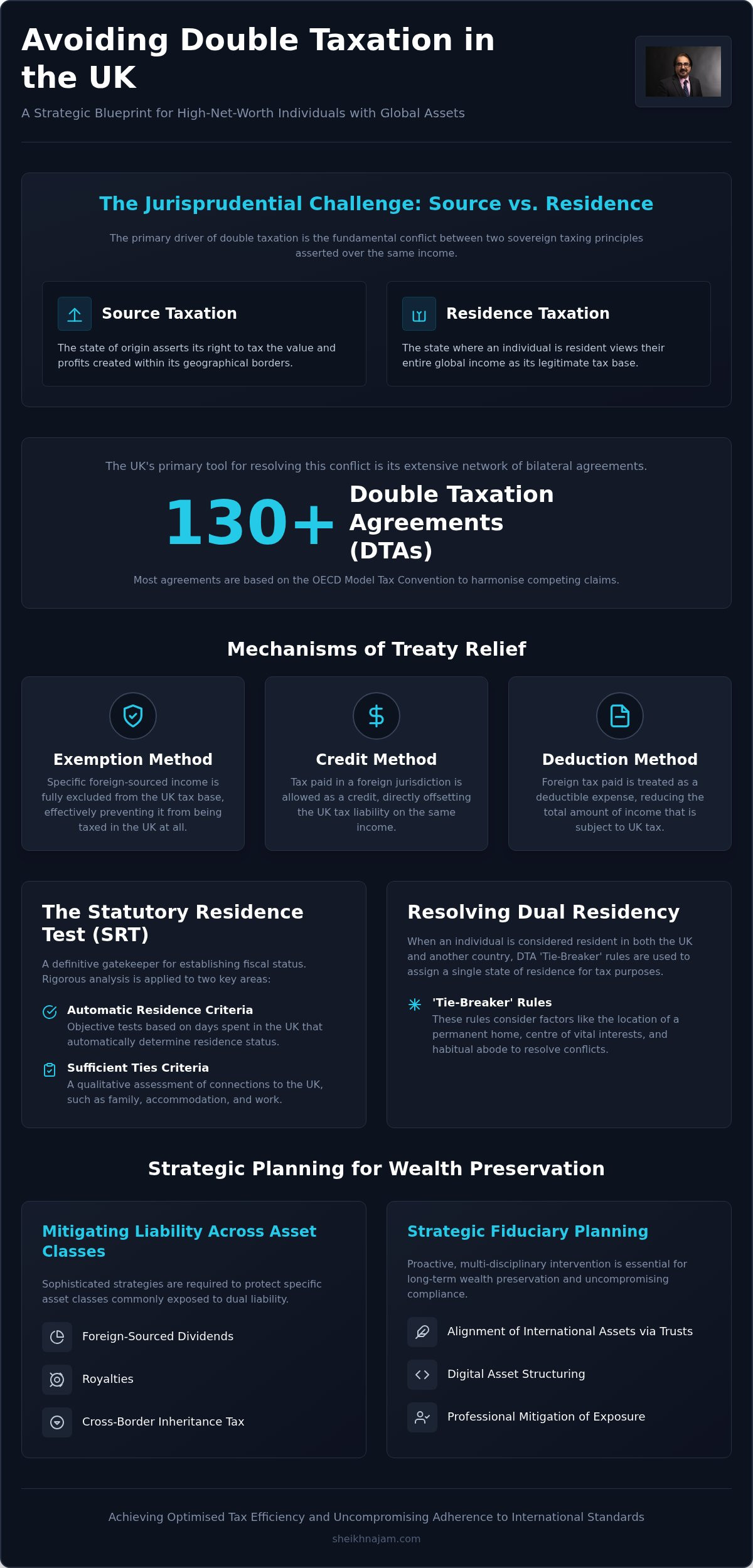
The fundamental conflict between 'Source' and 'Residence' taxation principles represents the cornerstone of modern fiscal dispute, where the state of origin and the state of residence assert simultaneous, often contradictory, claims over the same economic surplus. Within the sophisticated architecture of international finance, the 'Source' state demands its share of value created within its geographical borders, whilst the 'Residence' state views the individual's global income as its legitimate tax base. This jurisdictional friction is the primary driver behind the strategic necessity of avoiding double taxation in the UK. Most of the UK’s bilateral agreements, which numbered over 130 by mid-2026, are predicated upon the OECD Model Tax Convention, a framework that seeks to harmonise these competing claims through standardised distributive rules. Without such frameworks, the global citizen would face a confiscatory tax burden that stifles international investment and erodes multi-generational wealth.
Defining Dual Liability in a Globalised Legal Landscape
Double Taxation is a conflict of sovereign taxing rights over a singular fiscal event. To achieve absolute legal certainty, one must distinguish between juridical double taxation, where the same person is taxed on the same income by two states, and economic double taxation, which occurs when two different entities are taxed on the same underlying profit. A foundational step in understanding double taxation involves identifying whether the liability arises from a genuine jurisdictional overlap or a mere administrative oversight in reporting. The UK’s domestic legislation, though robust, often yields to treaty law, yet the complexity of these interactions requires meticulous multi-disciplinary oversight to ensure that relief is not only available but effectively claimed.
The Impact on High-Net-Worth International Private Clients
International private wealth is uniquely vulnerable to these triggers due to the diverse nature of modern asset portfolios. Dual residency status creates immediate fiscal exposure, particularly when an individual’s 'centre of vital interests' remains ambiguous under the scrutiny of multiple tax authorities. The financial burden of unmitigated tax leakage is often compounded by the psychological strain of potential HMRC penalties and the threat of double inheritance tax. Consider the case of a client with substantial property interests in London who maintains an active commercial presence in a civil law jurisdiction. Failure to harmonise international asset reporting in such a scenario doesn't just result in a higher tax bill; it risks triggering a cascade of compliance failures across several jurisdictions. Such failures often lead to the erosion of capital that would otherwise be preserved through pre-emptive fiduciary structuring and the application of relevant treaty protocols.
Navigating Double Taxation Agreements (DTAs): Mechanisms of Treaty Relief
In the hierarchy of British fiscal jurisprudence, Double Taxation Agreements (DTAs) occupy a position of significant authority, frequently overriding domestic statutory provisions to prevent the inequitable imposition of dual levies. This legal precedence ensures that treaty-based protocols remain the primary instrument for avoiding double taxation in the UK, providing a structured framework for relief that domestic law alone cannot replicate. Relief typically manifests through three distinct methodologies: the exemption method, where specific income is excluded from the UK tax base; the credit method, allowing foreign tax paid to be offset against UK liabilities; and the deduction method, which treats foreign tax as a deductible expense. High-net-worth individuals should consult the UK government guidance on foreign income to understand the baseline obligations before applying these more sophisticated treaty-based exemptions. The procedural necessity of securing these benefits often relies upon the strategic authentication of foreign documents, where notarial services provide the requisite institutional weight for international recognition.
The 'Tie-Breaker' Clause: Determining Fiscal Domicile
When an individual is deemed a resident under the domestic laws of two sovereign states, the 'Tie-Breaker' clause within the relevant DTA serves as the ultimate arbiter. This sequential test prioritises the location of a permanent home, followed by the individual’s 'centre of vital interests', a multi-faceted assessment of personal and economic ties. If these remain indeterminate, the habitual abode and, ultimately, nationality are scrutinised. Resolving such disputes often requires the invocation of Mutual Agreement Procedures (MAP), where competent authorities from both states negotiate a resolution. Strategic documentation, including proof of property interests and professional engagements, is vital to support these claims. For those managing such intricate affairs, engaging an expert in International Tax Planning ensures that every tie-breaker criterion is meticulously addressed.
Unilateral Relief: Mitigation in the Absence of a Treaty
In instances where the UK hasn't established a formal DTA with a specific jurisdiction, Section 790 of the Income Tax Act 2007 provides a critical safety net. This unilateral relief allows a credit for foreign taxes paid, provided the income would also be subject to UK tax. However, unilateral relief is inherently more restrictive than treaty-based mechanisms. It generally only permits a credit up to the amount of the UK tax liability on that specific income, whereas treaties may offer broader exemptions or lower withholding rates. Understanding these domestic limitations is essential for maintaining global fiscal efficiency. It's often the case that unilateral relief provides only partial protection, leaving the taxpayer vulnerable to higher effective rates than those secured under a bilateral treaty framework.
Residence, Domicile, and the Statutory Residence Test (SRT)
The Statutory Residence Test (SRT) functions as the definitive gatekeeper for UK tax residency, providing the objective framework necessary for avoiding double taxation in the UK. Before one can invoke treaty relief, one's fiscal status under the SRT must be established with absolute precision. This test moves beyond subjective intent, focusing instead on quantifiable metrics such as day counts and the nature of physical presence. It's essential to understand that an individual can be resident in two countries simultaneously under their respective domestic laws, making the SRT the first line of defence in determining whether the UK has a primary claim over your global income. For those residing abroad with UK-sourced income, the UK government guidance on double taxation agreements provides the necessary starting point for understanding how these domestic findings interact with international law.
The Statutory Residence Test: A Quantitative Analysis
The SRT quantifies fiscal presence. It relies on a tiered hierarchy of tests where the 'Automatic Overseas Test' and the 'Automatic UK Residence Test' provide immediate clarity. However, many international professionals find themselves within the nuanced 'Sufficient Ties Test'. This involves a meticulous calculation of day counts, where 'overnight stays' are the primary unit of measurement, balanced against specific ties such as the 'Work' tie or the 'Accommodation' tie. For instance, spending more than 40 days working in the UK can trigger a work tie, significantly reducing the number of days one can spend in the country without becoming resident. Managing 'Split Year' treatment is equally vital, as it allows for the tax year to be divided into a resident and non-resident part, preventing overlapping liabilities during the year of arrival or departure.
Domicile Status and the Remittance Basis of Taxation
While residence is determined by annual presence, domicile is a deeper, more permanent legal concept that governs long-term tax planning and international estate exposure. The 'Domicile of Origin', usually acquired from one's father at birth, exerts an enduring influence, often remaining even after decades of residence elsewhere. However, under current legislation, individuals are treated as 'Deemed Domiciled' once they've been resident in the UK for at least fifteen of the previous twenty tax years. This shift has profound implications for Inheritance Tax (IHT), which then applies to your worldwide estate rather than just UK assets. Until this threshold is met, non-domiciled individuals may utilise the remittance basis to shield foreign income and gains from UK taxation, provided these funds aren't brought into the country. This strategy requires rigorous compliance with reporting standards to avoid unintentional tax leakage.
Mitigating Dual Liability across Asset Classes and Inheritances
The diversification of global portfolios necessitates a granular approach to fiscal mitigation, as the protocols for avoiding double taxation in the UK vary significantly between passive income streams and capital assets. Dividends, royalties, and interest are typically managed through specific distributive rules within a Double Taxation Agreement (DTA), which often reduce or eliminate withholding taxes at the source. However, the intersection of double taxation and trust administration presents a more formidable challenge, particularly where the tax transparency of the trust vehicle differs between the UK and the foreign jurisdiction. In such instances, the characterisation of the payment as either income or capital can determine the availability of treaty relief, requiring a sophisticated analysis of the underlying fiduciary structure to ensure compliance with both UK and international reporting standards.
The Strategic Importance of Inheritance Tax Treaties
While the United Kingdom maintains a vast network of income tax treaties, specific bilateral agreements regarding Inheritance Tax (IHT) are remarkably rare. These vital tools are restricted to a select list of ten nations, including France, Italy, India, Pakistan, and the United States. For individuals crafting international wills London, these treaties provide the definitive mechanism for resolving conflicts of 'situs' for high-value assets, ensuring that the same estate is not decimated by dual levies upon death. In the absence of a specific IHT treaty, practitioners must rely upon Section 159 of the Inheritance Tax Act 1984. This provision allows for a credit against UK IHT for tax paid in a foreign jurisdiction on assets situated outside the UK, though its application lacks the absolute legal certainty afforded by a formal bilateral treaty.
Taxation of Foreign Immovable Property
Foreign immovable property is governed by the 'Lex Situs' principle, which dictates that the jurisdiction where the asset is physically located retains the primary right to tax capital gains. Despite this, the UK asserts its right to tax the global gains of its residents, creating a clear jurisdictional overlap during property disposals. Mitigating this dual liability requires the meticulous claiming of foreign tax credits, ensuring that the levy paid to the local authority is effectively offset against the UK Capital Gains Tax (CGT) liability. This process is rarely straightforward, as differences in the timing of the tax charge or the method of calculating the gain can lead to unmitigated tax leakage. Coordinated legal advice across both jurisdictions is not merely recommended; it is a strategic necessity for the preservation of capital. To secure your global estate against such friction, engaging in professional Inheritance Tax Planning is the only prudent course of action.
Strategic Fiduciary Planning: Professional Mitigation of Exposure
The orchestration of a multi-jurisdictional estate requires more than a superficial understanding of fiscal law; it demands the intervention of a Trust and Estate Practitioner (TEP) who can harmonise competing legal systems with absolute precision. Effective strategies for avoiding double taxation in the UK are often rooted in pre-emptive structuring, where the judicious use of trusts and foundations serves to manage or even disconnect a specific tax nexus. This proactive approach isn't merely about efficiency; it's a defensive measure against the increasing scrutiny of HMRC and international regulatory bodies. Annual tax compliance, when handled with the requisite academic rigor, functions as a primary bulwark against the disruption of a formal enquiry, ensuring that your global affairs remain beyond reproach.
Harmonising International Wills and Tax Treaties
Testamentary documents must be crafted with an acute awareness of cross-border recognition to prevent the administrative paralysis that often precedes fiscal disputes. The deployment of 'Situs Wills', which are separate testamentary instruments for assets located in different jurisdictions, allows for the isolation of specific asset classes, thereby simplifying the reporting process and reducing the risk of conflicting tax claims. Such coordination requires a seamless dialogue with foreign counsel to ensure that legal positions taken in the UK don't inadvertently compromise the estate’s standing elsewhere. Without this alignment, the estate may become embroiled in contentious probate London, where tax disputes between beneficiaries and authorities can lead to prolonged litigation and the significant erosion of the corpus.
The Fiduciary Duty of the Executor in Cross-Border Estates
The burden of duty upon an executor in a cross-border context is immense, carrying with it a potential personal liability for the failure to claim available treaty relief. It's not enough for an executor to simply report assets; they must actively investigate the interplay of bilateral agreements to ensure that the estate doesn't overpay. This often necessitates the use of formal notarial acts to authenticate claims for foreign tax credits, providing the high level of institutional proof required by international tax authorities. When an executor neglects these multi-disciplinary obligations, the resulting tax leakage can be viewed as a breach of fiduciary duty, potentially leading to personal surcharge or legal challenge from aggrieved heirs. To avoid these pitfalls and ensure your global legacy is preserved with absolute precision, you should consider the advantages of Sheikh Najam's strategic international tax planning.
Securing Global Fiscal Integrity through Multi-Disciplinary Oversight
The preservation of international private wealth demands a sophisticated alignment of residence status, treaty jurisprudence, and fiduciary structuring. By mastering the quantitative metrics of the Statutory Residence Test and leveraging the specific distributive rules within bilateral agreements, high-net-worth individuals can achieve absolute legal certainty. Avoiding double taxation in the UK is not merely an exercise in compliance; it's a strategic imperative that requires the meticulous orchestration of cross-border interests to prevent the erosion of capital through jurisdictional friction. From our strategic City of London location, we provide the authoritative command necessary to resolve complex international probate and trust disputes, ensuring that your global affairs remain resilient against shifting regulatory landscapes.
Secure the future of your multi-jurisdictional estate by engaging a practitioner with the specialist TEP qualification required for such intricate matters. Instruct Sheikh Najam TEP for Expert International Tax Planning and Notarial Services to ensure your legacy is handled with absolute precision and academic rigor. Your global interests deserve nothing less than the highest standard of institutional expertise to maintain long-term stability.
Frequently Asked Questions
What is a Double Taxation Agreement (DTA) and how does it protect my assets?
A Double Taxation Agreement is a bilateral treaty between two sovereign states designed to prevent the same income or capital gains from being taxed twice. It protects your assets by establishing distributive rules that allocate taxing rights between the jurisdictions, often reducing or eliminating withholding taxes at the source. This structured framework provides the absolute legal certainty required for the efficient management and protection of cross-border wealth.
Can I be a resident of two countries at once for tax purposes?
Dual residency is a frequent occurrence where an individual satisfies the domestic residency criteria of two different jurisdictions simultaneously under their respective national laws. In such instances, the 'Tie-Breaker' rules within a relevant Double Taxation Agreement are invoked to determine a single fiscal domicile for treaty purposes. This resolution is critical for maintaining tax efficiency and preventing conflicting jurisdictional claims over your global economic interests.
How does the UK Statutory Residence Test affect my international tax liability?
The Statutory Residence Test (SRT) serves as the primary objective gatekeeper for determining UK tax residency status based on quantifiable day counts and specific personal ties. By defining whether you are a UK resident, the SRT directly dictates the extent of your liability on worldwide income versus UK-sourced income alone. It remains the foundational step in the strategic process of avoiding double taxation in the UK.
What happens if the UK does not have a tax treaty with my other country of residence?
In the absence of a formal bilateral treaty, the UK may provide unilateral relief under Section 790 of the Income Tax Act 2007. This mechanism allows a credit for foreign taxes paid against UK liabilities on the same income, though it is inherently less comprehensive than treaty-based exemptions. Such scenarios require meticulous fiduciary oversight to prevent unmitigated tax leakage and ensure compliance with domestic reporting standards.
Is Inheritance Tax covered under standard Double Taxation Agreements?
Standard DTAs typically focus on income and capital gains, whereas Inheritance Tax (IHT) requires specific, separate bilateral treaties to mitigate dual liability upon death. The UK currently maintains such agreements with only ten jurisdictions, including France, Italy, and the United States. For estates in non-treaty countries, practitioners must rely on Section 159 of the Inheritance Tax Act 1984 to claim credit for foreign taxes paid.
How do I claim relief from double taxation on my UK tax return?
Relief is typically claimed through the Foreign Tax Credit Relief (FTCR) section of your Self Assessment tax return, where you must detail the foreign income and the tax already paid. Precision is paramount; you must ensure the claim aligns with the specific provisions of the relevant treaty or unilateral relief rules. Formal notarial authentication of foreign tax certificates is often required to substantiate these claims to HMRC.
What is the 'Tie-Breaker' rule in international tax law?
The 'Tie-Breaker' rule is a hierarchical series of tests within a DTA used to resolve dual residency by assigning a single fiscal domicile. The sequence prioritises the location of a permanent home, followed by the 'centre of vital interests' and habitual abode. If these remain indeterminate, nationality or mutual agreement procedures between competent authorities serve as the final arbiters of your status under the treaty framework.
Does my domicile status affect my ability to avoid double taxation?
Domicile significantly influences your tax base, particularly regarding the remittance basis and worldwide inheritance tax exposure. Whilst residence determines annual liability, domicile dictates the long-term jurisdictional reach over your global estate. Understanding this distinction is essential for avoiding double taxation in the UK, especially for non-domiciled individuals who may eventually transition toward 'deemed domicile' status after fifteen years of UK residence.


Comments