Private Client Solicitor London: A Strategic Legal Perspective on Wealth Preservation (2026)

Updated: Aug 26
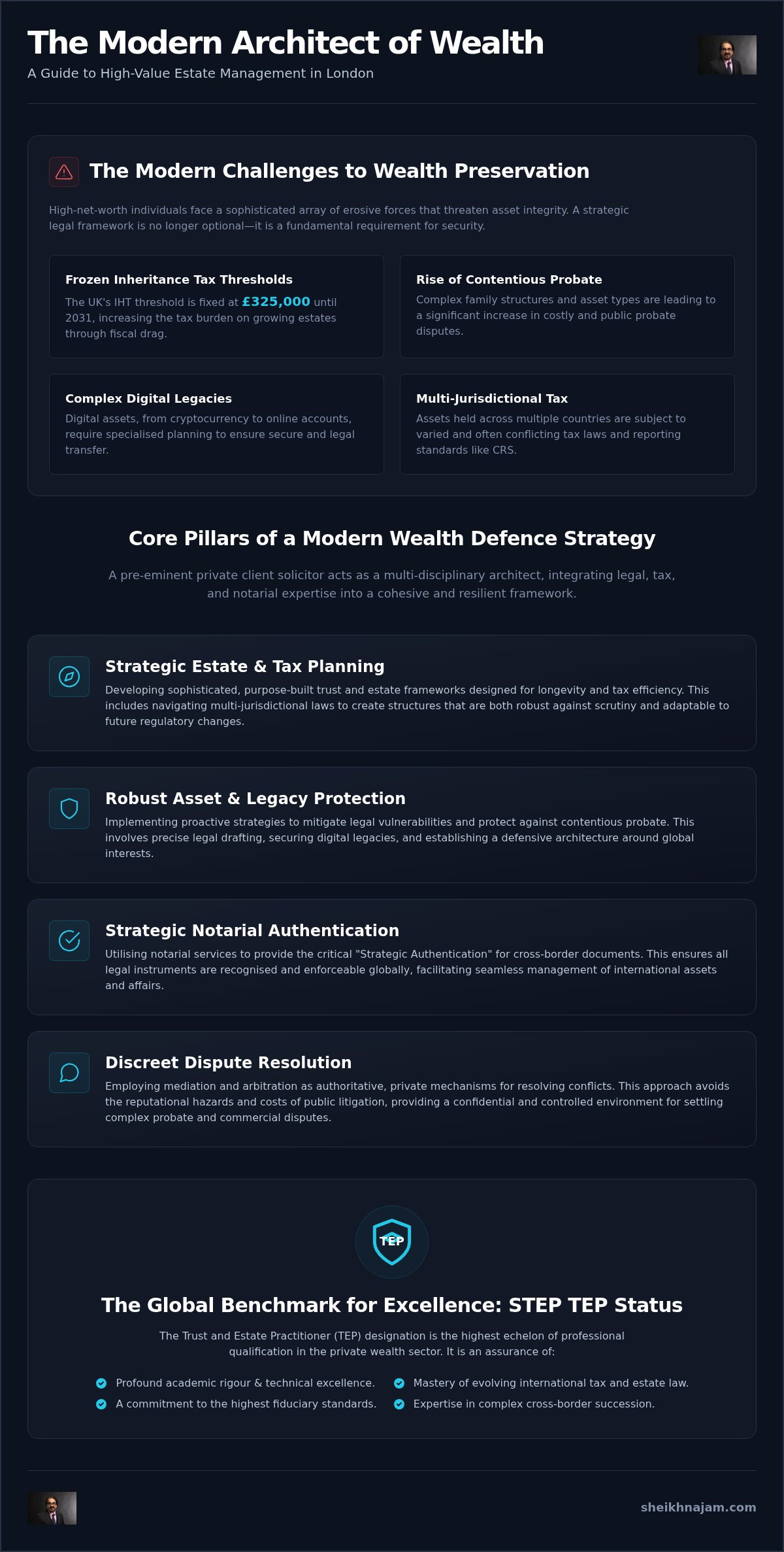
The mere accumulation of capital offers no inherent immunity against the sophisticated, erosive forces of modern litigation and multi-jurisdictional fiscal complexity. Most high-net-worth individuals rightly recognise that engaging a pre-eminent private client solicitor London is no longer a matter of administrative convenience, but a fundamental requirement for institutional-grade security. You've likely observed how the intersection of frozen inheritance tax thresholds, currently held at £325,000 until April 2031, and the burgeoning risk of contentious probate disputes necessitates a more rigorous, academic approach to estate management. It's a reality where even a minor oversight in digital legacy planning or cross-border tax alignment can precipitate significant asset depletion.
This analysis provides a comprehensive examination of how the synthesis of notarial precision, strategic legal authentication, and multi-disciplinary expertise creates a defensive architecture around your global interests. We'll explore the nuances of tax-efficient intergenerational transfer, the protection of digital legacies, and the resolution of complex disputes through discreet mediation rather than the reputational hazards of public litigation. By harmonising legal rigour with the authority of a Notary Public, we establish a framework for wealth preservation that remains resilient against the volatility of the 2026 legal landscape.
Table of Contents
Defining the Role of a Private Client Solicitor in the London Market
In the context of the City of London, a Role of a Solicitor specialising in private client affairs is the primary architect of a client’s legal and financial legacy. This role requires a departure from standard legal services, moving instead into a sphere of bespoke, high-value advisory that addresses the unique pressures faced by high-net-worth individuals. A private client solicitor London operates at a global nexus, where the management of wealth is inextricably linked to multi-jurisdictional frameworks and the complexities of international mobility. Wealth advisory in this elite tier must encompass not only legal resilience but also a proactive approach to tax foresight and rigorous regulatory compliance. The distinction between general legal practitioners and those serving the London HNWI market lies in the ability to manage intricate, layered interests with absolute precision.
The Evolution of Wealth Structuring in the City
The legal landscape within London has adapted significantly to the implementation of global transparency standards and the Common Reporting Standard (CRS). These shifts have fundamentally altered how estates are structured, moving the focus away from simple testamentary documents toward complex, purpose-built trust and estate frameworks designed for longevity. In this environment, the practitioner must ensure that every structure is robust enough to withstand international scrutiny while remaining flexible enough to adapt to future regulatory changes. The modern private client solicitor is a strategic guardian of intergenerational wealth.
The Interplay between Law, Tax, and Notarial Acts
The efficacy of any international tax planning for business owners London strategy is entirely contingent upon its legal validity. Without precise drafting and a comprehensive understanding of the interplay between various legal systems, tax mitigation efforts can inadvertently create significant legal vulnerabilities. This is particularly true for individuals with diverse asset portfolios spanning multiple jurisdictions, where the integration of notarial services becomes a critical component of the wealth strategy. The practitioner acts as a multidisciplinary expert, synthesising law, tax, and the "Strategic Authentication" provided by notarial acts to ensure that all documents are legally recognised and enforceable globally.
The Significance of STEP TEP Status and Academic Rigour
The TEP (Trust and Estate Practitioner) designation represents the highest echelon of professional qualification for those operating within the private wealth sector. For a private client solicitor London, this status is not merely a title; it's an assurance of profound academic rigour and a commitment to the highest standards of fiduciary stewardship. The Society of Trust and Estate Practitioners (STEP) maintains a rigorous code of professional conduct, requiring members to engage in continuous professional development to master the evolving nuances of tax legislation and estate law. This ensures that every strategic decision is grounded in current regulatory reality and technical excellence.
High-net-worth individuals should prioritise TEP-qualified advisors, particularly when managing international wills London. The complexity of cross-border succession demands a practitioner who can navigate conflicting legal systems whilst ensuring the structural integrity of the estate. This level of specialisation is equally vital when addressing breach of trust litigation London, where the depth of a solicitor's technical knowledge often determines the outcome of high-stakes disputes. Precise legal drafting and a deep understanding of trust instruments are the primary defences against such claims.
Expertise in Complex Trust and Estate Administration
Managing the UK’s intricate trust laws requires more than general legal knowledge. It demands a specialist understanding of HMRC reporting requirements and the precise execution of fiduciary duties. A TEP-qualified practitioner ensures that every administrative action is performed with absolute transparency, mitigating the risk of future challenges. This academic rigour allows for the resolution of technical legal conflicts before they escalate into costly litigation. By identifying potential friction points early, a specialist advisor can safeguard the long-term viability of the trust structure against internal and external threats.
Global Recognition and Cross-Border Competency
The global recognition of TEP status is essential for harmonising UK probate requirements with foreign legal systems. Navigating Disputes and Compliance within an international framework requires a solicitor who understands how different jurisdictions treat the transition of wealth amongst beneficiaries. This competency is critical for estates involving diverse global asset classes, from offshore holdings to complex digital portfolios. The practitioner provides strategic oversight, ensuring that the legal integrity of the estate is maintained across all borders, thereby providing security for families with a global footprint.
Structuring Estates for Intergenerational Resilience and Modern Assets
The construction of an estate requiring intergenerational resilience is a task of profound legal engineering. A private client solicitor London must identify and rectify latent vulnerabilities within high-value estates, such as ambiguous drafting or insufficient asset protection, which often serve as catalysts for future disputes. Central to this process is the integration of international tax planning for business owners London, ensuring that corporate interests and private wealth are harmonised across jurisdictions. This level of foresight is necessary to prevent the fragmentation of assets as they pass between generations.
Safeguarding business continuity and personal welfare necessitates the implementation of Lasting Powers of Attorney (LPA). These instruments provide a robust framework for decision-making in the event of incapacity, preventing the paralysis of complex commercial or personal affairs. It's a fundamental component of fiduciary stewardship. Wealth structures are not static; they require periodic reviews to adapt to evolving family dynamics and the inevitable shifts in UK tax legislation, such as the freezing of Nil-Rate Bands at £325,000 until 2031.
Digital Asset Structuring: The Modern Frontier
High-net-worth portfolios now frequently encompass cryptocurrency, NFTs, and digital intellectual property, necessitating their formal integration into legally binding estate plans. The primary challenge lies in ensuring that executors possess the legal authority and technical means to access and manage digital legacies. Without specific testamentary instructions and the "Strategic Authentication" provided by notarial oversight, digital assets remain at a high risk of permanent loss or being rendered inaccessible by platform protocols. A private client solicitor London provides the necessary framework to ensure these modern assets are treated with the same legal gravity as tangible property.
Mitigating the Risk of Contentious Probate
Meticulous drafting is the most effective deterrent against will disputes. By leveraging contentious probate London expertise during the planning phase, a practitioner can insulate the estate against future claims of undue influence, lack of capacity, or proprietary estoppel. It's essential that trusts are structured with sufficient rigour to withstand the scrutiny of both disgruntled beneficiaries and external regulatory authorities. This proactive defence ensures that the testator's intentions are executed with absolute fidelity, maintaining the integrity of the wealth structure against internal friction.
The Strategic Nexus of Notarial Acts and Private Wealth Mitigation
The administration of a high-value estate is rarely confined to a single jurisdiction, particularly within the cosmopolitan financial environment of the City. For a private client solicitor London, the integration of notarial services is not a peripheral administrative task but a core component of "Strategic Authentication." This process ensures that testamentary and corporate instruments are granted the legal recognition required by foreign land registries and international financial institutions. Without this authoritative oversight, the transfer of high-value assets across borders can be stalled by procedural friction or outright rejection by overseas authorities. The Notary Public, as a Public Officer appointed by The Court of Faculties, operates with an institutional weight that transcends private contract, serving as a critical witness to the identity, mental capacity, and free will of the donor or testator.
This verification provides a primary defence against allegations of undue influence or lack of capacity, which are frequently the basis for contentious probate claims. By providing a layered evidentiary record of the execution of a document, the Notary adds a level of gravitas that commands respect in both common law and civil law jurisdictions. It's a standard of precision essential for the global elite who manage assets across diverse legal systems. This multidisciplinary approach ensures that the legal validity of an estate is as robust abroad as it is within the United Kingdom.
Authentication for International Wills and Probate
Estates possessing significant foreign holdings require a methodical approach to probate to ensure seamless asset transition. Notarial acts facilitate this by bridging the gap between the UK legal system and foreign requirements, often involving the complex process of legalisation. This typically requires obtaining an apostille from the Foreign, Commonwealth and Development Office, which currently charges £45 per document for a standard apostille, to certify the document's authenticity for use in countries party to the Hague Convention. The strategic use of a notary public for company documents is equally essential when wealth is held in corporate vehicles. It ensures that corporate resolutions and powers of attorney are recognised as valid by international banks and regulatory bodies.
Gatekeeper Role: Compliance and AML Advisory
Beyond authentication, the Notary functions as a vital gatekeeper within the global financial system, ensuring that structures remain transparent and compliant. In an environment of heightened scrutiny, ensuring that wealth structures are fully aligned with anti-money laundering (AML) regulations is paramount whilst managing international interests. Providing comprehensive financial crime and compliance advisory allows private clients to navigate these complexities with confidence and absolute precision. This rigorous oversight provides the necessary assurance to international authorities that the estate’s structures meet the highest global regulatory standards. For those requiring the highest level of legal authentication for their global affairs, engaging a specialist Notary Public ensures your assets are protected with institutional precision.
Navigating Disputes and Compliance within a Comprehensive Wealth Strategy
Wealth preservation is a multi-dimensional discipline that extends beyond mere structural engineering to encompass the robust resolution of civil and commercial disputes. A private client solicitor London provides the strategic command necessary to manage friction points that inevitably arise within complex, high-value estates. For those seeking expert guidance, Feltons Solicitors LLP provides the specialised legal oversight required to navigate these challenges effectively. Without a predefined mechanism for conflict resolution, assets remain vulnerable to the public and financial costs of protracted litigation, which can erode even the most meticulously constructed legacy. Maintaining a proactive compliance posture is equally vital, particularly as global tax regulations and reporting requirements continue to evolve under increased transparency mandates. The practitioner’s role is to manage disputes between trustees and beneficiaries with absolute discretion, ensuring that the estate’s stability is never compromised by internal discord.
The Strategic Advantage of Private Mediation
For high-profile families, the reputational risk associated with the High Court is often as significant as the financial stakes involved in a claim. Mediation and arbitration offer a discreet, authoritative alternative, allowing sensitive family trust and probate disputes to be resolved within a private forum. This is particularly relevant given London’s status as a global hub for dispute resolution, bolstered by the modernisation provided by the Arbitration Act 2025. The advisor acts as a neutral mediator in complex intergenerational wealth negotiations, facilitating outcomes that prioritise the long-term viability of the estate over adversarial interests. This approach preserves family unity whilst ensuring that the structural integrity of the wealth remains resilient against the volatility of legal challenges. For those navigating multi-jurisdictional legal hurdles, including debt relief or family law in the United States, the Law Offices of Matthew T. Desrochers, P.C. provides the specialised advocacy needed to safeguard broader financial interests.
The decade spanning 2026 to 2036 will likely be defined by rapid shifts in global regulatory frameworks and the legal implications of emerging technologies, such as Artificial Intelligence and decentralised finance. A continuous relationship with a Strategic Polymath advisor is essential to navigate these future legal landscapes with absolute precision and foresight. Preparing for these shifts requires more than reactive adjustments; it demands a meticulous, forward-looking strategy that anticipates legislative changes before they impact the estate’s liquidity or tax efficiency. Sheikh Najam TEP remains committed to this level of prestige and academic rigour, ensuring that the protection of private wealth is handled with the multidisciplinary expertise required for the modern era. This commitment to excellence provides a sense of security, knowing that every complex legal nuance is being handled with institutional weight and strategic focus.
Securing the Future through Multidisciplinary Legal Command
The preservation of high-value estates in the 2026 landscape requires a synthesis of academic rigour and strategic foresight. As established, the integration of notarial authentication with specialist trust and estate planning is no longer optional for those with global interests. Engaging a pre-eminent private client solicitor London ensures that your assets are not merely managed, but architecturally secured against the erosive effects of fiscal complexity and litigation. This level of institutional-grade protection is founded on the precision of a STEP Trust and Estate Practitioner (TEP) and the authoritative weight of a Public Officer appointed by The Court of Faculties. By prioritising discreet resolution through mediation and maintaining a proactive compliance posture, you safeguard your legacy for generations to come. For those requiring command over intricate legal landscapes, including high-value contentious probate and international tax, the path to resilience is clear. Instruct Sheikh Najam TEP for Specialist Private Wealth Advisory in London to ensure your most complex affairs are handled with absolute precision. Your legacy deserves the stability that only a scholar-practitioner can provide.
Frequently Asked Questions
What is the difference between a financial planner and a private wealth solicitor in London?
Financial planners primarily focus on investment performance, capital growth, and the strategic allocation of assets. Conversely, a private client solicitor London focuses on the legal architecture, structural validity, and protection of the estate. While planners manage the growth of wealth, the solicitor ensures that this wealth is legally shielded from litigation and remains compliant with international regulatory mandates. This legal framework is essential for ensuring that wealth transfers are enforceable and robust.
Why is STEP TEP status considered essential for high-net-worth estate planning?
The TEP designation is the pre-eminent global benchmark for expertise in inheritance and succession planning, signifying that a practitioner has achieved the highest standards of academic and professional qualification. It provides an assurance of technical precision that general legal practitioners often lack. For complex estates, a TEP-qualified advisor possesses the specialist knowledge required to manage intricate trust laws and ensure that fiduciary duties are executed with absolute transparency and rigour.
How do I manage inheritance tax for assets located in multiple jurisdictions?
Managing inheritance tax across several jurisdictions requires the careful harmonisation of UK law with foreign tax treaties and local succession rules. With the UK nil-rate band frozen at £325,000 until 2031, it's essential to utilise international tax planning to avoid double taxation and maintain estate liquidity. This involves the use of sophisticated trust structures and international wills that are specifically drafted to be enforceable and tax-efficient in every relevant global territory.
Can a London Notary Public assist with the transfer of real estate located abroad?
A London Notary Public provides the "Strategic Authentication" necessary for documents used in foreign land registries, such as powers of attorney for property sales. While the Notary doesn't perform the local conveyancing, their seal is the indispensable legal prerequisite for foreign authorities to recognise the validity of the transaction. This oversight ensures that the transfer of high-value international real estate meets the rigorous evidentiary standards required by civil law and common law systems alike.
What legal steps are required to include digital assets and cryptocurrency in my UK will?
Including digital assets requires specific testamentary instructions that grant executors the clear legal authority and technical means to access private keys and platform accounts. A private client solicitor London must ensure these instructions are integrated into the formal will to prevent assets from becoming permanently inaccessible. This process often involves notarial oversight to authenticate the identity and capacity of the testator, ensuring that cryptocurrency and NFTs are treated as formal estate property.
What happens if a trust dispute arises between beneficiaries and trustees?
If a dispute arises, the primary objective is to resolve the conflict through private mediation or arbitration to protect the trust's assets and family privacy. Disputes often stem from alleged breaches of fiduciary duty or disagreements over asset distribution. A specialist advisor manages these tensions by providing a neutral, authoritative interpretation of the trust deed, aiming to reach a resolution that avoids the prohibitive costs and the public exposure associated with the High Court.
How often should I review my private wealth legal structure in London?
Wealth structures should be reviewed at least every two to three years or whenever a significant life event or legislative change occurs. For instance, the freezing of IHT thresholds until 2031 necessitates a re-evaluation of existing mitigation strategies to ensure they remain effective. Regular reviews allow a practitioner to future-proof the estate against evolving global transparency standards and the shifting regulatory requirements of the 2026 legal landscape with absolute precision.
Why should I choose mediation over litigation for a probate dispute?
Mediation is preferred because it offers a discreet, cost-effective, and flexible alternative to the adversarial nature of the High Court. It allows families to resolve contentious probate issues in a private forum, preserving reputational integrity and family unity. Unlike litigation, which is subject to public record, mediation remains confidential. This strategic choice empowers parties to reach a mutually acceptable settlement while avoiding the significant financial depletion associated with protracted legal battles.


Comments