Private Client Solicitor London: A Strategic Treatise on Fiduciary Excellence (2026)

Updated: Aug 26
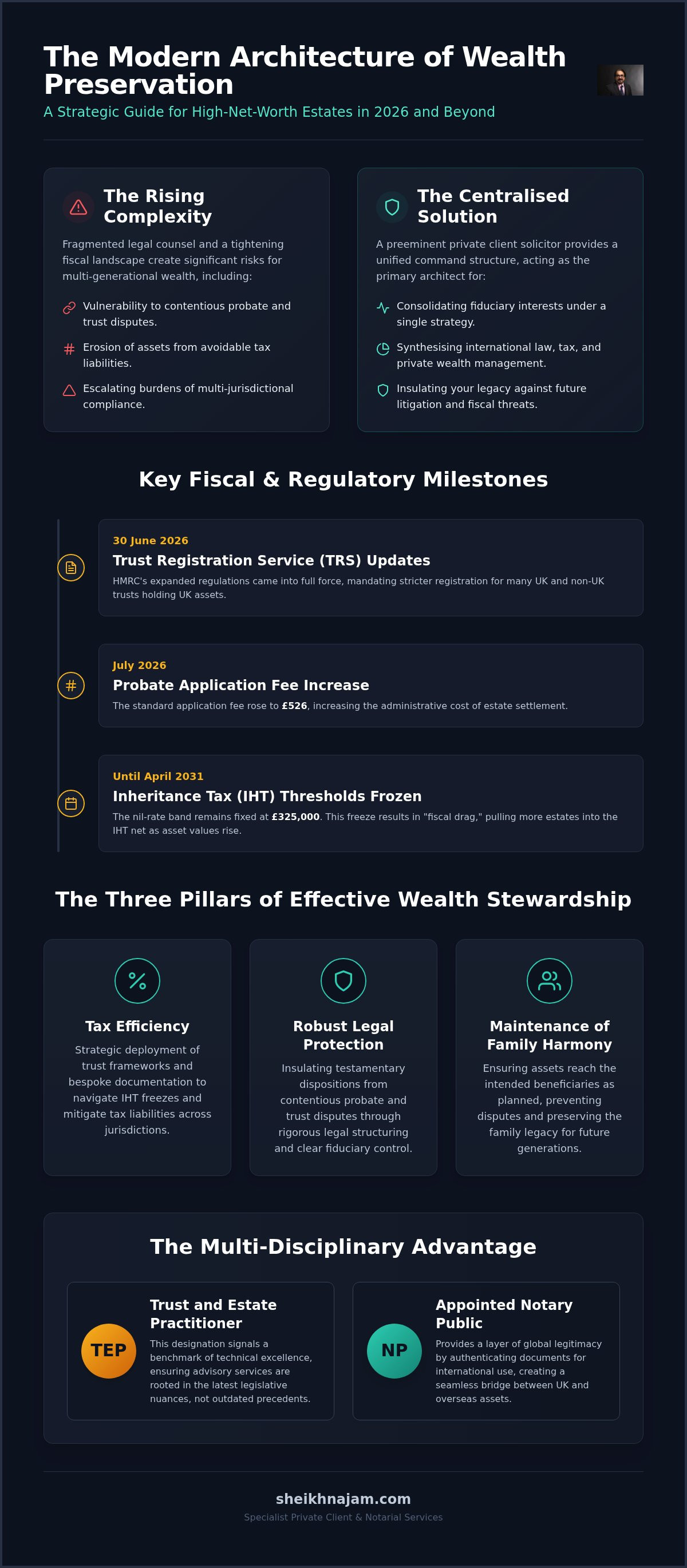
The preservation of multi-generational prosperity in 2026 is no longer a matter of simple stewardship; it's an exercise in high-stakes, multi-jurisdictional strategy where the margin for error has effectively vanished. You likely find that fragmented legal counsel across disparate firms often exacerbates the very risks it seeks to mitigate, especially as the complexity of non-domiciled tax regulations and the freezing of inheritance tax thresholds until April 2031 continue to tighten the fiscal landscape. Securing the counsel of a preeminent private client solicitor London is the foundational step toward consolidating your fiduciary interests under a single, authoritative command.
You understand that without a centralised architecture, your estate remains vulnerable to the caprices of contentious probate and the escalating burdens of administrative compliance, exemplified by the £526 probate application fee implemented in July 2026. This treatise provides a comprehensive analysis of the legal, tax, and fiduciary frameworks governing high-net-worth wealth from the perspective of a specialist London practitioner. We shall examine the nuances of international tax planning, the implications of the June 2026 Trust Registration Service updates, and the robust mechanisms required to insulate your legacy against future litigation and trust disputes.
Table of Contents
The Architecture of Private Wealth Advisory in London
The City of London remains the preeminent global nexus for the management of substantial private capital, yet the role of a private client solicitor London has undergone a profound transformation as we move through 2026. It's no longer sufficient to view this discipline through the narrow lens of testamentary drafting. Instead, it represents a multi-layered synthesis of private law, international tax mitigation, and rigorous fiduciary control. While many high-net-worth individuals confuse financial management with legal stewardship, the distinction is critical. Financial advisors focus on asset growth; a qualified solicitor provides the structural integrity required to ensure those assets actually reach the intended beneficiaries without being eroded by avoidable tax liabilities or legal challenges.
Securing a private client solicitor London who possesses the multi-disciplinary breadth of a TEP and a Notary Public is now a prerequisite for those seeking to insulate their wealth from systemic risk. This high-level command ensures that every aspect of an estate, from domestic property to complex offshore holdings, is governed by a unified strategy rather than a series of disconnected legal actions.
The Evolving Regulatory Landscape in 2026
The current fiscal year has introduced unprecedented levels of transparency, necessitating a more meticulous approach to compliance. HMRC's expanded Trust Registration Service (TRS) regulations, which came into full force on 30 June 2026, now mandate that even low-value non-UK trusts holding UK land must be registered by September 2027. This shift, coupled with the fundamental restructuring of non-domiciled taxation, has forced a re-evaluation of London residency for many global families. In this climate, the Trust and Estate Practitioner (TEP) designation serves as a vital benchmark. It signals a level of technical expertise that transcends general practice, ensuring that advisory services are rooted in the latest legislative nuances rather than outdated precedents.
Identifying the Pillars of Wealth Stewardship
Effective stewardship rests upon three non-negotiable pillars: tax efficiency, robust legal protection, and the maintenance of family harmony. With the inheritance tax nil-rate band frozen at £325,000 until April 2031, fiscal drag has become a primary threat to family legacies. Countering this requires bespoke documentation that reflects the unique multi-jurisdictional nature of your holdings. Generic, off-the-shelf solutions are fundamentally incapable of addressing the complexities of 2026 regulations. The integration of notarial acts within the broader wealth framework is also essential for those with international interests. By authenticating documents through an appointed Notary Public, a practitioner provides a layer of global legitimacy that standard legal services cannot match, creating a seamless bridge between UK assets and overseas jurisdictions. This multi-disciplinary command is what defines true fiduciary excellence in the modern era.
Fiduciary Structuring: The Strategic Role of Trusts and Estate Administration
The strategic deployment of trust structures represents a sophisticated mechanism for the preservation of capital against the erosive effects of taxation and legal volatility. Within the London legal system, a private client solicitor London operates as the primary architect of these fiduciary vehicles, ensuring that the duties and liabilities of trustees are clearly defined and meticulously managed. For estates involving multi-million-pound assets, the administration process requires a level of precision that transcends standard probate services, involving a rigorous synthesis of statutory compliance and strategic foresight. This is particularly vital when navigating the complexities of the Trust Registration Service (TRS) protocols, which were updated on 30 June 2026 to include a new exemption for low-value trusts whilst maintaining strict filing requirements for non-UK trusts holding UK land.
Trust Creation and Management Strategies
Selecting the appropriate trust vehicle is a decision of profound consequence that requires a deep understanding of both equity and tax law. Discretionary trusts offer significant flexibility in asset distribution, allowing trustees to respond to the changing needs of beneficiaries, whilst interest-in-possession trusts provide a structured income stream for specific individuals. For those seeking to align wealth with philanthropic objectives, charitable trusts offer a robust framework for long-term legacy building. Under the Variation of Trusts Act 1958, a seasoned practitioner can seek court approval to modify existing trust structures to meet modern requirements, ensuring that a family's fiduciary architecture remains resilient against legislative shifts. Proper alignment with Private Client Services standards ensures that these structures withstand the highest levels of regulatory scrutiny.
The Necessity of Lasting Powers of Attorney (LPA)
Fiduciary excellence extends beyond the distribution of assets to the protection of decision-making capacity. High-value estates necessitate the registration of both Health and Welfare and Property and Finance LPAs to ensure continuity of command in the event of unforeseen circumstances. The Business LPA is particularly vital for the City-based practitioner, as it allows for the seamless management of corporate interests and shareholdings should the donor become incapacitated. Given the current registration fee of £92 per LPA, these documents represent a negligible investment for a critical safeguard. Challenges to an LPA in London courts often hinge on claims of undue influence or lack of mental capacity, requiring a private client solicitor London to ensure the initial execution is beyond reproach. Establishing a robust trust and estate planning framework is the only certain method of maintaining control over your legacy during periods of transition.
Navigating Cross-Border Jurisdictions and International Tax Obligations
The unique challenges faced by non-UK domiciled individuals residing in London require a practitioner who can navigate the intricate intersection of global fiscal policy and domestic law with absolute precision. A private client solicitor London must meticulously evaluate the concept of 'situs', which refers to the legal location of an asset, against the client's domicile to determine the precise scope of UK tax exposure. This is particularly critical in 2026, as the regulatory environment for non-domiciled residents has shifted toward a more transparent, residency-based model. Harmonising multi-jurisdictional assets through strategic international tax planning London ensures that double taxation treaties are leveraged to their fullest extent, preventing the unnecessary depletion of private wealth across competing tax authorities.
Success in this arena depends on the ability to synthesise complex data from various legal systems into a single, coherent fiduciary strategy. Without this high-level command, the risk of conflicting probate requirements or unexpected tax charges in foreign jurisdictions becomes a significant threat to the integrity of the estate. A master advisor doesn't merely react to these complexities but anticipates them through the layered application of international law and treaty analysis.
International Wills and Succession Planning
Drafting international wills London is the primary defence against the risk of conflicting probate laws, particularly for those with significant interests in multiple jurisdictions. For UK clients holding European assets, a deep understanding of the EU Succession Regulation, commonly known as Brussels IV, is essential. This regulation allows an individual to elect the law of their nationality to govern the succession of their entire estate, thereby bypassing the restrictive forced heirship rules prevalent in many civil law jurisdictions. In cases involving high-value real estate in specific territories, the strategic use of 'situs wills' can expedite the probate process and ensure that local legal requirements are met without compromising the broader testamentary objectives.
Mitigating Global Inheritance Tax (IHT) Liabilities
The 2026 tax reforms have necessitated a more aggressive approach to global wealth distribution, as the freezing of the inheritance tax nil-rate band at £325,000 until 2031 continues to pull more international assets into the taxable net. Structuring worldwide assets to minimise exposure requires a thorough analysis of both lifetime transfers and trust settlements. In 2026, the seven-year rule dictates that lifetime gifts are categorised as potentially exempt transfers, becoming entirely free from inheritance tax only if the donor survives for seven years following the date of the gift. By integrating this rule into a broader gifting strategy, families can effectively reduce the taxable value of their estate whilst maintaining compliance with HMRC's stringent reporting requirements.
Mitigating Risk: Contentious Probate and Regulatory Compliance
The escalation of contentious probate London reflects a broader trend of litigation within high-value estates, often driven by the increasing complexity of multi-jurisdictional family structures and the substantial assets at stake. A private client solicitor London must possess the strategic foresight to insulate an estate against claims of lack of testamentary capacity or undue influence, which remain the primary legal grounds for challenging a will. Beyond testamentary disputes, family offices must now navigate a stringent regulatory environment concerning Financial Crime and Anti-Money Laundering (AML) compliance. Failure to implement rigorous internal controls can lead to severe reputational and legal consequences, making the role of a multi-disciplinary advisor indispensable. Mediation and arbitration have emerged as superior alternatives to public court proceedings, offering a discrete forum for resolving sensitive family disputes whilst preserving the privacy that high-net-worth individuals rightly demand.
Litigation and Dispute Resolution in Wealth Matters
Defending against claims under the Inheritance (Provision for Family and Dependants) Act 1975 requires a meticulous examination of the claimant's financial needs and the deceased’s intentions. In instances where a trustee has failed to act in the best interests of the beneficiaries, the legal grounds for removing a trustee due to a breach of fiduciary duty are strictly defined within the London courts. Strategic advisors often advocate for civil and commercial mediation, as it allows for a more nuanced resolution than the binary outcomes of litigation. This approach doesn't just resolve the immediate conflict; it seeks to preserve the underlying family relationships that are often collateral damage in public legal battles.
The Digital Frontier: Digital Asset Structuring
The fiduciary management of cryptocurrencies, NFTs, and digital intellectual property represents the new frontier of private wealth advisory, where traditional legal frameworks often struggle to keep pace with technological advancement. Ensuring that these assets are accessible and legally transferrable upon death requires a sophisticated understanding of both private keys and probate law. Regulatory advisory on the evolving legal status of Decentralised Autonomous Organisations (DAOs) is equally vital, as these structures often exist in a jurisdictional vacuum. By integrating digital asset structuring into a broader estate plan, a practitioner ensures that no part of the client's legacy remains in a state of legal limbo. For those seeking to fortify their estate against these emerging risks, engaging with a specialist in civil and commercial dispute resolution is a strategic imperative.
The Synthesis of Legal and Notarial Expertise in Wealth Stewardship
The ultimate efficacy of a fiduciary strategy often rests upon the seamless authentication of its constituent parts, a requirement that necessitates a profound synthesis of legal and notarial disciplines. Whilst many practitioners operate within narrow silos, a private client solicitor London who possesses the dual authority of a Trust and Estate Practitioner (TEP) and an appointed Notary Public offers a level of command and control that is essential for the global elite. This multi-disciplinary approach ensures that the sophisticated structures discussed in previous chapters, from discretionary trusts to international wills, are not only legally sound under English law but also carry the requisite global authority for foreign property acquisitions and complex corporate reorganisations. By integrating professional notarial services directly into the wealth stewardship framework, the practitioner operates as a Master Advisor, bridging the gap between deep academic theory and the practical resolution of high-stakes cross-border affairs.
The Strategic Advantage of Notarial Authentication
In an era of heightened regulatory scrutiny and sophisticated financial crime, the rigorous identity and capacity verification performed by a Notary Public serves as a critical bulwark against fraud. The international validity of powers of attorney and probate documents is not a given; it must be meticulously established through the Hague Apostille process, which streamlines transactions across jurisdictions that are party to the 1961 Convention. For those managing assets in non-convention territories, the requirement for consular legalisation adds another layer of complexity that only a seasoned private client solicitor London can navigate with precision. This authentication process is not merely an administrative formality but a strategic tool that ensures the seamless execution of fiduciary instructions, preventing the costly delays and legal ambiguities that often plague unauthenticated international instruments.
Concluding Thoughts on Holistic Wealth Preservation
The preservation of multi-generational prosperity in a volatile regulatory environment requires a commitment to continuous review and adaptation. As we have examined, the freezing of inheritance tax thresholds until 2031 and the fundamental shifts in non-domiciled taxation have rendered static estate plans obsolete. True stewardship moves beyond the clinical management of assets to encompass a broader legal and moral responsibility toward the family legacy. This involves anticipating the rising tide of contentious probate and ensuring that every testamentary disposition is insulated by robust documentation and verified capacity. In 2026, the London private wealth advisor functions as a strategic polymath who harmonises domestic statutory compliance with global fiduciary authentication to ensure the absolute integrity of the multi-generational estate. The complexity of the modern world demands nothing less than this holistic, multi-disciplinary precision.
Consolidating Fiduciary Command in an Era of Global Complexity
The preservation of multi-generational prosperity within the volatile fiscal landscape of 2026 necessitates a departure from fragmented advisory in favour of a centralised, multi-disciplinary command. We've established that the synthesis of rigorous trust administration, strategic international tax planning, and the precise authentication provided by notarial acts forms the only viable defence against the erosive effects of regulatory shift and contentious litigation. As a TEP qualified practitioner and appointed Notary Public, I provide the academic rigour and practical resolution required to navigate these intricate legal landscapes with absolute certainty. Securing the counsel of a preeminent private client solicitor London ensures that your global assets are governed by a unified strategy, mitigating the risk of multi-jurisdictional disputes whilst ensuring strict compliance with evolving HMRC transparency mandates.
I invite you to instruct Sheikh Najam TEP for your private wealth and international estate matters to ensure your legacy is handled with the meticulousness it deserves. Your most complex affairs remain secure under the guidance of a specialist in complex international tax and contentious probate. It's time to transition from passive asset management to proactive legal stewardship.
Frequently Asked Questions
What exactly is the role of a private client solicitor in London?
A private client solicitor London acts as the strategic architect of your family’s fiduciary framework, synthesising complex areas of equity, tax, and succession law into a unified command structure. This role transcends simple administrative tasking. It is a high-level advisory function designed to insulate capital against systemic risks whilst ensuring rigorous statutory compliance across all aspects of your estate. This practitioner provides the necessary legal stewardship to protect multi-generational wealth from fragmentation.
How has the non-dom tax status changed in 2026?
The 2026 legislative reforms have fundamentally restructured the fiscal landscape for non-UK domiciled individuals, transitioning the UK toward a residency-based tax regime. This shift necessitates a meticulous re-evaluation of worldwide asset exposure as traditional domicile-based advantages are replaced by more transparent, duration-dependent criteria. Global families must now navigate these residency rules with absolute precision to avoid unintended tax liabilities on their international holdings. Strategic foresight is required to adapt existing structures to this new transparency-driven environment.
Why do I need a specialised solicitor for an international will?
International wills require a practitioner capable of harmonising conflicting probate laws and forced heirship rules across multiple jurisdictions. A specialised private client solicitor London ensures that your testamentary dispositions remain valid in every territory where you hold assets, preventing the legal gridlock that often arises from multi-jurisdictional estates. Without this expert intervention, your estate remains vulnerable to the caprices of foreign legal systems and the complexities of regulations like Brussels IV.
Can a trust effectively reduce my inheritance tax liability in the UK?
Trusts remain a potent vehicle for mitigating inheritance tax, particularly as the nil-rate band remains frozen at £325,000 until April 2031. By legally divesting ownership of specific assets into a trust, you can effectively reduce the taxable value of your estate and manage the 40% IHT burden. However, success is predicated on strict adherence to the June 2026 Trust Registration Service protocols and a deep understanding of the specific tax charges associated with different trust structures.
What happens if a will is contested in a high-value London estate?
When a will is contested, the matter typically enters the Chancery Division of the High Court, often predicated on claims of lack of testamentary capacity or undue influence. These disputes are particularly prevalent in high-value estates where the financial stakes are substantial. In such instances, the objective is usually to achieve a resolution through mediation or arbitration. This approach seeks to resolve the conflict whilst preserving the confidentiality and privacy of the family’s private affairs.
Is a Notary Public required for all international wealth matters?
Whilst not mandatory for domestic probate, a Notary Public is indispensable for authenticating documents destined for foreign jurisdictions. This process, often involving the Hague Apostille, provides the global legitimacy required for the acquisition of foreign property or the management of overseas corporate interests. Engaging an advisor who is both a solicitor and a Notary Public ensures a seamless transition between English legal requirements and the authentication standards demanded by international authorities.
How can I protect my digital assets within my estate plan?
Protecting digital assets involves integrating cryptocurrencies, NFTs, and digital intellectual property into a formal fiduciary structure that ensures legal transferability upon death. You must establish a framework that allows executors or trustees to access private keys and DAOs without violating service agreements or security protocols. Without this strategic structuring, significant digital value can become permanently inaccessible, effectively eroding the total worth of your multi-generational legacy.
What is the difference between an executor and a trustee in the UK?
An executor’s primary duty is the immediate administration of the estate, which includes settling debts, paying the £526 probate fee, and distributing assets according to the will. A trustee assumes a continuing fiduciary responsibility for managing assets held within a trust after the initial estate administration is complete. Whilst the same individual often fills both roles, the legal duties differ significantly. Trustees operate under a long-term obligation to manage assets for the benefit of future generations.


Comments