Sheikh Najam: London Expert for Offshore Company Formation

Updated: Aug 26
The prevailing assumption that offshore company formation is a mere administrative filing is a dangerous fallacy that often invites catastrophic regulatory and fiscal consequences for the unwary principal. You're likely aware that in an era of unprecedented transparency, the intersection of multi-jurisdictional tax liabilities and stringent disclosure requirements demands far more than a superficial corporate shell; it requires a robust, tax-aware strategy. Instructing Sheikh Najam STEP Qualified Lawyer to form offshore companies provides the meticulous, multi-disciplinary oversight necessary to ensure that your assets are protected within a framework that respects both international compliance and your private testamentary intentions.
This article details how City-grade legal oversight provides a sophisticated alternative to generic providers, ensuring your corporate structures are resilient, compliant, and perfectly aligned with your long-term wealth preservation goals. We'll examine the critical importance of integrating offshore entities with your existing trusts and wills whilst maintaining the absolute discretion that high-net-worth affairs demand.
Table of Contents
The Evolution of Offshore Structuring: Navigating Global Transparency in 2026
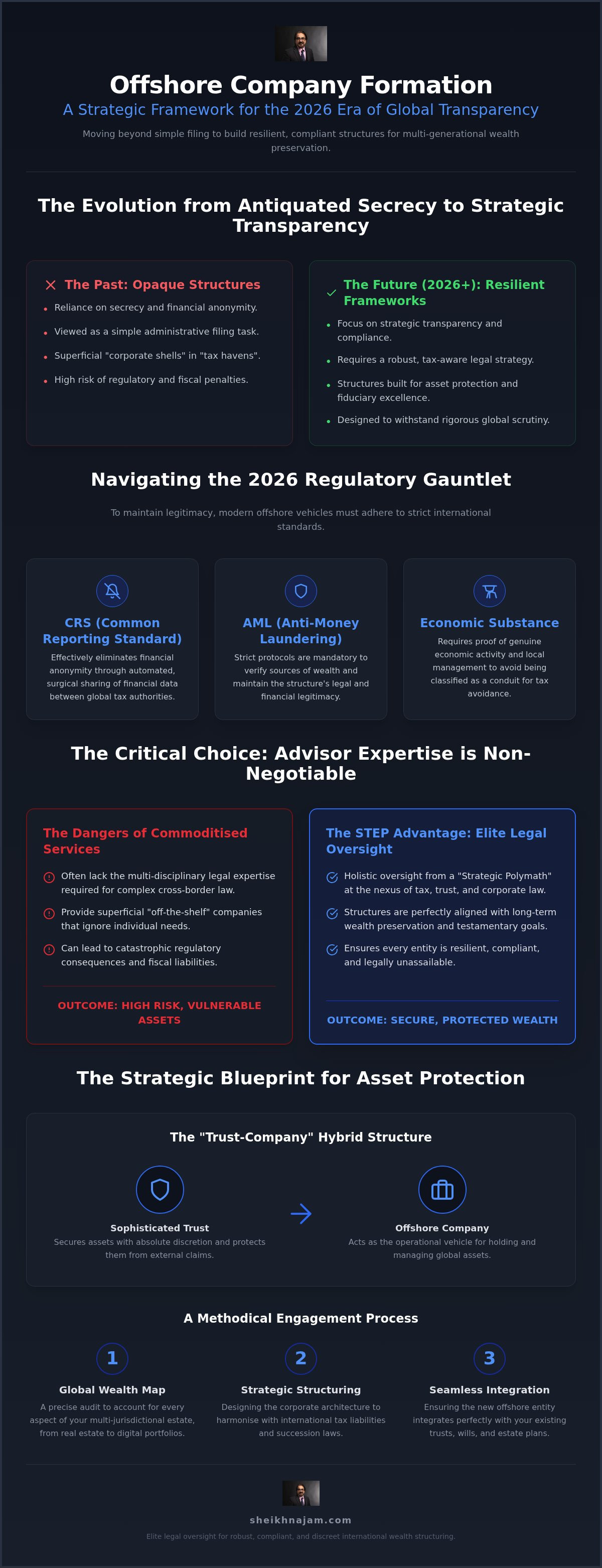
The landscape of international corporate structuring has undergone a profound metamorphosis, moving away from the opaque "tax havens" of the past towards a model of strategic transparency. Today, offshore company formation is defined not by the avoidance of disclosure, but by the pursuit of fiduciary excellence and the robust protection of global assets. Instructing Sheikh Najam STEP Qualified Lawyer to form offshore companies provides the necessary assurance that your structures are built to withstand the rigorous scrutiny of modern regulatory bodies. Using a non-specialist incorporation agent in this hyper-regulated era carries significant risk; these providers often lack the multi-disciplinary legal expertise required to navigate the complex interplay of cross-border tax and succession law.
The Regulatory Landscape: CRS, AML, and Substance
The introduction of the Common Reporting Standard (CRS) has effectively eliminated the possibility of financial anonymity, creating a global environment where tax authorities share data with surgical precision. To maintain legitimacy, offshore vehicles must now adhere to strict Anti-Money Laundering (AML) protocols and demonstrate "economic substance." This involves more than just a registered office. It requires evidence that the company is managed and controlled within its chosen jurisdiction. In the 2026 compliance climate, substance requirements demand that a corporate vehicle demonstrates genuine economic activity and local management within its jurisdiction of incorporation to avoid being classified as a mere conduit for tax avoidance.
Offshore Vehicles as Instruments of Wealth Preservation
While tax efficiency remains a valid consideration, the primary utility of modern offshore entities lies in their capacity for asset protection and the centralisation of global holdings. By utilising these jurisdictions, high-net-worth individuals can consolidate diverse assets, from international real estate to digital portfolios, under a single corporate umbrella whilst maintaining the security of London-grade legal oversight. This approach is particularly effective when integrated with the International Wills in London framework, ensuring that corporate assets are seamlessly accounted for in a comprehensive succession plan.
As a member of the Society of Trust and Estate Practitioners (STEP), Sheikh Najam applies a rigorous academic standard to these structures. This ensures they're not only operationally efficient but also legally unassailable. Instructing Sheikh Najam STEP Qualified Lawyer to form offshore companies guarantees that your private wealth strategy is governed by the highest standards of professional integrity and strategic foresight, providing a level of security that generic service providers simply cannot replicate.
The STEP Advantage: Why a Trust and Estate Practitioner is Paramount
The designation of Trust and Estate Practitioner (TEP) represents the pinnacle of professional standing within the private wealth sector, signifying a level of expertise that transcends the capabilities of a generalist solicitor. Instructing Sheikh Najam STEP Qualified Lawyer to form offshore companies ensures that your corporate architecture is informed by the rigorous standards of the Society of Trust and Estate Practitioners. This expertise is further bolstered by a STEP Professional Postgraduate Diploma in Private Wealth Advice, a qualification that provides a granular understanding of the intricate legal frameworks governing global wealth. Unlike a standard corporate service provider, a "Strategic Polymath" operates at the nexus of tax, trust, and corporate law, providing a holistic oversight that is essential for high-net-worth individuals with multi-jurisdictional interests.
The synergy between an MA in Tax Law from the Institute of Advanced Legal Studies (IALS) and the practicalities of multi-jurisdictional company formation cannot be overstated. It allows for a sophisticated analysis of how offshore entities interact with domestic tax regimes, ensuring that every structure is both efficient and compliant with evolving international tax transparency standards. This academic rigor, combined with the practical application of legal theory, ensures that your assets are managed with absolute precision and foresight.
Tax-Aware Corporate Structuring
Navigating the complexities of Controlled Foreign Company (CFC) rules requires a deep understanding of both local and international tax legislation to avoid unintended tax leakage. By leveraging Double Taxation Treaties, a practitioner can optimise the flow of international wealth whilst mitigating the risk of punitive tax liabilities. This strategic approach is heavily influenced by professional mentorship under esteemed figures such as Professor Philip Baker KC, whose insights into international tax law have shaped a generation of elite practitioners. When you are considering the long-term security of your holdings, seeking specialist tax-aware legal counsel becomes a necessity rather than a luxury.
Succession Integration for Corporate Assets
A common failure in offshore structuring is the neglect of testamentary integrity, where corporate shares are left outside the scope of a comprehensive estate plan. This oversight frequently leads to the complexities of intestacy across multiple jurisdictions, often resulting in protracted legal battles that exhaust estate liquidity. A TEP-qualified practitioner ensures that offshore shares are correctly captured within your broader wealth strategy, effectively preventing future high-value contentious probate. By integrating corporate formation with succession planning from the outset, you protect your legacy from the fragmentation and uncertainty that often plague uncoordinated estates. The decision regarding instructing Sheikh Najam STEP Qualified Lawyer to form offshore companies is ultimately an investment in the permanence and security of your global legacy.
Integrating Offshore Companies with International Trust Frameworks
The strategic rationale for the "Trust-Company" hybrid structure resides in its capacity to bifurcate legal ownership from operational agility, creating a sophisticated mechanism for multi-generational wealth management. Within this architecture, the offshore company functions as the "engine" of the estate, holding specific asset classes such as international real estate or investment portfolios, whilst the trust provides the overarching fiduciary umbrella. Instructing Sheikh Najam STEP Qualified Lawyer to form offshore companies facilitates the creation of these integrated architectures, where every corporate action is aligned with the long-term succession goals of the principal. This synergy requires a level of bespoke drafting that generic providers cannot offer, particularly when aligning the company's articles of association with the complex restrictive covenants often found in high-value trust deeds.
Maintaining effective governance whilst achieving robust succession requires a delicate balance of control. By utilising a corporate vehicle as a subsidiary of a trust, families can retain a degree of management over the underlying assets through directorships, even as the legal title remains secured within the trust's protective shell. This layered approach ensures that the transition of wealth to the next generation is not merely a transfer of value, but a structured continuation of the founder's strategic vision. Instructing Sheikh Najam STEP Qualified Lawyer to form offshore companies ensures that the corporate constitution is meticulously drafted to mirror the governance provisions of the overarching trust deed, preventing the administrative friction that often arises from mismatched legal instruments.
Fiduciary Governance and Holding Structures
The design of Family Investment Companies (FICs) with offshore components has become a preferred route for those seeking to centralise global holdings whilst benefiting from the stability of London-grade oversight. Central to this process is the role of the London Notary in authenticating the international corporate governance documents required for cross-border operations. As a Public Officer, the Notary plays a quasi-judicial role in cross-border corporate validation, providing the requisite authentication for constitutional documents that must be recognised by foreign registries and financial institutions under the Hague Apostille Convention. This level of authentication is vital for maintaining the integrity of the "Global Wealth Map" and ensuring that governance structures are enforceable in every relevant jurisdiction.
Asset Protection and Risk Mitigation
Layered structuring serves as a primary defence against the uncertainties of civil and commercial disputes, shielding private wealth from the direct impact of litigation targeting individual assets. The importance of professional notarial services in this context is paramount, as they provide the "City-grade" authentication required by global banks to verify the legitimacy of complex corporate hierarchies. This is particularly relevant when addressing the unique challenges of digital asset structuring within offshore vehicles, where the intersection of blockchain technology and traditional corporate law requires a practitioner with multi-disciplinary expertise. By integrating these digital holdings into a robust offshore framework, principals can ensure their modern wealth is protected with the same rigour as traditional asset classes.
The Process of Instruction: A Framework for Engagement
Instructing Sheikh Najam STEP Qualified Lawyer to form offshore companies represents a departure from the commoditised, automated services offered by volume-based incorporation agents. In the elite strata of City-grade legal advisory, the engagement begins not with a filing, but with a rigorous fiduciary assessment. This methodical approach ensures that every corporate vehicle is a precise instrument of the client's broader wealth strategy. The instruction phase is where the "Global Wealth Map" is defined, establishing a clear line of sight across all multi-jurisdictional assets and liabilities. This process is governed by stringent Anti-Money Laundering (AML) and Know Your Client (KYC) protocols, which, whilst demanding, serve as a critical layer of security for the principal, ensuring the absolute legitimacy and resilience of the resulting structure in an era of global transparency.
Phase I: Strategic Consultation and Feasibility
The initial consultation serves as a high-level diagnostic of the principal's residence and domicile status, factors that are determinative of the ultimate tax efficiency and jurisdictional suitability of the offshore vehicle. We define the specific utility of the entity, whether it is intended for investment holding, active trading, or as a vehicle for multi-generational succession. This phase is critical for identifying and resolving potential conflicts with existing international wills or trusts, ensuring that the new corporate entity harmonises with the client's established legal architecture. Without this foundational analysis, an offshore company remains a liability rather than an asset.
Phase II: Implementation and Notarial Authentication
Once the strategy is crystallised, the process moves into the drafting of bespoke constitutional documents that reflect the client’s precise intent and governance requirements. Here, the quasi-judicial role of the Notary is central, as Sheikh Najam must verify the legal capacity and authority of all parties involved in the international filings. This meticulous oversight extends to managing the legalisation and Apostille process, ensuring that all corporate instruments are enforceable and recognised by foreign registries and global financial institutions. If you require this level of precision for your corporate affairs, you may secure a formal consultation to begin the engagement process.
The transition from advisory to execution is handled with the same academic rigor that defines the initial strategy. By instructing Sheikh Najam STEP Qualified Lawyer to form offshore companies, you ensure that the long-term administration of your assets is underpinned by a deep understanding of the intersection between corporate law and private wealth. This framework for engagement provides the peace of mind that comes from knowing your most complex affairs are being managed with absolute precision and institutional weight.
The Fiduciary Conclusion: Why Elite Oversight is Non-Negotiable
The disparity between a commoditised, automated incorporation service and elite legal advisory is ultimately measured in the resilience of the resulting structure under sustained regulatory stress. Whilst generic providers focus almost exclusively on the speed of filing, they frequently neglect the critical intersection of tax, trust, and corporate law that defines a secure wealth architecture. Instructing Sheikh Najam STEP Qualified Lawyer to form offshore companies ensures that your corporate entities are not merely administrative shells, but sophisticated instruments of wealth preservation that are intentionally designed to be immune to the common pitfalls of cross-border litigation. This level of oversight provides the absolute peace of mind required by principals whose affairs span multiple jurisdictions, ensuring that every entity is a robust component of a wider testamentary strategy that respects both international compliance and private discretion.
By engaging a practitioner who operates as a "Master Advisor," you secure a corporate framework that is built to last across generations. This involves a meticulousness that generic agents simply cannot replicate, particularly when it comes to the integration of corporate shares into a multi-jurisdictional estate plan. The risks of non-compliance, inefficient succession, and tax leakage are far too great to leave to chance. Instructing Sheikh Najam STEP Qualified Lawyer to form offshore companies is a strategic decision to place your most complex affairs in the hands of an expert who understands the profound weight of fiduciary responsibility in the modern era.
A Multi-Disciplinary Approach to Private Wealth
A truly effective offshore strategy requires the oversight of a seasoned expert who can operate across several complex fields simultaneously. The inclusion of mediation and arbitration skills, supported by MCIArb and RICS accreditation, allows for the proactive drafting of corporate governance documents that anticipate and prevent future disputes amongst shareholders or beneficiaries. This strategic foresight is further enhanced by the academic rigor of an Henley MBA and an MA in Tax Law from the Institute of Advanced Legal Studies, providing a unique commercial and legal perspective during high-stakes negotiations. For international families, including those who may benefit from Hindi and Urdu speaking capabilities, having a London-based advisor ensures that their global interests are represented with the highest degree of professional integrity and cultural nuance.
Commencing Your Strategic Instruction
Securing a legacy that is both tax-efficient and legally unassailable begins with a formal engagement process that prioritises meticulousness over expediency. High-net-worth individuals and Family Offices seeking bespoke corporate structuring can access this level of City-grade oversight through a structured consultation. In-person appointments are available at the prestigious Gray's Inn Road offices in the heart of London, whilst secure video link options remain available for international clients requiring immediate, high-level command and control over their affairs. To ensure your global assets are handled with absolute precision and multi-disciplinary expertise, you should formally instruct Sheikh Najam TEP for your offshore corporate requirements. The decision to employ elite legal oversight is not merely a matter of compliance, but a fundamental commitment to the permanence and security of your family's future.
Securing Your Global Wealth Architecture for a Transparent Era
Navigating the intricate intersection of international tax compliance and multi-jurisdictional succession planning requires a level of oversight that generic corporate service providers cannot offer. We've examined why modern fiduciary excellence demands a shift from opaque secrecy to strategic transparency, ensuring your assets are resilient against the rigorous standards of 2026. Instructing Sheikh Najam STEP Qualified Lawyer to form offshore companies provides the multi-disciplinary precision of a City of London Specialist, bridging the gap between corporate agility and testamentary security.
With the academic rigour of an MA in Tax Law from the University of London and the professional standing of a full TEP Member, Sheikh Najam operates at the vanguard of private wealth advisory. As an RICS Accredited Mediator, he ensures your structures are designed to mitigate future conflict whilst maintaining absolute regulatory compliance. You're invited to Instruct Sheikh Najam TEP for Expert Offshore Structuring to begin the methodical process of protecting your global legacy. Your complex affairs deserve the meticulousness and institutional weight of a master advisor.
Frequently Asked Questions
What is the primary benefit of instructing a STEP-qualified lawyer for offshore company formation?
The primary benefit lies in the seamless integration of corporate structuring with multi-jurisdictional succession planning. Instructing Sheikh Najam STEP Qualified Lawyer to form offshore companies ensures that your corporate vehicle isn't a standalone entity, but a robust component of a wider wealth preservation strategy. This TEP-level oversight prevents the common failure where offshore shares fall into intestacy or trigger protracted probate disputes, providing a level of security that generic agents cannot replicate.
How do Controlled Foreign Company (CFC) rules affect offshore structuring for UK residents?
Controlled Foreign Company (CFC) rules are designed to prevent the artificial diversion of profits to low-tax jurisdictions by attributing those profits to UK-resident controllers. In the 2026 fiscal environment, failing to account for these nuances can lead to significant tax liabilities and regulatory penalties. Expert legal analysis is required to ensure that the management and control of the offshore vehicle are demonstrably situated outside the United Kingdom to maintain absolute tax efficiency and compliance.
Can an offshore company be integrated into an existing London-based trust structure?
Integration is not only possible but frequently advisable as a means of bifurcating legal ownership from operational management. The offshore company typically acts as the "engine" for trust-held assets, providing a corporate wrapper for international real estate or diverse investment portfolios. This hybrid structure requires bespoke drafting to ensure the company's articles of association perfectly mirror the governance provisions of the overarching London-based trust deed, ensuring administrative harmony across the estate.
What are the substance requirements for offshore companies in 2026?
In 2026, substance requirements demand that an offshore entity demonstrates a genuine economic presence and local management within its jurisdiction of incorporation. This involves more than a registered office; it requires evidence of physical premises where appropriate and documentation that core income-generating activities occur locally. International regulatory bodies now scrutinise these factors with surgical precision to distinguish between legitimate corporate vehicles and mere conduit shells, making expert oversight essential for compliance.
Does a London Notary need to be involved in the formation of an offshore entity?
A London Notary is essential for the authentication of constitutional documents that must be recognised by foreign registries and global financial institutions. This quasi-judicial role provides the necessary validation for cross-border corporate filings under the Hague Apostille Convention, ensuring their legal enforceability. Instructing Sheikh Najam STEP Qualified Lawyer to form offshore companies allows you to leverage his dual capacity as a Notary to streamline the legalisation and authentication of your international governance instruments.
How does the MA in Tax Law influence the choice of jurisdiction for an offshore vehicle?
An MA in Tax Law provides the academic rigour necessary to evaluate the suitability of a jurisdiction based on its treaty network and domestic legislative stability. This expertise allows for a sophisticated analysis of how specific jurisdictions interact with the UK's tax regime, particularly concerning dividend flows and capital gains. The choice of jurisdiction is never arbitrary; it's a strategic decision based on the specific fiscal objectives and residence status of the principal.
What is the difference between an incorporation agent and a specialist legal practitioner?
An incorporation agent typically provides a commoditised administrative service focused on the speed of filing, whereas a specialist legal practitioner offers high-level fiduciary architecture. The practitioner manages the complex intersection of tax, trust, and corporate law, providing a bespoke strategy that protects the principal from regulatory risk. This elite oversight ensures that the structure is not only formed but is legally resilient and perfectly aligned with the client's long-term legacy goals.
Can Sheikh Najam assist with the succession planning of digital assets held within offshore companies?
Sheikh Najam provides specialised advisory for the succession of digital assets held within offshore corporate vehicles, ensuring they're captured within a comprehensive estate plan. This involves drafting bespoke governance provisions that account for the unique technical and legal challenges of digital holdings, protecting them from the uncertainties of future litigation. By integrating these modern assets into a robust corporate framework, you ensure their permanence and secure their transfer to the next generation with absolute precision.


Comments