Tax Implications of Owning Property Abroad: A Strategic Analysis for UK Residents (2026)

The acquisition of international real estate has transitioned from a mere pursuit of lifestyle enhancement into a formidable multi-disciplinary legal challenge where the boundaries of residency, domicile, and treaty law must be meticulously harmonised to ensure fiscal security. You likely recognise that the prospect of double taxation and the labyrinthine nature of HMRC reporting requirements often transform a prestigious asset into a source of profound regulatory anxiety. Addressing the tax implications of owning property abroad UK residents must manage requires a sophisticated understanding of the intersection between domestic and foreign statutes. This strategic analysis provides the necessary command over international fiscal protocols to protect your global portfolio whilst ensuring seamless multi-generational asset transfer. We shall examine the nuances of the Statutory Residence Test, the impact of the frozen nil-rate bands, and the critical role of notarial precision in securing your legacy. By integrating meticulous tax planning with robust legal structuring, you can manage these complexities with absolute precision and strategic foresight.
Table of Contents
The Jurisprudence of UK Tax Residency and Overseas Property
The United Kingdom exerts a comprehensive fiscal jurisdiction over its residents, predicated upon the principle of worldwide taxation. For the high-net-worth individual, the mere act of physical absence from the British Isles doesn't unilaterally extinguish tax liabilities. Instead, the tax implications of owning property abroad UK residents encounter are governed by the rigorous application of the Statutory Residence Test (SRT). This framework serves as the primary arbiter of fiscal liability, ensuring that an individual's global real estate interests remain within the purview of His Majesty’s Revenue and Customs (HMRC) unless specific, restrictive criteria are met. Strategic management of one's physical presence is therefore paramount.
Understanding the Statutory Residence Test (SRT)
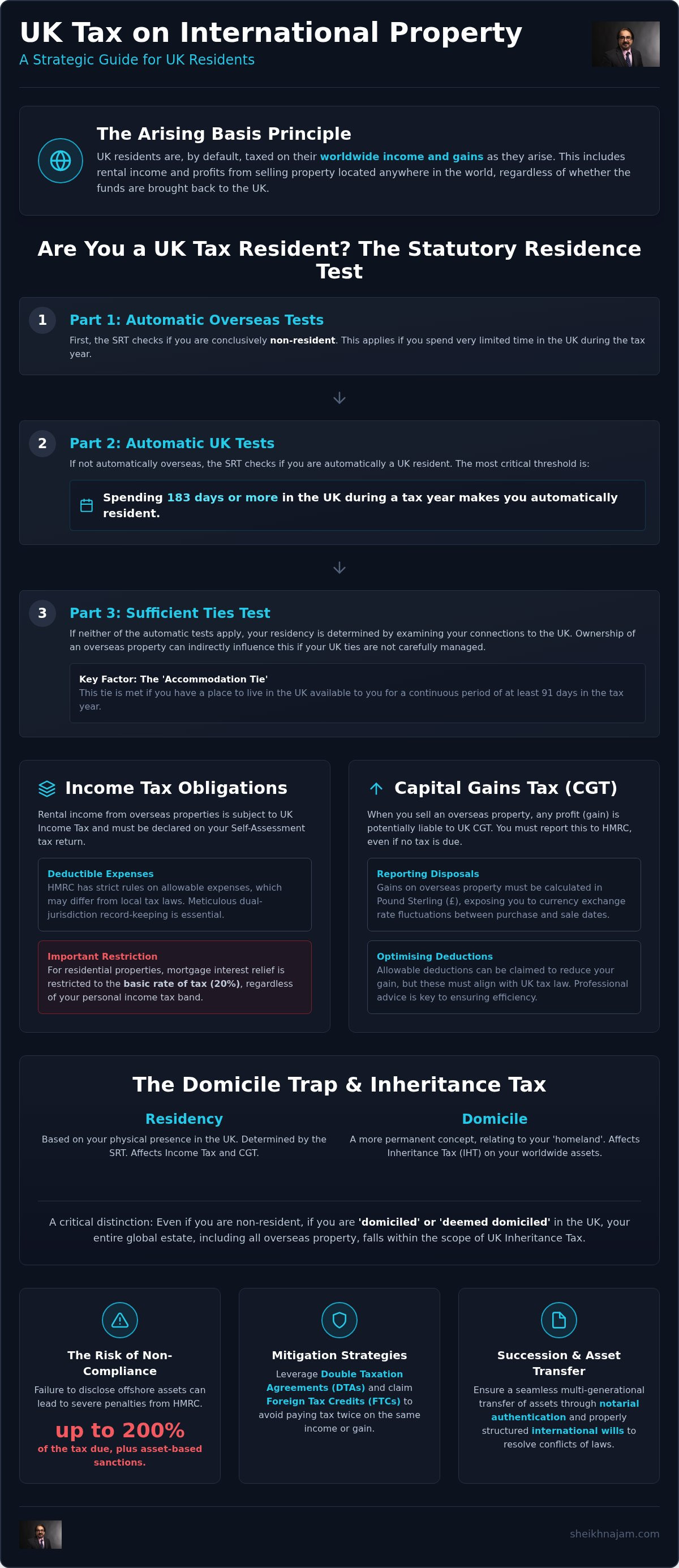
The SRT operates through a hierarchical, three-part structure designed to eliminate ambiguity regarding an individual's tax status. First, the 'Automatic Overseas Tests' determine if a person is conclusively non-resident. If these aren't met, the 'Automatic UK Tests' apply. The 183-day rule remains a non-negotiable threshold; spend 183 days or more in the UK during a tax year, and you're automatically resident. For those falling into neither category, the 'Sufficient Ties Test' examines the depth of an individual's connection to the UK. Property ownership is a critical factor here. The 'accommodation tie' considers whether you've a place to live in the UK for at least 91 days, whilst your overseas holdings may inadvertently influence your status if your UK ties aren't structured with precision. Precise record-keeping is essential for those spending significant time amongst multiple jurisdictions to avoid an accidental descent into UK residency.
Worldwide Income and the Arising Basis
By default, UK residents are taxed on the 'arising basis'. This means you're liable for tax on all worldwide income and gains in the year they occur, regardless of whether the funds are brought into the UK. This applies directly to foreign rental yields, which must be declared via the Self-Assessment system. Compliance isn't optional. The 'Requirement to Correct' (RTC) legislation has significantly heightened the stakes, imposing severe financial penalties for the non-disclosure of offshore assets. These penalties can reach up to 200% of the tax due. In some instances, asset-based sanctions may also apply. Consequently, the integration of international tax planning is a fundamental requirement for the preservation of capital against regulatory scrutiny. Proactive disclosure and meticulous structuring remain the only viable defences against the complexities of modern fiscal transparency.
Capital Gains and Income Tax Obligations for Foreign Real Estate
Beyond the fundamental determination of residency, the fiscal burden of international real estate manifests most acutely through the dual prisms of income and capital gains. The tax implications of owning property abroad UK residents encounter are not merely a matter of calculating local profit; they require a rigorous reconciliation with British statutory requirements. Any revenue generated from overseas assets is brought within the UK tax net on the arising basis, necessitating a sophisticated understanding of how foreign yields interact with domestic thresholds. Failure to harmonise these obligations often leads to significant fiscal leakage and regulatory scrutiny.
Foreign Rental Income and Deductible Expenses
Rental yields derived from overseas holdings are subject to UK Income Tax, yet the criteria for allowable deductions often differ markedly between jurisdictions. Whilst a local tax authority might permit broad capital allowances, HMRC maintains strict parameters regarding property management expenses and maintenance. Most significantly, the UK’s restricted finance cost rules apply to foreign residential property, limiting mortgage interest relief to the basic rate of tax. This creates an administrative burden where investors must maintain dual-jurisdiction records to ensure compliance. To ensure your portfolio remains efficient, referencing the official guidance on foreign income is essential for identifying which foreign taxes can be effectively offset through the Foreign Tax Credit system.
Currency Risk and the 'Sterling Gain' Trap
The disposal of international property introduces the 'Sterling Gain' trap, a phenomenon where currency volatility creates a tax liability independent of the asset's local market performance. HMRC requires all capital gains calculations to be converted to Sterling at the date of acquisition and disposal. Consequently, if the Pound weakens against the local currency during the period of ownership, you may face a substantial UK Capital Gains Tax (CGT) bill even if the property's value remained static in its home territory. For the 2026/27 tax year, CGT on residential property is levied at 18% for basic rate taxpayers and 24% for those in the higher or additional rate brackets. Meticulous strategic tax structuring is required to manage these fluctuations and protect the underlying capital.
Reporting timelines remain a critical area of risk. While the specific 60-day reporting and payment rule primarily targets UK residential property, the disposal of foreign residential assets must be declared with absolute precision within the annual Self-Assessment framework. The complexity of calculating the 'gain' in Sterling, whilst accounting for foreign transaction costs and local tax paid, demands a high degree of technical expertise. It's not simply about the sale; it's about the comprehensive academic reconciliation of two distinct legal and fiscal environments to prevent a dispute with the authorities.
The Domicile Trap: Inheritance Tax Implications for Global Assets
While residency dictates your annual obligations to the Exchequer, domicile remains the ultimate anchor for long-term fiscal liability. It's a common misconception amongst high-net-worth individuals that simply residing outside the UK or holding assets in foreign jurisdictions insulates their estate from the reach of His Majesty’s Revenue and Customs. In reality, the tax implications of owning property abroad UK residents must confront are most severe at the point of succession. For a UK-domiciled individual, the entirety of their worldwide estate, including prestigious real estate in France, Spain, or the United States, falls within the 40% Inheritance Tax (IHT) net. This liability is predicated upon the 'situs' of the assets, where the legal location of the property necessitates its inclusion in the total valuation of the estate upon death.
Inheritance Tax (IHT) and the Worldwide Estate
The fiscal consequences of UK domicile are profound, particularly when an estate exceeds the frozen nil-rate band of £325,000. Foreign residential real estate is frequently the most exposed asset class within a portfolio because it rarely qualifies for Business Property Relief (BPR), a mechanism often reserved for active trading concerns rather than passive property holdings. During the probate process, valuation protocols for foreign assets require meticulous reconciliation with local market appraisals, often necessitating notarial authentication to satisfy both UK and foreign authorities. Whilst many investors focus on the immediate Capital Gains Tax on overseas property during their lifetime, the lack of strategic foresight regarding IHT can lead to the forced liquidation of cherished family assets to settle tax debts.
The Concept of Deemed Domicile
The statutory landscape shifted significantly with the introduction of the 'deemed domicile' rule, which captures individuals who have been resident in the UK for at least 15 of the last 20 tax years. Once this threshold is crossed, the individual is treated as UK-domiciled for all tax purposes, regardless of their original domicile of origin or their long-term intentions. This transition triggers the loss of 'Excluded Property' status for foreign assets, bringing previously shielded overseas real estate into the scope of UK IHT. Protecting a global legacy requires a sophisticated approach to international tax structuring for private clients. By implementing robust frameworks before the 15-year threshold is reached, you can mitigate the risk of the domicile trap and ensure your assets remain protected for future generations. Precision in these matters isn't merely a preference; it's a fundamental requirement for wealth preservation.
Strategic Cross-Border Tax Planning for Families: Mitigation Frameworks
Strategic wealth preservation necessitates a move from reactive reporting to proactive structural design. For the high-net-worth individual, the tax implications of owning property abroad UK residents must manage are not insurmountable obstacles, but rather variables that can be optimised through sophisticated legal frameworks. Mitigation is achieved by harmonising domestic obligations with international protocols, ensuring that global assets are protected from unnecessary fiscal leakage. This requires a granular understanding of how differing jurisdictions interact at the level of treaty law and fiduciary structuring.
Double Taxation Relief Protocols
The primary defence against fiscal duplication lies in the robust application of double taxation treaties. These agreements allocate taxing rights between the UK and the host nation, typically allowing for the Foreign Tax Credit (FTC) to offset UK liability against taxes already paid in the jurisdiction where the property is situated. Where no formal treaty exists, the UK provides 'Unilateral Relief', a mechanism that prevents the same income or gain from being taxed twice, albeit with less certainty than a formal bilateral agreement. The tie-breaker clause in most international tax treaties serves as a final arbiter to assign a single state of residence to an individual who would otherwise be considered a resident by both jurisdictions under their respective domestic laws. Utilising these protocols ensures that your portfolio remains fiscally efficient whilst maintaining absolute compliance with HMRC’s evolving standards.
Corporate and Trust Structuring
For high-value portfolios, the use of corporate holding vehicles can offer significant advantages in terms of asset management and succession planning. In particular, using a Dutch holding company for UK residents provides a sophisticated gateway for managing European real estate, often benefiting from favourable participation exemptions and a stable legal environment. However, such 'enveloping' of residential property must be balanced against the Annual Tax on Enveloped Dwellings (ATED), which applies to properties valued over £500,000 held by companies or other collective vehicles. Fiduciary structures, including family trusts, remain indispensable for multi-generational wealth transfer, though they require meticulous drafting to navigate the intersection of UK trust law and foreign civil codes. These instruments must be handled with absolute precision to avoid unintended tax charges or probate disputes. To ensure your family's global legacy is secured through a bespoke framework, you may wish to seek a consultation for international tax planning.
Ensuring Continuity: Notarial Authentication and International Succession
The strategic management of global real estate extends beyond the immediate tax implications of owning property abroad UK residents experience; it demands a robust framework for legal continuity and the seamless transmission of assets across borders. While fiscal efficiency is paramount, the legal validity of title and the efficacy of testamentary dispositions are often contingent upon meticulous notarial intervention. In many civil law jurisdictions, the common law concept of testamentary freedom is curtailed by rigid statutes, making the authentication of documents a critical component of risk mitigation. Without precise legalisation, even the most sophisticated tax structures may fail at the point of execution.
Notarial Acts and Property Transactions
The role of the Notary Public is indispensable in the context of international real estate, serving as the primary bridge between the UK legal system and foreign land registries. When executing transfers or charges over overseas property, the Notary must verify the identity and legal capacity of the parties with absolute certainty, ensuring that all documentation meets the exacting standards of the host nation. This process frequently involves obtaining an Apostille from the Foreign, Commonwealth & Development Office to legalise UK documents for international use. Such measures are not merely administrative formalities; they are essential for ensuring compliance with international Anti-Money Laundering (AML) and financial crime regulations, protecting the integrity of your global portfolio against future challenges.
Succession Planning for the Global Family
Navigating the 'Conflict of Laws' is perhaps the most complex aspect of cross-border estate management. Many European and Middle Eastern jurisdictions operate under 'Forced Heirship' regimes, which mandate that a specific portion of an estate must pass to direct descendants, regardless of the deceased's wishes. To counter these restrictions, the strategic drafting of international wills is required to harmonise your intentions with the lex situs of the property. Co-ordinating a UK-based will with a foreign 'situs' will prevents protracted probate delays and ensures that executors possess the necessary authority in all relevant jurisdictions.
Continuity also requires planning for incapacity. A standard UK Lasting Power of Attorney (LPA) may not be recognised by foreign banks or authorities without specific notarial certification or the creation of a local equivalent. By integrating notarial services into your broader estate plan, you ensure that your fiduciaries can manage foreign assets without interruption. This multi-disciplinary approach provides a level of command and control that simple tax planning cannot achieve alone. For professional guidance on these complex multi-jurisdictional matters, please contact Sheikh Najam TEP for a formal consultation to secure your family's international legacy.
Securing Your Global Legacy in an Evolving Fiscal Landscape
The strategic management of international real estate requires a meticulous reconciliation of residency status, treaty-based relief protocols, and the nuances of cross-border succession. We've examined how the Statutory Residence Test and the 15-year deemed domicile threshold serve as critical pivot points for long-term wealth preservation. Addressing the tax implications of owning property abroad UK residents must navigate demands a synthesis of legal and fiscal expertise that transcends traditional boundaries. By integrating international wills with specialist notarial authentication, you protect your portfolio from the vagaries of forced heirship and administrative delay. To ensure your global affairs are handled with absolute precision, you're invited to schedule a strategic consultation with Sheikh Najam TEP. Our practice offers preeminent expertise in International Tax Planning and Specialist Notarial Services; this advisory is grounded in the institutional weight of the Society of Trust and Estate Practitioners (TEP). You can secure your multi-generational legacy with confidence and strategic foresight.
Frequently Asked Questions
Do I have to pay tax in the UK on property I own abroad?
UK residents are subject to the arising basis of taxation on their worldwide income and gains. This fundamental principle ensures that any revenue or profit derived from international real estate is included in your annual Self-Assessment. Understanding the tax implications of owning property abroad UK residents face is essential for maintaining regulatory compliance. You must declare all foreign rental yields and capital gains, as HMRC treats these as part of your total taxable global estate.
What happens if the country where my property is located also taxes my rental income?
You can typically mitigate fiscal duplication by leveraging Double Taxation Agreements (DTAs) between the UK and the host nation. These treaties allow you to claim a Foreign Tax Credit (FTC) to offset the tax paid in the foreign jurisdiction against your UK liability. If no treaty exists, unilateral relief may be available. This mechanism ensures that you aren't taxed twice on the same income, preserving the fiscal efficiency of your international real estate portfolio.
Is foreign property subject to UK Inheritance Tax if I am a non-domiciled resident?
Non-domiciled individuals are generally only liable for UK Inheritance Tax (IHT) on their UK-situs assets. However, if you've resided in the UK for 15 of the last 20 tax years, you'll be treated as 'deemed domiciled'. At this point, your entire worldwide estate, including all foreign property, falls within the 40% UK IHT net. Strategic planning is required before reaching this statutory threshold to protect your global assets from significant fiscal exposure.
How does HMRC know about my overseas property and bank accounts?
HMRC receives detailed financial information through the Common Reporting Standard (CRS) and the Automatic Exchange of Information (AEOI). Over 100 jurisdictions currently participate in these protocols, sharing data regarding offshore bank accounts and asset ownership. This transparency is reinforced by the 'Requirement to Correct' legislation, which imposes severe penalties for non-disclosure. It's no longer possible to hold significant overseas assets without the knowledge of the UK tax authorities.
Can I use a UK company to buy property abroad to save on tax?
While purchasing property through a UK company can provide certain structural benefits, it often triggers the Annual Tax on Enveloped Dwellings (ATED) if the property value exceeds £500,000. Corporate ownership can also lead to complex interactions with foreign local taxes and may eliminate certain individual capital gains reliefs. A thorough analysis of the specific jurisdiction's laws is necessary before adopting a corporate vehicle, as the administrative costs often outweigh the perceived tax savings.
What is the 60-day rule for reporting Capital Gains on foreign property?
The specific 60-day reporting and payment deadline applies exclusively to the disposal of UK residential property. For foreign residential assets, you must report the gain through your annual Self-Assessment tax return. However, you must still calculate the gain in Sterling at the dates of acquisition and disposal. This calculation must account for currency fluctuations, which can inadvertently increase your UK tax liability even if the property's local value remains static.
Do I need a separate will for my property located in a foreign jurisdiction?
Drafting an international will is a critical step in securing cross-border continuity. While a UK will may be legally valid, it often encounters procedural hurdles in civil law jurisdictions that enforce forced heirship rules. A separate 'situs' will, or a meticulously drafted international will, ensures that your testamentary intentions are harmonised with local laws. This prevents protracted probate disputes and ensures a seamless multi-generational asset transfer within your global real estate portfolio.
How can a Notary Public assist with my overseas property purchase?
A Notary Public serves as an essential arbiter of legal validity for documents intended for use in foreign jurisdictions. They verify the identity and capacity of the signatories, ensuring that all deeds and powers of attorney comply with the requirements of foreign land registries. By providing notarial acts and facilitating the Apostille process, the Notary ensures that your property transactions are recognised as legally binding abroad, thereby mitigating the risk of future title disputes.


Comments