The Jurisprudential Function of a Notary Public in London: A Strategic Overview

Updated: Aug 26
The efficacy of a sophisticated international wealth structure or a high-stakes corporate acquisition frequently hinges upon the jurisprudential weight of a single public officer's seal. You likely recognise that the inherent complexity of cross-border document recognition creates profound anxiety regarding the validity of international powers of attorney and the acute time-sensitivity of global transactions. This strategic overview provides an authoritative examination of the institutional function of a notary public london, demonstrating how rigorous notarial acts provide the foundational security required for seamless international legal compliance and wealth planning.
We'll evaluate the implications of the Notaries (Conduct and Discipline) Rules 2026 and the recent updates to the Money Laundering and Terrorist Financing Regulations 2026 to illustrate how meticulous expertise commands respect in foreign jurisdictions. By moving beyond mere administrative formality, this analysis previews the precise multi-disciplinary approach necessary to ensure your most complex affairs are handled with absolute precision. This examination serves as a definitive guide for those seeking to integrate their private interests within the demanding regulatory frameworks of the City of London and the wider global legal landscape.
Table of Contents
The Office of the Notary Public: An Institutional Pillar in London
The Strategic Necessity of Notarisation in Cross-Border Jurisdictions
Navigating the Legalisation Framework: Apostilles and Consular Authentication
Notarial Acts for Private Wealth and Corporate Governance in the City
Sheikh Najam TEP: Elevating Notarial Services Through Multi-Disciplinary Expertise
The Office of the Notary Public: An Institutional Pillar in London
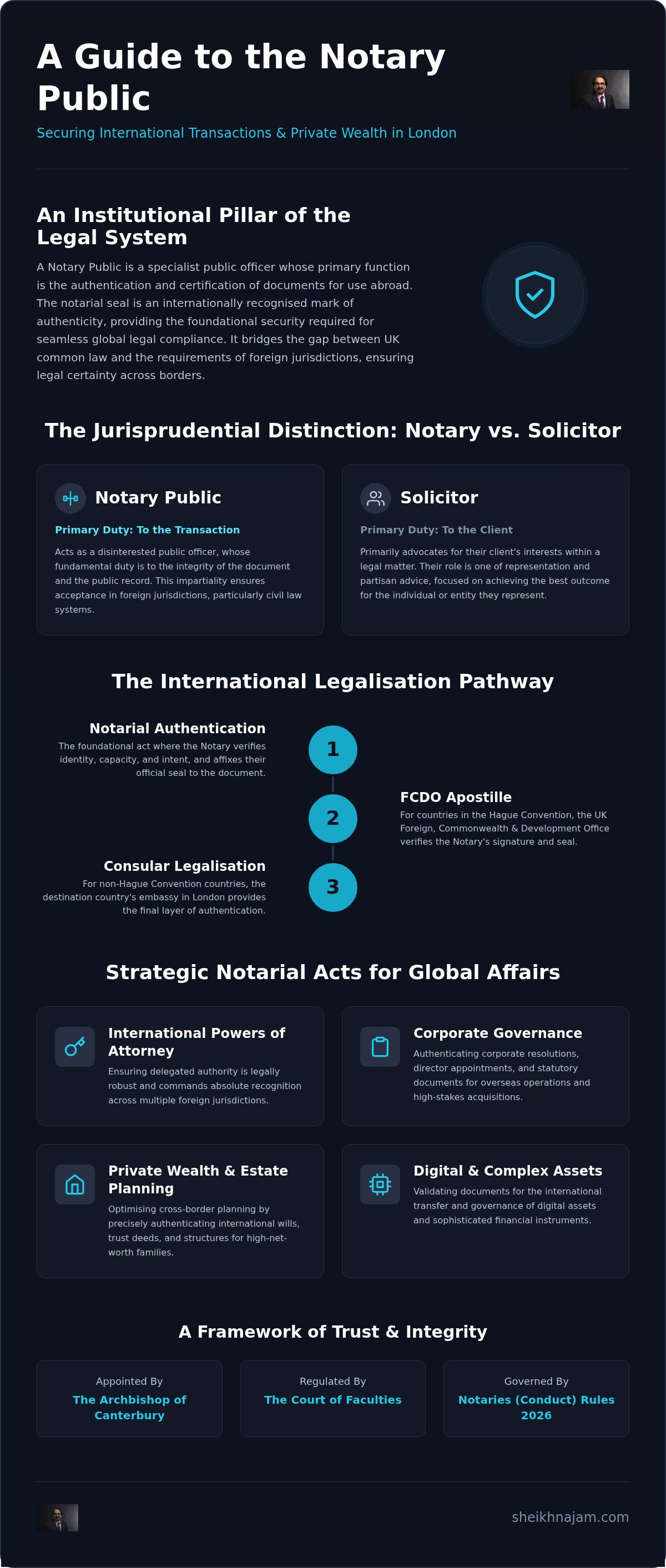
The office of the notary public london represents a foundational pillar of the English legal system, serving as a bridge between the common law traditions of the United Kingdom and the diverse requirements of international jurisdictions. Unlike other legal practitioners, a Notary is a public officer of ancient standing, whose primary function is the authentication and certification of documents for use abroad. This role is rooted in a historical tradition that predates the modern legal profession, ensuring that an instrument bearing a notarial seal is invested with a high degree of international trust. The Office of the Notary Public functions as a guarantor of legal rectitude; it provides the necessary assurance that the facts stated within a document have been verified by a disinterested and highly qualified professional. The seal is paramount. It's the internationally recognised mark of authenticity that allows a document to cross borders with legal certainty.
The Jurisprudential Distinction: Notary vs Solicitor
A fundamental distinction exists between the role of a solicitor and that of a Notary. While a solicitor's primary duty is to advocate for their client's interests, a Notary's primary duty is to the transaction itself and the integrity of the public record. This impartiality is essential for the acceptance of documents in civil law jurisdictions, where the Notary is seen as an independent witness to the capacity and intent of the parties involved. It's this independence that ensures a power of attorney or a corporate resolution executed in London commands respect in Paris, Dubai, or Tokyo. The Notary doesn't just witness a signature; they verify the underlying legality of the act.
Regulatory Oversight and Professional Standards
Notarial practice is governed by stringent standards to maintain the profession's global reputation. Most Notaries in London are appointed by the Archbishop of Canterbury and are regulated by the Court of Faculties. The profession has recently seen significant regulatory updates, including the Notary (Conduct and Discipline) Rules 2026, which came into effect on 28 April 2026. These rules, alongside the Notaries Accounts Rules 2026, ensure that practitioners maintain the highest levels of financial and professional integrity. Every notary public london must adhere to these rigorous standards, ensuring that the public register remains a reliable source of truth for international authorities and financial institutions alike. This oversight guarantees that the meticulousness required for high-net-worth legal advisory is never compromised.
The Strategic Necessity of Notarisation in Cross-Border Jurisdictions
Beyond the administrative application of a seal, the intervention of a notary public london serves as a critical strategic safeguard in the execution of international trade and the management of sophisticated private legal affairs. It's not merely a procedural formality; rather, it's a rigorous verification process where the practitioner confirms the identity, legal capacity, and genuine intent of the parties involved. In high-stakes global transactions, this professional scrutiny effectively mitigates the risk of fraud, providing a layer of security that simple witnessing cannot achieve. The evidentiary value of such acts is profound. In foreign litigation or complex probate proceedings, a notarised instrument carries a presumption of authenticity that is often irrefutable under civil law codes, ensuring that your legal standing remains unchallenged across borders.
Authentication of International Powers of Attorney
Ensuring the validity of delegated authority across multiple jurisdictions requires a meticulous approach that accounts for varying local requirements. When a director or high-net-worth individual executes an international power of attorney, the notary public london must verify not only their identity but also their specific corporate authority to bind a legal entity. This involves a granular analysis of constitutional documents and board resolutions to prevent any future challenge to the agent's actions. Navigating the Legalisation Framework is often the essential next step, as many jurisdictions require an apostille to accompany the notarial certificate to ensure full recognition. For those managing intricate global interests, engaging a practitioner with deep expertise in notarial services ensures that these instruments are robust enough to withstand the most rigorous foreign scrutiny.
Corporate Governance and Global Transactions
In the context of corporate governance, the Notary acts as a vital link for London-based firms operating overseas subsidiaries. Authenticating board resolutions, certificates of incumbency, or constitutional amendments is essential for high-value asset acquisitions and disposals. Compliance with foreign regulatory requirements often demands that these documents are notarised to a standard that satisfies both local laws and international standards. With the commencement of the Money Laundering and Terrorist Financing (Amendment) Regulations 2026 on 30 June 2026, the level of diligence required has increased, making the Notary’s role even more pivotal in maintaining corporate integrity. This strategic foresight prevents the costly delays and legal setbacks that arise from improperly executed international instruments, facilitating a seamless transition in global commercial dealings.
Navigating the Legalisation Framework: Apostilles and Consular Authentication
The transition from the primary act of authentication by a notary public london to the subsequent layers of state-sanctioned legalisation represents a critical juncture in the lifecycle of an international instrument. Whilst the notarial seal provides the foundational verification of identity and capacity, many foreign jurisdictions require a secondary level of state-level assurance to recognise the document's validity. This legalisation framework operates within a strict hierarchy, typically progressing from the Notary's act to the issuance of an Apostille by the Foreign, Commonwealth & Development Office (FCDO), and, where necessary, final authentication by a consular or diplomatic mission. Understanding this hierarchy is essential for ensuring that documents intended for use in diverse legal regimes, from the European Union to the GCC, are not summarily rejected by foreign registries or financial institutions.
The efficacy of the Apostille is governed by the 1961 Hague Convention, a multilateral treaty that streamlines the recognition of public documents amongst member states. For countries that are signatories to this convention, the Apostille serves as the final step in the legalisation chain, effectively bypassing the need for embassy intervention. However, for jurisdictions that remain outside the Hague framework, the process remains significantly more complex, requiring a multi-staged approach that demands meticulous co-ordination between the notary public london, the FCDO, and the relevant embassy. This strategic management of the legalisation path is vital for avoiding the administrative bottlenecks that frequently jeopardise the timing of cross-border corporate transactions or private wealth transfers.
The Mechanics of the Apostille Service in London
The FCDO serves as the competent authority in the United Kingdom for the issuance of Apostilles, verifying that the signature and seal of the Notary match the records held by the state. As of July 2026, the standard paper-based legalisation service typically requires a processing window of 15 to 20 working days, reflecting the rigorous nature of state authentication. For modern digital transactions, the emergence of the e-Apostille has provided a more efficient alternative, with processing times reduced to approximately 2 working days. This digital path is increasingly utilised for corporate resolutions and digital asset structuring, provided the receiving jurisdiction possesses the technical infrastructure to verify electronic signatures. The choice between these paths must be informed by the specific evidentiary requirements of the destination country.
Consular and Embassy Legalisation
For documents destined for non-Hague Convention countries, particularly within Middle Eastern and Asian jurisdictions, consular legalisation remains a mandatory requirement. This process involves the document being presented to the diplomatic mission in London, where it undergoes a final layer of scrutiny by the consul. Each mission maintains bespoke requirements, varying consular fees, and specific procedural nuances that must be followed with absolute precision. Failure to comply with the exact administrative standards of a particular embassy can result in significant delays, making it imperative to co-ordinate these multi-stage authentications through a practitioner who understands the intricate demands of international diplomatic protocols.
Notarial Acts for Private Wealth and Corporate Governance in the City
The deployment of a notary public london within the context of high-net-worth wealth preservation requires a level of sophistication that transcends standard administrative witnessing. For family offices and ultra-high-net-worth individuals, the authentication of instruments is inextricably linked to broader objectives of international tax planning and Inheritance Tax (IHT) mitigation. It's a precise exercise in multi-disciplinary expertise where the practitioner must possess an intimate understanding of the underlying fiscal implications. Authenticating trust deeds or international wills for cross-border succession requires a practitioner who understands the stringent requirements of foreign probate registries and the nuances of civil law forced heirship regimes. By ensuring that these fiduciary documents are robust and compliant with both UK and international standards, the Notary provides the foundational security necessary for the seamless transition of multi-generational wealth across sovereign borders.
International Succession and Probate
In the sphere of international succession, the Notary's role in verifying testamentary capacity and the validity of execution is paramount. This is particularly relevant when managing the resealing of grants or complex international probate matters where assets are distributed across multiple jurisdictions. The practitioner must ensure that every instrument of succession is executed with absolute precision to withstand potential trust or will disputes. This meticulousness is essential for securing assets against legal challenges in foreign courts, where the notarial act serves as primary evidence of the testator's intent and legal standing. The intersection of notarial acts with probate and estate administration ensures that the strategic intent of the wealth creator is preserved, even within the most demanding legal environments.
Digital Assets and Modern Notarial Practice
The evolving landscape of fintech and decentralised finance has necessitated a shift in traditional notarial principles to accommodate digital asset structuring and the verification of crypto-wealth ownership. Following the commencement of the Money Laundering and Terrorist Financing (Amendment) Regulations 2026 on 30 June 2026, the notary public london must apply rigorous compliance standards to these modern assets. This involves verifying ownership of decentralised holdings whilst navigating the complexities of digital identity verification standards announced on 26 June 2026. This ensures that the authentication of digital holdings meets the evolving expectations of global regulatory bodies and financial institutions. For those seeking to integrate these complex holdings into a broader estate plan, engaging a specialist in notarial services and digital asset structuring provides the strategic foresight required to navigate this intricate legal terrain.
Sheikh Najam TEP: Elevating Notarial Services Through Multi-Disciplinary Expertise
The practice of Sheikh Najam TEP represents a significant departure from the conventional model of notarial services in the City. By integrating the office of the notary public london with the specialised expertise of a Trust and Estate Practitioner (TEP), the practice offers a bespoke delivery framework designed for the most complex legal requirements. This multi-disciplinary approach ensures that notarial acts aren't performed in a vacuum but are instead informed by a profound understanding of international tax planning and estate resilience strategies. For high-net-worth individuals, this provides an underlying sense of security; they know their instruments of power and succession are being verified by a practitioner who understands the intricate fiscal and regulatory consequences of the act itself. The prestigious London location serves as a centre for global legal excellence, where the seal of the Notary is backed by the weight of institutional authority and academic rigor.
The Strategic Polymath: Beyond Simple Authentication
The designation of a Strategic Polymath is earned through the synthesis of deep academic theory and practical, high-stakes resolution. Sheikh Najam's background in international tax law allows for a command-and-control approach to intricate legal landscapes, where a single point of contact manages both the authentication and the underlying wealth planning structure. This prevents the fragmentation of advice that often occurs when administrative tasks are separated from strategic legal counsel. By providing this jurisprudential depth, the practice ensures that every notarised document serves as a robust component of a wider, global wealth preservation regime. It's a style of advisory that assumes a high level of literacy and professional familiarity from the reader, focusing on the stability and compliance required for multi-generational asset protection.
Engagement and Consultation
The communication rhythm of the practice is methodical and thorough, reflecting the gravity of the affairs under management. Every engagement begins with a deliberate intake process and a comprehensive document review to ensure absolute compliance with the Notary (Conduct and Discipline) Rules 2026 and the 30 June 2026 updates to the Money Laundering and Terrorist Financing Regulations. This meticulousness isn't merely a regulatory hurdle; it's a cornerstone of the practice's commitment to precision and security. By proposing a framework for long-term fiduciary partnership, Sheikh Najam TEP positions the notary public london as a master advisor who provides stability and strategic foresight in an increasingly volatile global regulatory environment. For those requiring a sophisticated level of command over their international legal affairs, initiating a consultation for bespoke notarial and estate planning services ensures that even the most complex instruments are executed with absolute precision.
Securing Global Interests Through Jurisprudential Precision
The strategic deployment of a notary public london represents a foundational safeguard for the integrity of international legal regimes, transcending mere administrative formality. By acknowledging the institutional weight of the notarial office and the rigorous demands of the global legalisation framework, you ensure that your corporate governance and private wealth instruments command absolute recognition across sovereign borders. This overview has demonstrated that the efficacy of an international power of attorney or a cross-border estate plan depends upon a meticulous verification of capacity and intent, performed with the highest degree of academic rigor and multi-disciplinary foresight.
As a specialist sole practitioner appointed by the Court of Faculties and a member of the Society of Trust and Estate Practitioners (TEP), Sheikh Najam provides the command-and-control oversight necessary for navigating these intricate landscapes. It's essential to integrate your notarial requirements with broader international tax and estate planning to ensure long-term estate resilience. We invite you to consult with Sheikh Najam TEP regarding your notarial and international legal requirements to secure the absolute legal certainty your affairs demand. Your most complex global transactions deserve the precision of a scholar-practitioner dedicated to institutional excellence.
Frequently Asked Questions
What is the primary difference between a Notary Public and a solicitor in London?
The primary distinction lies in the Notary's overriding duty to the transaction and the public record rather than the interests of a single client. Whilst a solicitor acts as an advocate for their client, a notary public london serves as an independent public officer whose authentication is designed for international recognition. This impartiality ensures that documents satisfy the stringent evidentiary requirements of civil law jurisdictions.
When is an Apostille required in addition to a notarial act?
An Apostille is mandatory when a document authenticated by a Notary is intended for use in a country that is a signatory to the 1961 Hague Convention. This certificate, issued by the Foreign, Commonwealth & Development Office (FCDO), provides state-level verification of the Notary’s seal. For jurisdictions outside the Hague framework, a further stage of consular legalisation at the relevant embassy is typically required.
Can a Notary Public in London verify documents for use in any country?
Yes, a Notary in London possesses the authority to authenticate documents for use globally, provided the practitioner adheres to the specific legalisation requirements of the destination state. While the notarial act itself is universally recognised, the subsequent chain of authentication varies significantly between Hague Convention members and those requiring bespoke diplomatic intervention through consular channels.
What are the typical fees associated with professional notarial services in the City?
Professional fees for notarial acts are generally determined by the complexity of the instrument and the volume of documents requiring authentication. Within the City, hourly rates for specialist practitioners often reflect the high level of expertise required, whilst statutory fees for Commissioner for Oaths acts are fixed at £5.00 for witnessing an affidavit and £2.00 for each exhibit.
How does a Notary verify the capacity of a corporate director for international transactions?
Verification of corporate capacity involves a granular analysis of the entity’s constitutional documents, including the Articles of Association and relevant board resolutions. The notary public london confirms that the director possesses the specific authority to bind the company, often referencing current filings at Companies House or international commercial registries to ensure absolute legal certainty in the transaction.
Is it possible to notarise documents electronically in the UK for use abroad?
Electronic notarisation and the issuance of e-Apostilles are increasingly prevalent, following the new standards for digital identity verification announced on 26 June 2026. Whilst the UK supports these digital processes, their efficacy depends entirely on whether the receiving foreign jurisdiction possesses the legislative framework and technical infrastructure to accept and verify electronically authenticated instruments.
What identification is required for a notarial appointment in London?
Clients must provide original, valid photographic identification, such as a passport or driving licence, alongside recent proof of residential address to satisfy stringent Anti-Money Laundering (AML) regulations. In accordance with the Money Laundering and Terrorist Financing (Amendment) Regulations 2026, practitioners must conduct thorough due diligence to verify the identity and standing of all parties appearing before them.
How does notarisation impact the validity of an international will?
Notarisation significantly enhances the validity of an international will by providing conclusive evidence of the testator's identity, capacity, and voluntary intent at the time of execution. This professional authentication is particularly vital for estates spanning multiple jurisdictions, as it facilitates the resealing of grants and helps mitigate the risk of future contentious probate or cross-border trust disputes.


Comments