The Strategic Role of a Notary Public for Company Documents in International Commerce

Updated: Aug 26
In the high-stakes arena of global commerce, the mere execution of a signature is rarely sufficient to bridge the chasm between disparate legal systems. For the modern director or general counsel, the engagement of a specialist notary public for company documents represents far more than a procedural box-ticking exercise; it's a critical strategic safeguard. Without the rigorous authentication of corporate instruments, the risk of jurisdictional rejection and the subsequent paralysis of international transactions becomes a tangible threat to institutional stability.
You likely recognise that navigating the labyrinthine requirements of the Foreign, Commonwealth and Development Office (FCDO) alongside various foreign embassies is often a source of profound frustration and unnecessary delay. This article provides a definitive reference for those seeking absolute legal certainty and the seamless integration of notarial acts within a broader corporate strategy. We shall examine the nuances of multi-jurisdictional legalisation, the meticulous standards of the London-centric legal tradition, and the precise methodologies required to ensure your international filings remain beyond reproach. By aligning notarial precision with commercial foresight, you'll ensure your organisation's global mobility is never compromised by regulatory friction or administrative complexity.
Table of Contents
Understanding the Notary Public for Company Documents
The office of the Notary Public represents a specialised cadre of public officers, whose authority is derived from the Court of Faculties of the Archbishop of Canterbury. For a notary public for company documents, this appointment is not merely a title but a mandate to provide the 'Public Faith' required for international commerce. In the intricate ecosystem of the City of London, the notary acts as a bridge between common law traditions and the civil law requirements of foreign jurisdictions. This role is essential; it transforms private corporate instruments into public acts that possess presumptive truth in the eyes of foreign registries and sovereign courts.
The Legal Authority of the Notary in 2026
By 2026, the notarial profession has successfully synthesised ancient tradition with the demands of a digital-first corporate environment. The practitioner acts as an independent witness, verifying the identity and capacity of signatories to ensure that international filings are beyond reproach. Despite the rise of digital signatures, the physical notarial seal remains an indispensable requirement for many sovereign legal systems, providing a layer of security that purely digital protocols often fail to replicate. It's the notary's seal that signals to a foreign official that the document has been vetted by an officer of the court with global standing.
Notary vs. Solicitor: Strategic Distinctions
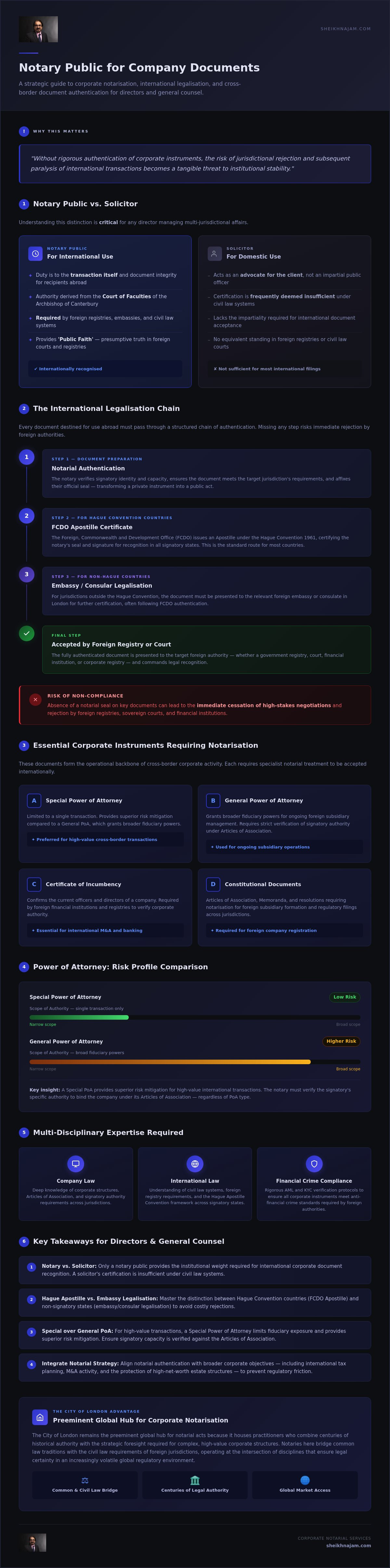
Distinguishing between a solicitor and a notary public for company documents is vital for any director managing multi-jurisdictional affairs. Whilst a solicitor acts as an advocate for their client, the notary’s duty is to the transaction itself and the integrity of the document for its eventual recipient abroad. This impartiality is the cornerstone of international document acceptance.
Duty to the Transaction: The notary ensures that the corporate act is legally robust for all parties, including the foreign government departments that will rely upon it.
International Recognition: Foreign registries and embassies almost exclusively require the intervention of a notary, as a solicitor’s certification is frequently deemed insufficient under civil law systems.
Multi-disciplinary Expertise: Effective corporate notarisation requires a deep understanding of company law, complex corporate structures, and financial crime compliance.
The City of London remains the preeminent global hub for these acts because it houses practitioners who combine this historical authority with the strategic foresight required for complex, high-value corporate structures. It's this intersection of disciplines that ensures legal certainty in an increasingly volatile global regulatory environment.
Essential Corporate Instruments Requiring Notarisation
The authentication of corporate instruments is not a mere formality; it is a fundamental pillar of cross-border legal integrity. When a director seeks a notary public for company documents, they are often securing the foundational authority for a foreign subsidiary's operations or the disposal of high-value international assets. In this context, protecting intangible assets is equally crucial; for instance, Henry Goh & Co provides essential insights into why patents are a vital component of any international expansion strategy. These acts transform private instructions into public instruments that command recognition from foreign state actors and financial institutions. In the complex landscape of international M&A and trade, the absence of a notarial seal on key documents can lead to the immediate cessation of high-stakes negotiations.
Powers of Attorney for International Affairs
The execution of a Power of Attorney (PoA) is perhaps the most critical instrument requiring the intervention of a notary. When destined for a civil law jurisdiction, a PoA must be drafted with meticulous attention to detail, as foreign registries often require specific linguistic formulae that differ significantly from English common law standards. The notary’s role extends beyond witnessing; it involves a rigorous verification of the signatory's capacity and their specific authority to bind the company under its Articles of Association. A 'Special' Power of Attorney, limited to a single transaction, often provides a superior level of risk mitigation compared to a 'General' PoA, which grants broader fiduciary powers. Ensuring these documents are fit for purpose requires a practitioner who understands the underlying corporate architecture.
Constitutional and Regulatory Documents
Beyond agency, the notary is frequently called upon to verify the current standing and constitutional framework of London-based entities. This is particularly vital for foreign branch registrations or international tenders. The process involves several key certifications:
Certificates of Incumbency and Good Standing: These are essential for the opening of foreign bank accounts, providing independent verification of an entity’s regulatory compliance and its authorised officers.
Memorandum and Articles of Association: Notarising these documents ensures that the company's internal governance is recognised as valid by foreign regulators.
Board Resolutions and Minutes: Authentication of these records provides the necessary evidence of corporate intent for cross-border mergers or significant asset acquisitions.
Certificates of Tax Residence: Verifying these instruments is often a prerequisite for international tax planning, ensuring fiscal efficiency and the prevention of double taxation across multiple jurisdictions.
The strategic value of these notarial acts lies in their ability to provide absolute legal certainty. By verifying the current status of an entity through official Companies House data and internal corporate records, the notary provides the institutional weight necessary for global expansion. This meticulous approach ensures that your organisation's constitutional documents are accepted without delay by foreign sovereign authorities.
The authentication performed by a notary public for company documents constitutes the foundational layer of international legal standing, yet for many jurisdictions, it represents only the inaugural phase of a multi-tiered legalisation chain. To achieve absolute legal certainty within foreign territories, corporate entities must navigate the rigorous protocols established by the Foreign, Commonwealth & Development Office (FCDO) and various sovereign diplomatic missions. This framework ensures that the notarial seal is verified by the issuing state’s supreme authority before it's presented to a foreign registry or judicial body. In the context of 2026, where regulatory scrutiny has reached unprecedented levels, the meticulous management of this chain is a prerequisite for institutional stability.
The Hague Convention and the Apostille Process
The 1961 Hague Apostille Convention introduced a standardised methodology for the cross-border recognition of public acts, replacing the cumbersome requirement for full legalisation amongst member states. In the United Kingdom, the FCDO serves as the competent authority, affixing an Apostille certificate to the instrument to validate the signature and standing of the notary public for company documents. Whilst the UK has expanded its E-Apostille service to accommodate a digital-first corporate environment, directors must exercise caution. Digital legalisation is not a universal panacea; many jurisdictions still demand the physical weight of a wet-ink signature and a traditional embossed seal. Pitfalls frequently occur when entities assume digital equivalence without first confirming the specific requirements of the receiving foreign registry.
Embassy and Consular Legalisation Strategy
For sovereign states that haven't acceded to the Hague Convention, such as the United Arab Emirates, China, or Qatar, the authentication process requires additional layers of institutional scrutiny. This 'full legalisation' involves a sequential path from the notary to the FCDO, and finally to the relevant London-based embassy for consular attestation. These missions often perform their own independent verification of the signatory’s authority and the document’s compliance with local regulations. Strategic planning is essential here, as processing times at certain embassies can extend to several weeks, potentially jeopardising the closing of high-value transactions. A sophisticated advisor anticipates these delays, integrating the legalisation timeline into the broader corporate strategy to ensure that administrative requirements never impede commercial momentum.
Verification Protocols and Compliance Standards
The authentication of corporate instruments by a notary public for company documents requires a meticulous examination of the legal nexus between the individual signatory and the corporate entity. Unlike rudimentary witnessing services, corporate notarisation demands a forensic level of scrutiny to ensure every act is supported by sufficient constitutional authority. This process begins with the rigorous identification of directors and authorised signatories, adhering to the highest standards of the UK’s regulatory framework. It's this precision that prevents the rejection of documents by foreign registries or sovereign judicial bodies.
Establishing Signatory Authority
A primary responsibility of the notary is to confirm that the individual appearing before them possesses the requisite legal power to bind the organisation to international obligations. This involves a granular review of the company's Articles of Association and the specific Board Resolutions that authorise the transaction. By examining "Authorised Signatory Lists" and internal corporate mandates, the notary protects the company against the risk of unauthorised international commitments. This step is vital; it ensures that no director acts ultra vires, thereby safeguarding the institution’s global legal standing and financial integrity.
Financial Crime and Regulatory Compliance
In an era of heightened global transparency, the notary operates at the vanguard of the UK’s financial crime prevention framework. Every notarial act is underpinned by robust Know Your Customer (KYC) protocols, particularly when dealing with the beneficial owners of complex, multi-layered corporate structures. This level of diligence ensures that notarial acts align seamlessly with international tax planning for business owners London, providing a defensive shield against allegations of non-compliance or fiscal impropriety. To ensure your corporate governance meets these exacting standards, you may consult our specialist notarial team for a comprehensive review of your international instruments.
The integrity of the process is further solidified by the maintenance of a permanent Notarial Register. This record serves as an immutable audit trail, providing a historical account of the due diligence performed for every corporate instrument. For directors and legal counsel, this register represents a vital safeguard. It ensures that their international filings are supported by a contemporary record of compliance that can withstand future judicial or regulatory inquiry. This methodical approach to documentation is what differentiates a standard administrative act from a strategically managed notarial protocol.
Sheikh Najam: A Strategic Approach to Corporate Notarisation
The traditional perception of the notary as a mere administrative functionary is increasingly obsolete in the context of sophisticated global markets. As a specialist notary public for company documents, Sheikh Najam TEP transcends this narrow definition, positioning the notarial act as a core component of strategic risk management. This practice ensures that the authentication of corporate instruments isn't performed in isolation; instead, it's meticulously harmonised with broader objectives such as international tax planning and the long-term preservation of institutional integrity. This bespoke advisory service is specifically calibrated for family offices and high-net-worth corporate structures that require a level of precision that standard practices often fail to provide.
Operating as a "Strategic Polymath," the practitioner brings a profound academic and professional background to every engagement, bridging the gaps between corporate law, trust administration, and regulatory compliance. This multi-disciplinary oversight is particularly pertinent when managing the intersection of corporate authority and personal succession, such as the authentication of international wills London. By understanding the underlying legal and financial architecture of a client’s affairs, the notary ensures that every instrument is not only authenticated but is also strategically robust for its intended jurisdiction.
Multi-Disciplinary Expertise in the City
High-level formality and academic rigor are the hallmarks of this London-centric practice. It's not merely about the witnessing of a signature; it's about the intellectual framework that supports the entire transaction. This synergy between notarial acts and broader dispute resolution strategy provides a secure environment for the most sensitive corporate affairs. When documents are vetted with this degree of meticulousness, the likelihood of future litigation or regulatory challenge is significantly diminished. The practitioner’s standing as a public officer appointed by the Court of Faculties adds a layer of institutional weight that is recognised globally.
Seamless Execution for London Corporations
For corporations based in the City, global expansion requires a partner who can manage complex legalisation paths without administrative friction. Through proactive verification and a deep understanding of FCDO and embassy requirements, Sheikh Najam ensures that international transactions proceed without delay. This commitment to absolute precision in notarial services reflects an understanding of the weight of institutional reputation. By engaging with a practitioner who understands the strategic implications of every seal and signature, directors can ensure their organisation’s international filings remain beyond reproach. This methodical approach provides the command and control necessary to navigate the most intricate legal landscapes with absolute certainty.
Securing Institutional Integrity in Global Markets
The successful execution of international commerce demands more than mere administrative compliance; it requires the foresight to treat every corporate instrument as a strategic safeguard. By engaging a specialist notary public for company documents, directors ensure that their multi-jurisdictional filings possess the institutional weight necessary to withstand the scrutiny of foreign sovereign authorities and financial registries. We've explored how the meticulous verification of signatory authority, coupled with a robust understanding of the FCDO legalisation chain, forms a defensive perimeter around your organisation’s global interests.
Absolute legal certainty is achieved when notarial acts are integrated with overarching corporate objectives, including international tax planning and financial crime compliance. Operating from a central London practice, Sheikh Najam provides the multi-disciplinary expertise required to manage these complex affairs with absolute precision. As a practitioner appointed by the Court of Faculties and a specialist in international tax and trust administration, he offers the command and control necessary for high-stakes cross-border operations. You're invited to Instruct Sheikh Najam for Strategic Corporate Notarial Services to fortify your organisation's international standing. With the right expert oversight, the path to global expansion becomes a structured journey toward institutional security.
Frequently Asked Questions
What is the primary difference between a notary public and a solicitor for business documents?
A notary public is a specialist legal officer whose primary duty is to the transaction and the international community, whereas a solicitor acts as an advocate for their specific client. While solicitors are common for domestic matters, a notary public for company documents is required for international recognition because their seal carries presumptive truth under civil law systems. This distinction ensures the document's validity is accepted by foreign registries and sovereign courts.
Why do my company documents need an Apostille after being notarised?
An Apostille is necessary to validate the signature and seal of the notary for use in countries that are members of the Hague Convention. It is issued by the Foreign, Commonwealth & Development Office (FCDO) and serves as a state-level verification of the notary's standing. Without this certificate, foreign officials have no mechanism to independently verify that the notary is a legitimate public officer appointed by the Court of Faculties.
Can a notary public verify the authority of a company director to sign a contract?
Yes, a notary public for company documents is specifically trained to verify the constitutional authority of a director to bind their organisation. This involves a forensic review of the company's Articles of Association and relevant Board Resolutions to ensure the act isn't ultra vires. By performing this verification, the notary protects the institution from unauthorised international commitments and provides legal certainty to the foreign recipient of the corporate instrument.
How long does the corporate notarisation and legalisation process typically take in London?
The timeline for corporate notarisation in London depends on the required legalisation path, but basic notarisation is often completed within one to two business days. If FCDO legalisation or embassy attestation is required, the process can extend to several weeks. In 2026, standard FCDO processing times remain subject to volume, so it's essential to integrate these administrative requirements into your broader corporate strategy to avoid transaction delays.
What documents must a director provide to a notary to prove their identity and authority?
Directors must typically provide a valid passport for identity verification alongside proof of residential address, such as a utility bill or bank statement. To establish corporate authority, the notary requires the company's Articles of Association, a current Certificate of Good Standing, and an original Board Resolution authorising the specific transaction. These documents allow the practitioner to perform the necessary due diligence required by the UK’s financial crime and regulatory compliance framework.
Are electronic signatures and e-notarisation accepted for international company documents?
Electronic signatures are increasingly common, but their acceptance for international company documents depends entirely on the requirements of the receiving jurisdiction. While the UK offers E-Apostilles, many sovereign states and foreign registries still mandate traditional wet-ink signatures and embossed seals. You shouldn't assume digital equivalence without first confirming the specific legal standards of the country where the document will be used, as this prevents administrative rejection.
What happens if a company document is not correctly notarised for use abroad?
Incorrectly notarised documents are almost invariably rejected by foreign registries, leading to significant delays and potential financial loss in international transactions. Such failures can jeopardise M&A closings, prevent the opening of foreign bank accounts, or invalidate subsidiary management instructions. Ensuring absolute precision through a specialist practitioner is the only way to mitigate the risk of regulatory non-compliance and maintain the institutional integrity of your organisation’s filings.


Comments