The Strategic Role of Will Dispute Mediation in London: A Fiduciary Perspective

Updated: Aug 26
The traditional recourse to the High Court’s Chancery Division often serves as a blunt instrument that inadvertently dismantles the very legacies it seeks to protect through public exposure and ruinous expense. For the discerning fiduciary or high-net-worth individual, the prospect of a protracted legal battle represents not merely a financial risk but a strategic failure to preserve the sanctity of private family affairs. You likely recognise that the adversarial nature of litigation is fundamentally at odds with the delicate requirements of multi-jurisdictional asset management. It's for this reason that will dispute mediation London has evolved from a mere alternative into a sophisticated tactical necessity for those navigating complex testamentary conflicts.
This article provides a rigorous examination of how advanced mediation frameworks offer a superior mechanism for resolving intricate estate disputes whilst ensuring absolute confidentiality and fiduciary integrity. We shall analyse the intersection of the Civil Procedure Rules and strategic negotiation, demonstrating how a multi-disciplinary approach can secure a cost-effective settlement without compromising your legal standing. By exploring the nuances of international tax planning and trust structures within the mediation process, this analysis outlines a definitive path toward protecting both the capital and the reputation of the estate.
Table of Contents
Navigating Contentious Probate: Why Will Dispute Mediation in London is Essential
The Procedural Mechanics of Estate Mediation within the London Chancery Division
Mediation versus Litigation: A Strategic Framework for High-Value Estate Resolution
Tactical Preparation for Will Mediation: Evidence, Capacity, and Fiduciary Duty
Integrating Multi-Disciplinary Expertise: The Sheikh Najam Methodology
Navigating Contentious Probate: Why Will Dispute Mediation in London is Essential
Within the rigorous domain of private wealth management, will dispute mediation London serves as a specialised form of Alternative Dispute Resolution (ADR) specifically calibrated for the intricacies of probate and succession. It represents a structured, confidential process where an independent third party, often a seasoned legal practitioner with trust and estate expertise, facilitates a binding settlement between parties whose interests in a decedent's estate have diverged. This mechanism is not merely a courtesy; it's a strategic imperative for those wishing to avoid the blunt trauma of public litigation.
The City of London has witnessed a significant escalation in contentious probate London, driven largely by the appreciation of prime residential assets and the increasing complexity of modern family structures across multiple jurisdictions. Litigation in the Chancery Division, while authoritative, often imposes a catastrophic financial and emotional burden on the participants, frequently exhausting the very assets under dispute. For the fiduciary, mediation provides a controlled environment to discharge duties whilst mitigating the risk of personal liability for depleted estate funds.
The Legal Framework for ADR in England and Wales
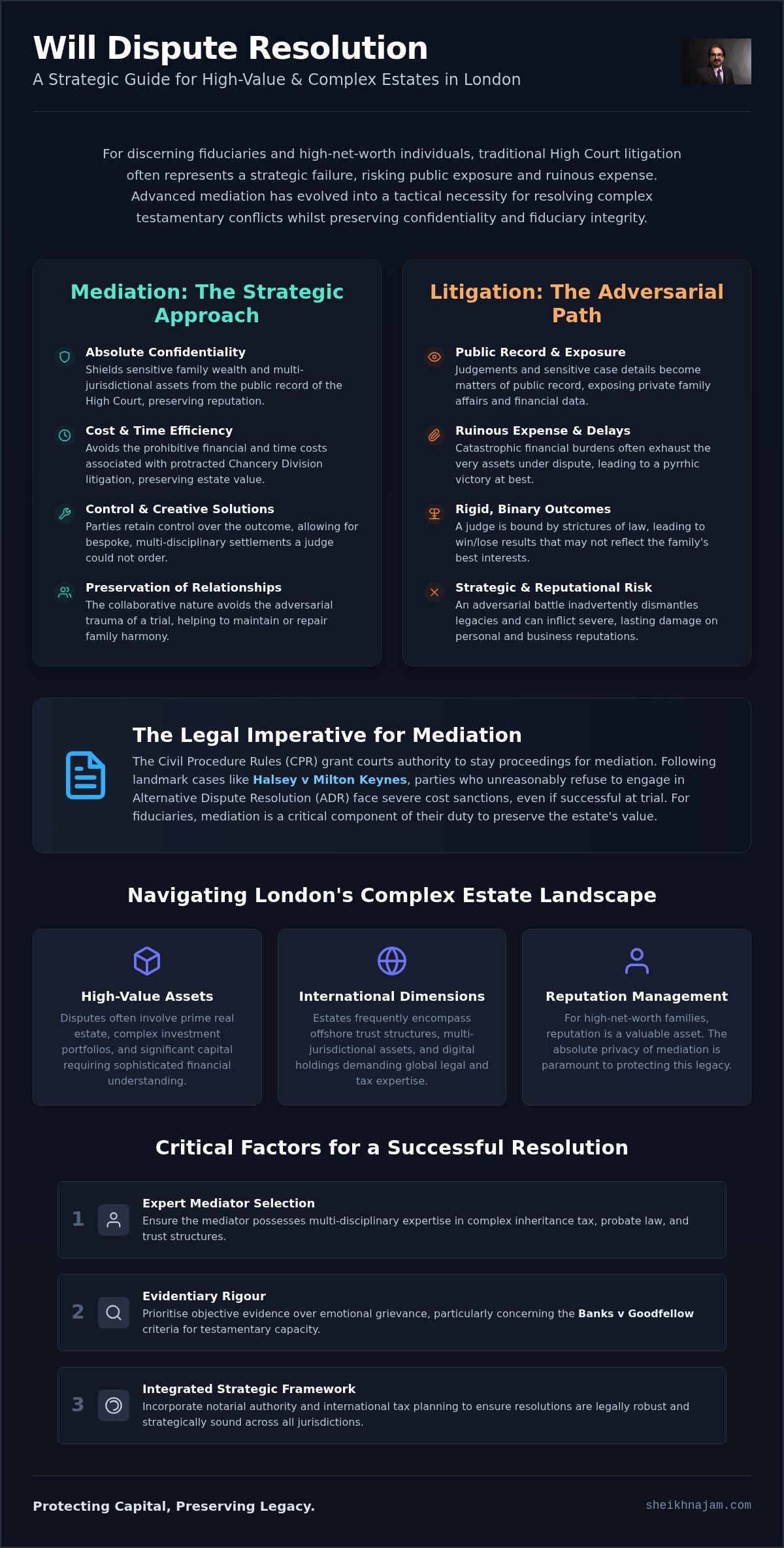
The Civil Procedure Rules (CPR) grant the judiciary broad powers to manage cases, including the authority to stay proceedings so that parties may explore mediation. Following the landmark precedents established in Halsey v Milton Keynes General NHS Trust and PGF II SA v OMFS Co 1 Ltd, the courts have increasingly penalised parties who unreasonably refuse to engage in ADR. These cost sanctions can be severe, often resulting in a successful litigant being deprived of their costs if they avoided mediation without a compelling justification. For executors and trustees, engaging in this process reinforces their 'fiduciary shield,' demonstrating a proactive commitment to preserving the estate's value against the corrosive effects of a full trial.
The London Context: High-Value and International Assets
London's status as a global financial hub ensures that estate disputes here rarely involve simple domestic arrangements. Instead, they frequently encompass prime real estate, offshore trust structures, and digital assets that require a high degree of technical literacy to untangle. Leading inheritance litigation solicitors London recognise that the primary advantage of mediation in this context is the preservation of absolute privacy. Unlike the High Court, where judgements are public and family secrets become matters of record, the mediation room remains a closed forum. This confidentiality is paramount for high-net-worth families whose reputations are as valuable as their financial holdings. It allows for creative, multi-disciplinary settlements that a judge, bound by the strictures of the law, simply could not order.
The Procedural Mechanics of Estate Mediation within the London Chancery Division
The efficacy of will dispute mediation London resides in its highly structured, multi-phasic architecture, which is designed to transition parties from entrenched adversarial positions toward a mutually executable settlement. Unlike the rigid, binary outcomes of a High Court trial, the mediation process within the City’s legal ecosystem operates with a degree of procedural fluidity that accommodates the specific complexities of high-value estates. The selection of a mediator remains the most critical decision in this sequence. It's non-negotiable that the chosen individual possesses not only advanced facilitative skills but also a profound technical mastery of trust law and inheritance tax implications, as a mediator without this specialised knowledge cannot adequately stress-test the viability of proposed settlement structures.
Phase 1: The Opening Statements and Position Papers
The initiation of a formal mediation session requires the submission of a comprehensive position paper, a document that must serve as both a legal treatise and a strategic framework for resolution. This paper isn't merely a summary of the claim; it's a sophisticated instrument used to signal legal strength whilst subtly indicating a readiness to settle on commercially sensible terms. In multi-million pound estate resolutions, the strategic decision of whether to conduct an opening joint session is paramount. Whilst traditional practice favours a face-to-face meeting, seasoned advisors often recommend bypassing this stage in particularly volatile family dynamics to prevent the calcification of grievances before negotiations have truly begun. Establishing a professional, serious tone from the outset ensures the proceedings reflect the institutional weight of the assets involved.
Phase 2: Private Caucuses and Tactical Negotiation
Once the preliminary stages conclude, the mediator employs a 'shuttle diplomacy' model, moving between secluded chambers to engage in private caucuses with each party. This allows the mediator to deconstruct the legal positions presented in will disputes London and identify the underlying interests, which frequently revolve around themes of recognition or the preservation of specific family heirlooms rather than purely liquid capital. During these sessions, the presence of expert witnesses, such as medical professionals specialising in testamentary capacity, provides the evidentiary weight necessary to move the needle on settlement figures. Tactical negotiation often involves the use of 'bracketed' offers, a method that narrows the gap between disparate claims without requiring an immediate commitment to a final number. For those managing intricate fiduciary responsibilities, engaging a specialist in mediation and arbitration ensures that these negotiations are handled with the requisite academic and strategic rigor.
The complexity of these sessions increases significantly when the estate includes digital holdings or international business interests that require immediate valuation and compliance checks. The mediator’s role is to ensure that any proposed settlement is not only agreeable to the parties but also robust enough to withstand future regulatory scrutiny. By the time the session reaches its final stages, the focus shifts toward the drafting of a binding settlement agreement, a task that requires meticulous attention to detail to ensure that every clause aligns with the overarching goal of fiduciary protection and legacy preservation.
Mediation versus Litigation: A Strategic Framework for High-Value Estate Resolution
In the high-stakes environment of London estate litigation, the choice between the Chancery Division and the mediation chamber is not merely a procedural preference but a strategic decision of profound consequence. Litigation is inherently binary; a judge, bound by the strictures of the law, must ultimately find in favour of one party, often leaving the estate's complex architecture in ruins. Conversely, will dispute mediation London provides a forum for non-binary resolutions that the court lacks the jurisdiction to order, such as the retrospective variation of trusts or the creative redistribution of non-liquid assets to satisfy diverse beneficiary requirements. Whilst a trial might offer the allure of total victory, it's often a pyrrhic one when the estate's liquidity is exhausted by the process.
Beyond the procedural advantages, the issue of confidentiality remains a significant differentiator for those managing substantial private wealth. High Court judgements are matters of public record, often exposing sensitive details of family wealth, previous tax structuring, and internal discord to the scrutiny of the public and the press. For high-net-worth families, this loss of privacy can result in irreparable reputational damage that far outweighs the value of the disputed assets. Mediation, being entirely private and conducted on a 'without prejudice' basis, ensures that the details of the settlement and the underlying family dynamics remain strictly confidential, thereby protecting the integrity of the family legacy for future generations.
The Cost-Benefit Analysis of the Chancery Route
The financial implications of a fully contested trial in the City are often overlooked until the 'burn rate' of legal fees begins to cannibalise the residuary estate. Under the standard 'loser pays' principle, the financial stakes are absolute, creating a scenario where litigation costs may exceed the value of the disputed interest. Litigation risk is the mathematical probability of an adverse judicial finding. Quantifying this through rigorous assessment allows advisors to establish a rational settlement range reflecting the uncertainties of judicial interpretation.
Preserving the Estate: The Fiduciary's Duty to Mediate
For the professional executor, the duty to preserve estate value is paramount. A failure to engage in mediation can lead to personal liability for costs, piercing the standard indemnity and exposing the practitioner to significant risk. Mediation serves as a tool for family governance, addressing the underlying frictions that precede legal claims to prevent future conflicts amongst heirs. The resolution is formalised through a Tomlin Order or Settlement Agreement, providing finality that a protracted appeal process simply cannot offer.
Tactical Preparation for Will Mediation: Evidence, Capacity, and Fiduciary Duty
The tactical efficacy of will dispute mediation London is fundamentally contingent upon the rigour of the evidentiary foundation established prior to the commencement of the session. High-net-worth disputes frequently succumb to the fallacy that a perceived lack of moral fairness constitutes a legal claim; however, within the professional register of the City's legal community, such sentiments are secondary to objective data. Success is predicated on a meticulous examination of the Banks v Goodfellow (1870) criteria, which remains the definitive test for testamentary capacity. This requires a structured analysis of whether the testator understood the nature of the act, the extent of the property being disposed of, and the claims of those who might reasonably expect to benefit. Without this evidentiary precision, a party enters the mediation chamber with a compromised strategic position that is easily dismantled by a sophisticated opponent.
For estates encompassing multi-jurisdictional assets, the integration of notarial services becomes indispensable for the strategic authentication of international evidence. Whether verifying the provenance of overseas property deeds or certifying the signatures on foreign testamentary documents, the notarial act provides a layer of institutional weight that commands respect during negotiations. Preparing a client for the emotional rigour of a day-long session is equally vital. It's not merely about legal arguments; it's about maintaining a disciplined focus on the long-term objective of legacy preservation whilst navigating the inevitable psychological pressures of the 'shuttle diplomacy' process.
Evidence Gathering: The Contentious Probate Toolkit
A robust preparation strategy involves the early procurement of Larke v Nugent statements from the drafting solicitor, providing a contemporaneous account of the testator's instructions and the circumstances surrounding the will's execution. This is supplemented by the appointment of specialist valuation experts to assess volatile London real estate and complex business interests, ensuring that settlement discussions are anchored in current market realities rather than historical estimates. Using 'without prejudice' correspondence effectively allows advisors to signal their evidentiary strength, often narrowing the issues in dispute before the mediation even begins.
Managing Expectations and the 'Bottom Line'
A core component of the "Master Advisor" role is defining the BATNA (Best Alternative to a Negotiated Agreement), which serves as the ultimate yardstick for any settlement offer. This requires a cold, academic assessment of litigation risk versus the certainty of a mediated outcome. When faced with unreasonable counterparts, strategic patience and the 'reality check' phase, often facilitated by the mediator, are used to recalibrate expectations toward a commercially viable resolution. Integrating sophisticated tax planning into the final settlement ensures that the net benefit to the client is maximised, turning a legal compromise into a strategic financial victory. For those requiring a multi-disciplinary assessment of their evidentiary standing, engaging a specialist in will disputes provides the necessary command over complex legal landscapes.
Integrating Multi-Disciplinary Expertise: The Sheikh Najam Methodology
The resolution of high-value testamentary conflicts requires more than mere facilitative skill; it demands a "Strategic Polymath" approach that synthesises legal expertise with notarial authority and regulatory foresight. Within the context of will dispute mediation London, the Sheikh Najam TEP methodology operates at the nexus of these disciplines, ensuring that every settlement is not only agreeable but also structurally sound from a fiduciary and tax perspective. By holding the TEP (Trust and Estate Practitioner) designation, the practitioner brings an institutional weight to the table that reassures stakeholders their complex trust arrangements are being analysed with academic precision. This multi-disciplinary lens is particularly critical when addressing digital asset structuring London, where the ephemeral nature of crypto-wealth often eludes traditional legal frameworks and requires a sophisticated understanding of digital custody and compliance.
Cross-Border Expertise in London Mediation
London's status as a global wealth hub ensure that many disputes involve testators who were non-UK domiciled or held significant assets across multiple jurisdictions. In these instances, the mediation process must account for the interplay between English probate law and foreign succession regimes to avoid future challenges. The strategic use of international wills can often simplify current disputes by providing a clear, authenticated roadmap for asset distribution that respects global tax obligations. Additionally, ensuring absolute compliance with global Anti-Money Laundering (AML) and financial crime regulations during the settlement process is paramount to protecting the fiduciary’s reputation. A settlement that fails to account for these regulatory nuances is not a resolution; it's a future liability that could compromise the entire estate structure.
The Fiduciary Conclusion: Securing the Legacy
The culmination of a successful will dispute mediation London is the transition from broad 'heads of terms' to a robust, legally binding deed that provides absolute finality. This stage requires the gravitas and meticulousness that the authoritative approach of Sheikh Najam TEP provides, ensuring that no detail is left to chance and that the settlement is executable across all relevant jurisdictions. By choosing a path that prioritises confidentiality and strategic foresight, you protect the capital and the character of the family estate from the corrosive effects of public litigation. To move toward a definitive resolution that preserves your legacy, you may Consult with Sheikh Najam TEP to orchestrate a strategic resolution to your estate dispute.
Securing Fiduciary Integrity through Strategic Resolution
The transition from protracted litigation to the controlled environment of the mediation chamber represents a profound shift in the preservation of high-value legacies. By prioritising will dispute mediation London, fiduciaries effectively mitigate the risks of public disclosure and the catastrophic depletion of estate liquidity that typically accompanies a High Court trial. You've seen how the integration of academic rigour, particularly concerning testamentary capacity and international tax planning, ensures that settlements are both legally robust and strategically sound. This multi-disciplinary strategy is the hallmark of a TEP-qualified advisor who understands the delicate balance between legal standing and the preservation of family reputation. It's essential to act with foresight to protect the assets and the legacy you are charged with managing. Secure a Strategic Consultation for Your London Estate Dispute to ensure your complex affairs are handled with the precision and authority they deserve. Resolving these intricate conflicts with strategic command ensures your family's future remains secure and respected.
Frequently Asked Questions
Is mediation compulsory for will disputes in London?
Mediation isn't strictly mandatory under current statutes, yet the Civil Procedure Rules impose significant pressure on litigants to engage in Alternative Dispute Resolution. Refusing a proposal for will dispute mediation London without a robust, justifiable reason frequently results in severe cost penalties, even for the party that eventually prevails at trial. The judiciary increasingly views litigation as a last resort, expecting fiduciaries to have exhausted all reasonable settlement avenues before occupying the court's time.
What happens if we cannot reach an agreement during mediation?
If the session concludes without a settlement, the litigation simply resumes its course toward a judicial determination in the Chancery Division. Because the process is conducted on a "without prejudice" basis, any concessions, offers, or admissions made during the session remain strictly confidential and cannot be disclosed to the trial judge. This ensures that parties can explore creative settlement options without fear that their positions will be compromised if the matter proceeds to a final hearing.
How much does will dispute mediation typically cost in London?
The financial investment required for mediation remains a fraction of the costs associated with a fully contested probate trial. Whilst fees vary depending on the mediator's seniority and the estate's complexity, the parties typically share the mediator's fee equally, or it's settled as a legitimate administration expense from the estate's assets. This cost-effective nature is one of the primary reasons why professional executors and trustees favour the mediation chamber over the High Court.
Can a mediator decide who is right in a will dispute?
A mediator possesses no adjudicative authority and cannot issue a binding judgement on the merits of the case or the validity of a testamentary document. Their function is strictly facilitative, as they use strategic negotiation techniques to assist the parties in identifying a mutually acceptable resolution. Unlike a judge, a mediator doesn't look for a "winner" but instead works to bridge the gap between disparate interests and entrenched family positions.
Is the outcome of a London mediation legally binding?
The outcome becomes legally binding only at the moment a formal Settlement Agreement or a Tomlin Order is signed by all parties and their legal representatives. Until this document is executed, any verbal agreements or "heads of terms" reached during the day remain non-binding. Once signed, however, the agreement carries the same weight as a contract and can be enforced by the court if any party fails to adhere to its terms.
How long does a typical estate mediation session last?
Most sessions are scheduled for a single, intensive day, often beginning in the morning and extending into the late evening to capitalise on the momentum of negotiation. For exceptionally complex multi-jurisdictional estates or those involving numerous beneficiaries and trust structures, a multi-day framework may be established. This intensive duration is designed to provide the necessary space for "shuttle diplomacy" and the meticulous drafting of the final settlement deed.
Can I mediate a dispute if the executor is refusing to cooperate?
You can formally propose mediation even if an executor appears recalcitrant, as fiduciaries are under a strict legal duty to act in the estate's best interests and preserve its value. An executor’s unreasonable refusal to engage in the process can be brought to the court's attention during cost arguments, potentially leading to the executor being held personally liable for legal fees. Often, the threat of such cost sanctions is enough to bring an uncooperative party to the table.
How do we choose a mediator for a high-value London estate?
Selecting a mediator for a substantial estate requires a focus on technical competency and academic rigour rather than mere facilitative experience. It's imperative to engage a professional with a profound understanding of trust law, inheritance tax, and will dispute mediation London. Ideally, the individual should hold specialised designations such as TEP (Trust and Estate Practitioner) to ensure they possess the multi-disciplinary expertise required to navigate the intricate financial and regulatory landscapes typical of City estates.


Comments